The Monthly SEO Roundup Journey That Actually Gets Read
This playbook shows how to build a monthly, interest-based SEO content roundup journey in Spreeflo that runs on a cyclic schedule, personalizes by topic, tracks engagement, and quietly boosts retention and LTV for SEO SaaS products.
Industry
Niche
Pattern
Loading sequence...
Every month you publish smart posts on log-file analysis, topical authority, or SERP volatility… and most of your users never see them. A generic “new on our blog” blast goes out when someone remembers, clicks stay flat, and your content library quietly gathers dust.
For a product like RankPulse or BrieflySEO, that’s wasted retention fuel. Your best content is exactly what keeps agencies and in‑house teams logging in, exploring features, and justifying that renewal.
The sequence at the top of this page is the whole journey, end to end. It’s a monthly content‑roundup automation built in Spreeflo that runs on a schedule, branches by interest tags, and nudges people just enough to turn content into recurring engagement.
Let’s walk through how it works and how to adapt it to your own SEO SaaS.
Why a monthly roundup deserves its own automation
A lot of SEO tools treat content as top‑of‑funnel only. Blog posts bring in trials; the product handles the rest. Then churn creeps up because customers stop discovering new ways to win with your tool.
A disciplined monthly roundup solves three problems at once:
It guarantees every valuable post gets a second life in the inbox, not just in organic search.
It keeps users seeing new use cases and success stories, which is how you protect and grow LTV.
It creates a consistent touchpoint that feels useful, not salesy, especially when it is tuned to each person’s interests.
Done manually, this falls apart after two or three sends. Done as a recurring journey, it runs quietly in the background while you focus on shipping features.
Under the hood, this pattern leans on:
A Cyclic trigger to fire on a monthly schedule.
A Multi-way Split to branch by interest tags.
One or more Send Email nodes per branch, wired through Time Delay and Check Email Activity so follow-ups are targeted and spaced.
A bit of tagging and attribute tracking so each send makes your segmentation smarter over time.
You get ongoing nurture (plugging the lifecycle leak) and you speak differently to someone obsessed with technical SEO than to someone living in content calendars.
Prep work: define interests and your “best of” cadence
Before you drop nodes on a canvas, make a few decisions outside the editor.
Choose 3–5 audience interests
Decide what “best posts” means
For a typical SEO SaaS, clean, actionable buckets might be:
Technical SEO
Content / on‑page SEO
Link building / digital PR
Local SEO
Agency operations / reporting
In Spreeflo, represent these as tags on the contact, for example: topic-technical-seo, topic-content, topic-links, topic-local, topic-agency.
Those tags might already exist from onboarding forms, in‑app behavior, or previous campaigns. If not, start applying them in your other journeys (for example, based on which product features they use most often).
If you want a refresher on tagging and criteria options, the segment builder doc is worth a skim.
You need a monthly editorial habit:
At the end of each month, pick 3–5 standout pieces per topic (guides, changelogs, case studies, webinars on your blog, etc.).
Update a small set of reusable templates with those links and blurbs.
The automation you are about to build will fire every month. Your only job is to keep the content inside the templates fresh.
Step 1: Cyclic trigger on your roundup day
You’ll build this as a Journey in Spreeflo, not a one‑off campaign, because it should run forever.
Create a new journey from the campaigns and journeys screen.
Drop in a Cyclic trigger node as the starting point.
Configure it:
Repeat interval: Every 1 month.
Time of day: Whatever works for your audience, e.g. 09:00.
Timezone: Usually your customer’s primary timezone, or your own if your audience is global.
Re-enrollment: Turn this on. You want the same contact to flow through this journey on every tick, not just once.
Under Criteria, decide who should receive the roundup. This is where the Segment Builder appears inside the trigger.
A solid starting criteria group:
Email Subscription Status is Subscribed
Marketing Status is Marketing
(Optional) Email Activity opened at least 1 time in the last 90 days
That last rule keeps completely cold contacts out of this nurture so you can handle them with a more deliberate re‑engagement journey.
Result: on your chosen day each month, every engaged, subscribed contact enters the journey at once.
Step 2: Split by topic with Multi-way Split
Next, add a Multi-way Split node right after the Cyclic trigger. This is where your interest tags pay off.
Set up one branch per topic tag:
Branch “Technical SEO”: Condition: Contact Tags contact is tagged with
topic-technical-seoBranch “Content / On‑page”: Condition: Contact Tags contact is tagged with
topic-contentBranch “Links / PR”: Condition: Contact Tags contact is tagged with
topic-linksBranch “Local SEO”: Condition: Contact Tags contact is tagged with
topic-localElse branch: No condition; this is everyone who doesn’t have a topic tag.
Order matters. Put your most common topics first; the split evaluates from top to bottom and a contact takes the first branch they match.
Why split here instead of running separate journeys per topic? Because:
One Cyclic trigger handles timing for everyone.
You can still customize content deeply by topic.
Maintenance stays simple as your tagging evolves.
This is exactly what Spreeflo is built for: capture enough detail on each customer to talk to them differently, without multiplying your workload.
Step 3: Build tailored roundup emails for each branch
Now you create one Send Email node per branch.
For the “Technical SEO” branch, attach a template like “Monthly Roundup – Technical SEO.” Do the same for each topic and for the Else branch (“General SEO Roundup” or similar).
In each Send Email node:
Pick the right marketing email template.
Choose the sender identity (usually your main product address).
Turn Send only once off. You want this email to go out every month the contact comes through, not only the first time.
Then, in the email builder, structure each template for scanning:
A clear headline: “Last month’s best technical SEO breakdowns.”
3–5 articles with tight descriptions and a single primary call‑to‑action each.
A small product section tying content to your app:\nFor example: “See how RankPulse caught this cannibalization issue” linking to a feature page.
If you want to move faster on subject lines and snippets, you can use Spreeflo’s AI personalization features described in the AI variables guide to generate draft copy and then tune it for your voice.
For the Else branch, create a broader mix that touches multiple topics, or simply reuse the most universally useful posts.
At this point, anyone entering the journey on the monthly tick gets a topic‑specific roundup email.
Step 4: Follow up on behavior without spamming
A single email per month is safe, but you can usually extract more value by nudging non‑clickers once, and quietly marking engaged readers for later.
To keep things respectful, you will space these actions and keep them behavior‑based.
For each branch, do the following right after its Send Email node.
Insert a Time Delay
Check who interacted with the roundup
For “Link Clicked”: tag engaged readers and stamp a timestamp
For “Not Opened”: send a single, focused reminder
Optionally merge paths
Add a Time Delay node:
Delay: 3 days
Unit: Days
This pause gives people time to read. It also ensures you never send two emails in a row without a gap, which keeps the experience far from “spray and pray.”
After the delay, drop in a Check Email Activity node that references the roundup template for that branch.
Select at least these activities to branch on:
Link Clicked
Not Opened
Spreeflo will create outgoing branches for each of these states plus an Else branch.
Here is how to route them.
On the “Link Clicked” branch:
Add an Add Tag node, applying something like
roundup-engaged.Optionally, follow that with an Update Contact Attribute node that sets a custom TIMESTAMP attribute (for example
last_roundup_click_at) to “now.”
That timestamp uses the “Set to now” update type, so each time a contact clicks in any month’s roundup, you refresh their last‑engaged time.
Later, you can build segments like “roundup‑engaged in the last 90 days” directly in the segment builder and treat those people as a warmer audience for product launches or pricing changes.
On the “Not Opened” branch:
Add a Send Email node with a much shorter template:
One standout article.
A different subject line (“One SEO story you probably missed last week”).
Minimal framing.
In this follow‑up Send Email node, keep Send only once on. That way, if you later reuse this node in another automation or the contact somehow re‑enters the branch, they will not see the same “you missed this” email multiple times.
Because this node sits after a 3‑day Time Delay, every path still respects good pacing: nobody ever receives two emails from this journey on the same day.
To keep your canvas tidy, you can put a Merge node after the “Link Clicked” and “Not Opened” paths and the Else branch, then end the journey after that.
Functionally, they are done for the month. The Cyclic trigger will bring them back in on the next scheduled run.
Step 5: Track CTR, discovery, and return visits
With the core journey in place, you can now use Spreeflo’s data to measure whether the pattern is actually pulling its weight.
Roundup CTR (click‑through rate)
Content‑discovery rate
Return visits and product engagement
At the email level, each “Monthly Roundup – [Topic]” template will show opens and clicks. To slice it more flexibly, build a segment:
Email Activity clicked at least 1 time
Marketing email is “Monthly Roundup – Technical SEO”
Time window in the last 30 days
Compare the size of this segment to the total number of recipients for that email to get a practical CTR, broken out by topic if you need it.
Because you only include posts from the previous month, any click on those links is, by definition, discovery of fresh content.
You can either treat CTR as your discovery rate, or go a bit deeper:
Use the Link Clicked criteria in the Segment Builder to zero in on contacts who clicked a specific URL from the roundup.
Cross‑reference this with Total Visits or Page Visited filters from the web tracking and analytics doc to see whether they tend to visit only when nudged, or also on their own.
Over a few months, you’ll see which topics and article formats reliably pull in people who would not otherwise visit your blog.
The long‑term goal is not just blog traffic, it is product stickiness.
Two easy segments to watch over time:
“Roundup‑engaged AND app visitor”:\nTag contains
roundup-engaged\nTotal Visits greater than a threshold (for example, 3 visits in the last 30 days)“Roundup‑engaged but app‑inactive”:\nTag contains
roundup-engaged\nTotal Visits less than 1 in the last 30 days
The first group is your sweet spot. The second is a signal that your content is good but the path from article to product action isn’t obvious enough yet.
Because all of this runs on Spreeflo’s single contact record, you do not need to bounce between analytics tools to piece it together.
Keeping maintenance light for a small team
If you are running a 3–5 person SEO SaaS, you cannot afford a newsletter that takes a day a month to assemble.
A few patterns keep this journey sustainable:
Standardize structure per topic: same sections every month; only links and blurbs change.
Maintain a shared doc where the team drops candidate posts through the month; editorial on the 28th takes an hour, not half a day.
When a new topic emerges (say “AI content workflows”), start adding a
topic-ai-contenttag elsewhere, add a branch to the Multi-way Split, and clone an existing email node.
The automation doesn’t change month to month. Only the content inside your templates does.
And if you ever want to experiment harder with subject lines or layouts, you can insert a Random Split before a Send Email node in one branch and send variant A/B templates to see which wins. Each contact only flows down one branch, so you stay within the same respectful pacing.
Why this pattern quietly improves LTV for SEO SaaS
For an SEO platform, churn usually does not come from outrage. It comes from neglect.
An agency signs up to monitor 20 clients, sets things up, then months later cancels with “we just didn’t use it enough.” You rarely lose them on raw feature set; you lose them because you stopped reminding them of the problems you solve.
A monthly, interest‑based roundup tackles that head‑on:
It uses the detail you have on each customer to talk about the slice of SEO they care about most.
It keeps your brand and your best thinking in their inbox without shouting.
It steadily feeds other journeys with better data: who clicks, who never opens, which topics signal high‑value accounts.
Most businesses leak lifetime value because they do not nurture engagement between major moments like signup and renewal. This one journey is a simple, concrete way to change that for your own product.
Set it up once in Spreeflo, keep your templates fresh, and your content engine starts working for retention as hard as it already works for acquisition.
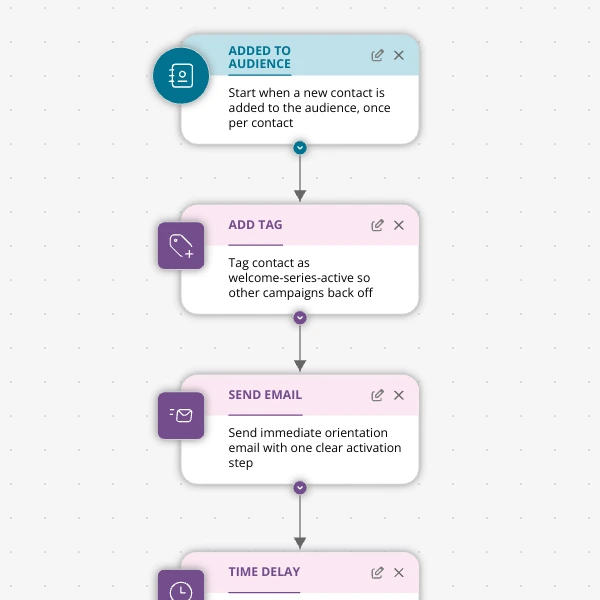
The Shopify app welcome series that turns installs into income
A step-by-step Shopify app welcome email journey for tools like CartSpark, showing how to turn new installs into activated, retained merchants using Spreeflo journeys, tags, and behavioral triggers so fewer trials quietly churn and more trials convert.
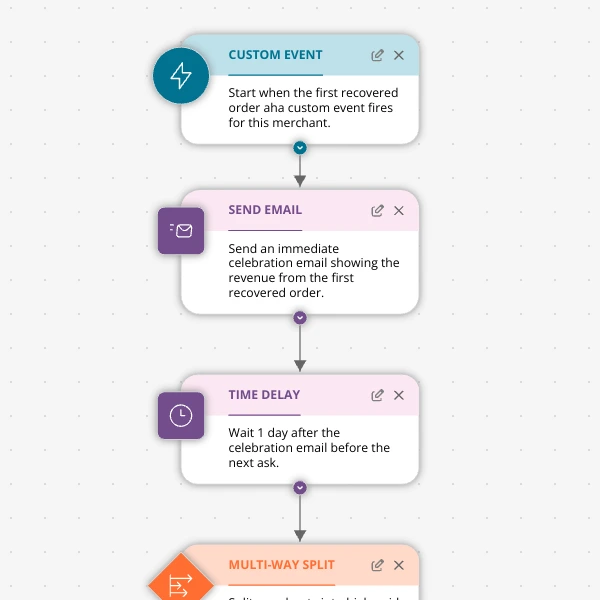
The Aha-Moment Playbook For Shopify Apps: Turn One Magic Action Into Months Of Revenue
A node-by-node playbook for Shopify and e‑commerce apps to center their lifecycle on one aha-moment custom event in Spreeflo, celebrate it, segment merchants by profile and engagement, and turn first recovered value into lasting revenue and retention.
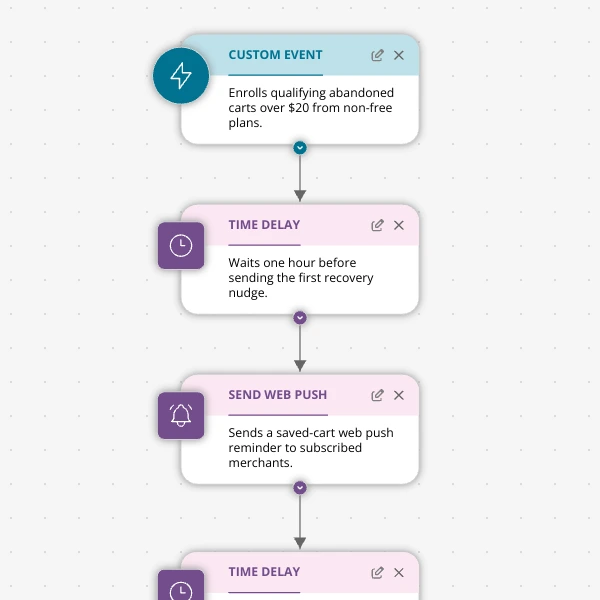
Stop Letting High‑Intent Carts Die: A 3‑Email Recovery Journey for Shopify Apps
A detailed, node-by-node walkthrough of a three-email (plus optional web push) cart-abandonment recovery journey for Shopify apps in Spreeflo, showing how to trigger events, branch on behavior, tag outcomes, and measure recovered carts and revenue.
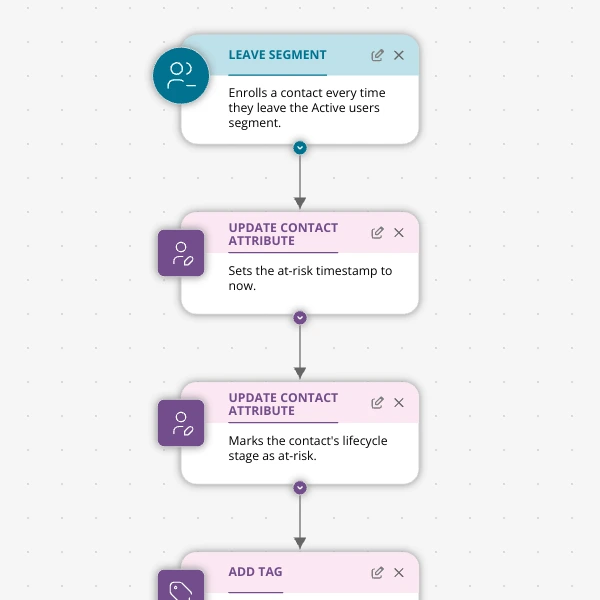
When Active Users Go Dark: A 4‑Touch Win‑Back Journey For Your Shopify App
A detailed, node-by-node Spreeflo journey for winning back previously active Shopify app users who stop engaging, using segment-based triggers, conditional logic, and a four-touch email plus internal alert sequence to recover usage and MRR.