The New-Contact Warm-Up Sequence That Keeps Your SEO SaaS Out of Spam
A complete warm-up email journey for new SEO SaaS contacts in Spreeflo, using pacing, engagement-based branching, and tagging so only interested subscribers graduate into heavier campaigns while protecting your sending domain and long-term revenue.
Industry
Niche
Pattern
Loading sequence...
Your new rank-tracking customer signs up, you fire off a beautiful onboarding sequence… and Gmail quietly routes half of it to Promotions or spam. Trial-to-paid drops, churn ticks up, and the problem hides under a “templates” tab instead of showing up on a dashboard.
This playbook is about fixing that early, structurally. The sequence at the top of this page is the whole journey, end to end: a new-contact warm-up that protects sender reputation while still nurturing engagement for your SEO SaaS.
We’ll follow a fictional product, RankPilot: a 4‑person team selling rank tracking and content briefs to agencies at ~$45k MRR. Email is doing most of the work: trial onboarding, feature education, weekly “SEO health” digests. If deliverability degrades while they’re ramping a new domain or adding a fresh segment of contacts, every downstream growth metric gets harder.
Let’s walk the exact journey you’d build in Spreeflo and why each node is there.
Why you need a warm-up journey, not just a welcome email
A lot of SEO SaaS teams treat “welcome email” as a copy problem. It’s not. It’s an audience and volume problem.
When you dump a fresh batch of contacts onto a fresh or little-used sending domain and blast them all with a 7-email sequence:
Engagement looks artificially low in the first 30 days.
Spam and Promotions placement rises right when you’re trying to prove value.
Every future launch, digest, or upsell email pays the price.
For founder-led teams, that’s not just a deliverability headache. It’s a lifetime value leak: the users who would have stuck around and upgraded never even saw the onboarding that would have helped them.
A warm-up journey solves this by:
Sending a small number of high-engagement emails first.
Pausing to see who actually opens and clicks.
Letting only the engaged contacts graduate into your heavier campaigns.
Keeping quiet with contacts who look cold, instead of grinding your domain reputation against them.
Spreeflo gives you the building blocks to do this systematically: an Add to Audience trigger, routing logic, delays, and behavior checks inside one visual flow. If you haven’t already, this is a great time to build a journey in your account and mirror the structure you see at the top of this page.
Step 1: Trigger on every new contact (Add to Audience)
Node: Add to Audience trigger
Key option: Re-enrollment = off
The journey starts with the Add to Audience trigger. Any time a contact is created in your workspace, they enter this warm-up once:
New trials created via your signup form.
Leads added from a Spreeflo form on your blog.
Imports from CSV or server-side events via the Spreeflo API.
Leave Re-enrollment off. Warm-up is a one-time experience; if you ever remove and re-add a contact, you don’t want to run them through the same “who are you?” email again.
If you have radically different sources (for example, live product signups vs. a large legacy list import), add an immediate If/Else process node after this trigger:
Condition: a contact attribute like
acquisition_sourceisproduct_signupvslegacy_import.“True” branch: go into this warm-up.
“Else” branch: send imports to a different, more conservative flow.
That condition uses Spreeflo’s segment builder under the hood, so you can mix attributes, tags, and activity if you need more nuance later.
Step 2: Tag them as “in warm-up” so other automations back off
Node: Add Tag (warmup_in_progress)
Next, apply a tag like warmup_in_progress to every new contact. This looks small but it’s important for list health.
You’ll use this tag in two ways:
As an exclusion in other journeys and campaigns
For example, your weekly SEO insights digest might target a segment “Email subscription is Subscribed AND NOT tagged withwarmup_in_progress.” That keeps fresh contacts from being thrown straight into your highest-volume sends while they’re still proving engagement.As a reporting lens
You can build a saved segment “In warm-up” and watch their opens, clicks, and unsubscribe rates separately. Early, this tells you whether your new domain and welcome content are actually landing in inboxes.
Think of this tag as a quarantine flag: these contacts are real, but we’re letting them earn their way into the heavier streams.
Step 3: Send a simple, reply-friendly first email
Node: Send Email (“Welcome + 1 quick question”)
Now you send the one email in your entire account with the single highest likelihood of engagement.
This is where deliverability work starts: if mailbox providers see strong opens and replies on this first message from your domain, everything after gets easier.
In Spreeflo’s email builder, keep this first touch intentionally plain:
From: a real person (e.g. “Gabe from RankPilot”).
Subject: simple and benefit-led, e.g. “What’s the one SEO metric you care most about?” or “Here’s how we’ll help you grow organic traffic.”
Body: short, text-heavy, no heavy design. Introduce yourself, restate the value proposition in 2–3 bullets, and ask one low-friction question they can reply to (e.g. “Are you more focused on content, technical, or links right now?”).
Two key configuration details:
Leave “Send only once” on. If the contact ever re-enters this node by mistake (for example, through a future edit), they won’t get the same welcome twice.
Reuse this email as the reference for later Check Email Activity, so give it a clear internal name like “Warmup #1 – Welcome.”
You’re sending this immediately after the tag, which is fine. The no-back-to-back rule only applies to consecutive Send Email nodes with nothing in between; we’re coming straight from a tagging action.
Step 4: Pause to collect engagement before doing anything else
Node: Time Delay (2 days)
After the first email, add a Time Delay of 2 days.
This waits long enough for most inboxes to register opens and clicks and gives late-openers a chance to catch up. SEO folks often clear email in focused batches, not instantly; rushing to judge engagement would mislabel good users as cold.
Configuration:
Delay value: 2
Unit: days
You could shorten this to 1 day if your volume is low and you need to move faster, or lengthen to 3–4 days during a sensitive domain warm-up. What matters is that the same delay sits in front of every branch that reacts to engagement, so they all use the same observation window.
Step 5: Split by engagement using Check Email Activity
Node: Check Email Activity (on “Warmup #1 – Welcome”)
Now you want the journey to treat high-intent users differently from the ones who ignore you.
Drop in a Check Email Activity process node, pointed at the welcome email you just sent. Configure three branches:
Branch A: “Clicked”
Branch B: “Opened”
Else branch: everything else (not opened, not clicked, not delivered).
Behind the scenes, this node is using Email Activity filters: “clicked at least 1 time” vs “opened at least 1 time” for that specific template. Ordering matters; make sure “Clicked” is evaluated separately from “Opened,” or you’ll accidentally double-count. The journey builder handles the logic, you just pick the activities.
Why this matters for deliverability:
Clickers are gold. They’re the best proof to Gmail/Outlook that your content is wanted.
Openers without clicks are still warm, but less committed.
No visible engagement after 2 days on a welcome email is a red flag. You don’t want to keep pounding those inboxes while your sending domain is new.
Each of these branches now gets its own pacing and further messaging.
Step 6A: Fast-track the clickers
Nodes on “Clicked” branch:
Add Tag (
warmup_clicked)MERGE later
Contacts who clicked your first email have shown clear intent. For these, keep the warm-up journey light:
Add a tag like
warmup_clickedorhigh_engagement_new.
This helps you later, for analysis and for any “power user” campaigns you design.Optionally, you can send a second email with a product tour or invite them to turn on rank alerts. If you do, respect pacing:
- There was already a 2-day delay since the first email.
- If you send another email here, you don’t strictly need another Time Delay node, but adding a 1-day delay keeps the feel respectful.
To keep the diagram simple, the sequence at the top routes clickers straight to a MERGE node after tagging, without a second email. The idea: let them flow into your core lifecycle streams quickly, which we’ll prepare for at the end.
Step 6B: Nurture the openers with one more high-value touch
Nodes on “Opened” branch:
Time Delay (1 day)
Send Email (“1 workflow to try today”)
MERGE later
Openers saw your email but didn’t click. Treat this as a “curious but not yet sold” state.
Add:
A Time Delay of 1 day
This avoids sending two emails on the same day, which can feel pushy even though the previous one was 2 days ago.A second Send Email, with a concrete workflow:
- Subject: “Steal this rank tracking workflow”
- Body: one short recipe, like “Add 10 keywords, connect Search Console, set your first alert.” Include a single, clear CTA back into the app.
This email is still value-first. No “big launch” messaging, no heavy promotional copy. Your goal is to get them to use the product once in a meaningful way, because usage will do more for retention and LTV than any clever subject line.
Again, keep “Send only once” on.
After this second email, branch B also flows into the same MERGE node as the clickers.
Step 6C: Gently test the unengaged, then back off
Nodes on Else branch:
Time Delay (3 days)
Send Email (“Still want SEO insights from us?”)
Optional Wait Condition
MERGE later
The Else path catches:
People who never opened.
Soft bounces that eventually delivered late.
Contacts on addresses that auto-archive transactional mail.
For a brand-new or warming domain, these are the people most likely to degrade your sender reputation if you keep hitting them with volume.
So you do two things:
Add a longer Time Delay, say 3 days
This creates at least a 5-day gap between the welcome and any follow-up. That’s gentle enough that even if they do see both emails, it doesn’t feel like harassment.Send one “are you still interested?” style email:
- Subject: “Do you still want SEO rank updates from RankPilot?”
- Body: remind them why they signed up, give one or two bullets of value, and offer a very clear CTA plus a visible unsubscribe link. This email should feel like a last nudge, not the start of a barrage.
You can optionally add a Wait Condition after this second email:
Condition: “Opened OR Clicked this second email” (configured via the segment builder).
Timeout: 4–7 days.
If they engage within the window, they’ll arrive at the MERGE as “late warmers”. If not, they still join the MERGE, but you’ll handle them differently with tags in the final step.
Step 7: Close the warm-up and graduate contacts cleanly
Nodes after MERGE:
Add Tag (
warmup_completed, optionallysafe_for_broadcasts/low_engagement_new)Remove Tag (
warmup_in_progress)
The MERGE node recombines all three paths so you can handle the end state in one place.
Now apply:
A
warmup_completedtag to everyone.An additional engagement-tier tag if you want more nuance:
warmup_highfor clickers.warmup_mediumfor openers who didn’t click.warmup_lowfor those who never engaged.
Finally, remove the warmup_in_progress tag. From here on, other campaigns and journeys will see them as eligible.
How this plugs back into your broader system:
Weekly digests and product update campaigns:
- Target saved segment “Email subscription is Subscribed AND tagged withwarmup_completedAND NOT tagged withwarmup_low.”Re-engagement journeys:
- Trigger a Criteria Match or Join Segment-based journey when a contact is taggedwarmup_low, with a far lighter cadence.
By ending the journey with clean tagging, you’re making it trivial for your future self to add campaigns without accidentally undoing the warm-up discipline.
Don’t forget the technical basics
This journey is about behavior and pacing. It sits on top of technical sending hygiene, not instead of it.
Before you run real volume through any warm-up:
Authenticate your domain properly with SPF/DKIM/DMARC using the guide to set up your sending domain.
Start on smaller daily volumes and grow gradually, especially if you’re importing a large historical list into Spreeflo.
Keep your From name, address, and footer consistent so mailbox providers can build a profile for you.
Warm-up flows like this amplify those basics by feeding providers a cleaner signal: more opens, more clicks, fewer annoyed non-engagers.
What to measure and how to tune it
The three metrics that tell you whether this warm-up journey is doing its job:
Inbox placement on cold-start
Watch open rates and spam complaint rates for your warm-up emails vs. your legacy tool or previous sends. If the first two emails in this sequence are getting clearly better engagement than your old “blast everyone” approach, you’re on the right track.Engagement rate during ramp
Compare:
- Click-through on the welcome email.
- Click-through on the “workflow” email.
- Click-through on similar emails sent to already-warmed contacts.
If warm-up contacts are underperforming by a wide margin, something is off in the offer or copy, not just deliverability.Downstream sender reputation
Over a few weeks, watch how new campaigns perform as more of your audience carries thewarmup_completed+ engagement-tier tags. You should see fewer sharp drops in open rate when you run a big launch, because the dead weight has been filtered out early.
If you need to be more conservative:
Lengthen the delays, especially on the Else branch.
Add stricter exclusions to your high-volume campaigns (e.g. exclude
warmup_mediumfor the first 14 days).Reduce the number of links in your first email to minimize spam-filter suspicion.
If things look healthy, you can carefully shorten the delays or add one more value email to the engaged branches without overloading inboxes.
Why this earns its place in your stack
Most SEO SaaS founders think about distribution but underinvest in nurture. They fight for every new trial or lead, then let deliverability issues quietly erode the relationship before it even starts.
A new-contact warm-up sequence fixes that at the root. It treats every new subscriber as an individual signal, lets behavior guide the pace, and keeps your domain in good standing while you grow.
The best part: you build this journey once in Spreeflo and it keeps working while you focus on product and acquisition. For a team of four trying to hit $100k MRR, that kind of compounding system is worth far more than another one-off campaign.
When you’re ready, open your account, set up your domain, and map this flow onto a real journey. The combination of a thoughtful warm-up and Spreeflo’s automation is one of those quiet moves that, over a year, shows up clearly in your churn, upgrades, and expansion revenue.
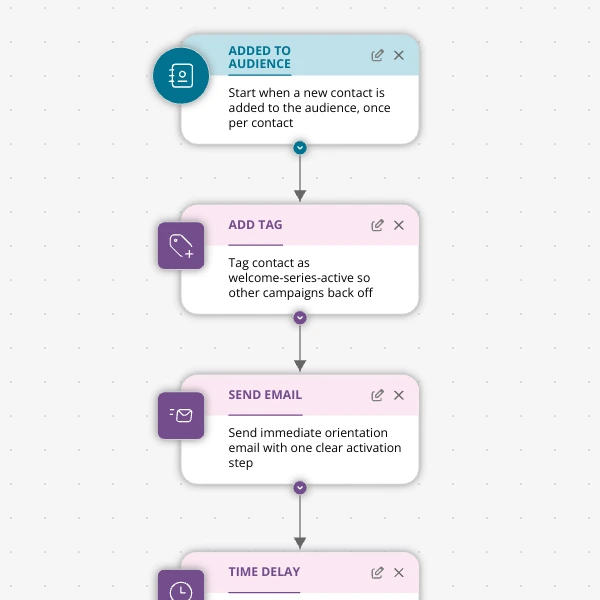
The Shopify app welcome series that turns installs into income
A step-by-step Shopify app welcome email journey for tools like CartSpark, showing how to turn new installs into activated, retained merchants using Spreeflo journeys, tags, and behavioral triggers so fewer trials quietly churn and more trials convert.
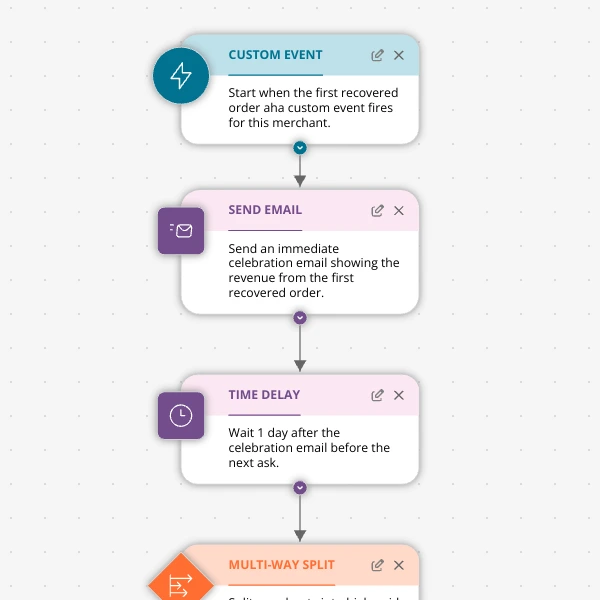
The Aha-Moment Playbook For Shopify Apps: Turn One Magic Action Into Months Of Revenue
A node-by-node playbook for Shopify and e‑commerce apps to center their lifecycle on one aha-moment custom event in Spreeflo, celebrate it, segment merchants by profile and engagement, and turn first recovered value into lasting revenue and retention.
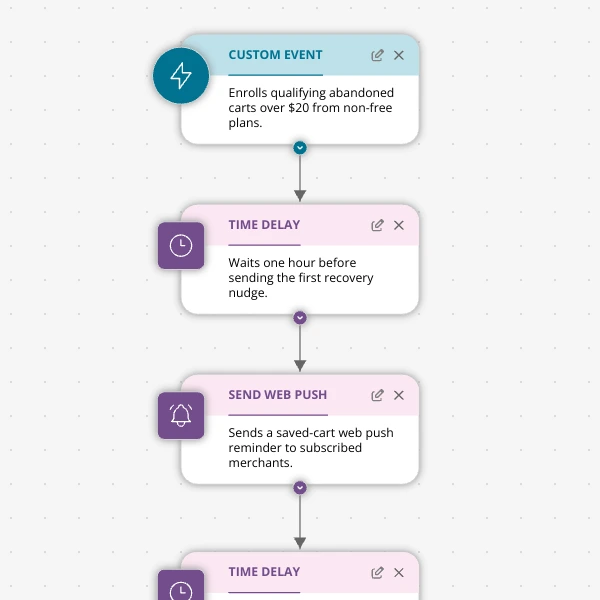
Stop Letting High‑Intent Carts Die: A 3‑Email Recovery Journey for Shopify Apps
A detailed, node-by-node walkthrough of a three-email (plus optional web push) cart-abandonment recovery journey for Shopify apps in Spreeflo, showing how to trigger events, branch on behavior, tag outcomes, and measure recovered carts and revenue.
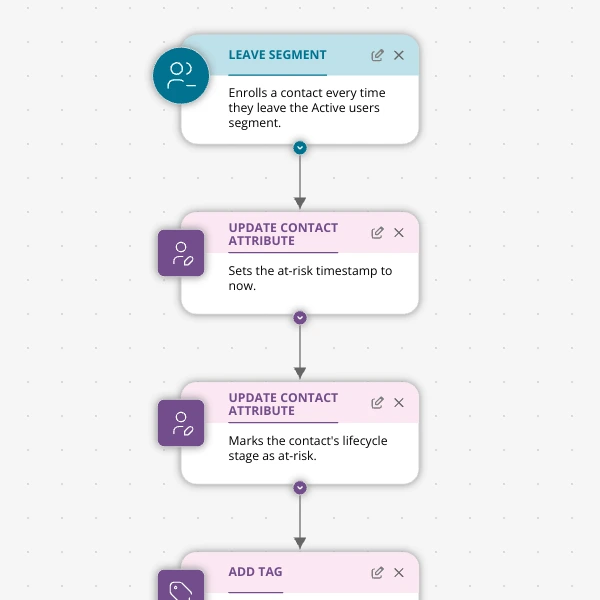
When Active Users Go Dark: A 4‑Touch Win‑Back Journey For Your Shopify App
A detailed, node-by-node Spreeflo journey for winning back previously active Shopify app users who stop engaging, using segment-based triggers, conditional logic, and a four-touch email plus internal alert sequence to recover usage and MRR.