The SEO SaaS Sunset Sequence: One Last Email Before You Let Go
This playbook shows how an SEO SaaS like RankSignal builds a one-time, last‑chance sunset journey in Spreeflo so disengaged subscribers are suppressed cleanly while protecting deliverability and retaining genuinely interested, active customers.
Industry
Niche
Pattern
Loading sequence...
That “48k subscribers” slide looks less impressive when 20k of them haven’t opened a single update in six months and Gmail is quietly shoving you into Promotions or spam.
This playbook is about that moment where you stop pretending they’re still listening and send one clean, respectful, last‑chance email before you suppress them from your marketing audience. The sequence at the top of this page is the whole journey, end to end. We’ll walk through how a fictional SEO SaaS, RankSignal at ~$80k MRR, wires this into Spreeflo so they protect deliverability without throwing away recoverable customers.
Why your SEO SaaS needs a real sunset, not endless “we miss you”
For most SEO tools, list growth isn’t the problem. Content, free trials, and product-led flows keep adding subscribers. The leak is later:
Trial users who churn but stay on your list.
Agencies who no longer use you after a client project.
Power users who flipped to a competitor months ago.
They still get every launch, every update, every “new integration with Google Search Console” email. They never open. That hurts you in three ways:
Inbox providers learn that “emails from you are ignored,” which pushes all your email (including to fans) toward junk.
Your metrics get fuzzy. It’s harder to know if a subject line actually underperformed or if your base is just bloated with zombies.
You pay for marketing contacts who are never going to buy or refer again.
A structured sunset journey solves all three. You give cold subscribers one last clear choice: “Do you still want SEO insights and product updates from us?” If yes, they show a signal and stay. If no (or they ignore you), you suppress them cleanly.
This is where most businesses quietly leak lifetime value. They either never clean the list, or they batch-delete everyone without giving them a chance to raise a hand. The pattern in this article threads that needle.
Who should enter this last‑chance journey (and who should never see it)
The primary trigger in this pattern is a Criteria Match journey trigger. You define “this person is truly disengaged” once using Spreeflo’s segment builder, then the journey runs in the background, catching new zombies as they emerge.
For an SEO SaaS like RankSignal, a solid starting definition is:
Email subscription status is Subscribed.
Has your “newsletter” or “marketing-updates” tag.
Has not opened any marketing emails in the last 90 days.
Has already gone through your earlier re‑engagement series and didn’t respond (for example, tagged
reengage_failedby another journey).Is not in critical segments you want to protect, like “current enterprise customer” or “active power user.”
You can express that in the Criteria Match trigger with a few rules:
Contact Tags: is tagged with
newsletter.Email Subscription Status: is
Subscribed.Email Activity: did not open marketing emails in the last 90 days.
Tags or Segment Membership: is member of segment
Re-engagement failed.Segment Membership: is not member of segment
Enterprise customers.
If you track in‑app behavior into Spreeflo as custom events via the Spreeflo API, you can be even smarter:
Custom event logged_in triggered at least 3 times in the last 30 days → exclude from this flow, even if they don’t open email. They’re clearly active in the product.
The goal: only true non‑engagers enter this journey. Nobody should be surprised to receive a “we’re going to stop emailing you” message.
Designing the sunset journey in Spreeflo
Let’s walk the sequence node by node, using Spreeflo’s journeys. If you’ve not built one before, this sits under Campaigns & Journeys and uses the same visual editor you’d use to build a journey.
1. Criteria Match trigger: define “ready to sunset”
Node: Criteria Match trigger
Re‑enrollment: off
Configuration:
Criteria: the disengaged definition above (no opens in 90 days, subscribed, newsletter tag, flagged as having failed earlier re‑engagement, excluding key segments or active users).
Leaving Re‑enrollment off is deliberate. When this journey has run once for a contact, you don’t want them re‑entering and getting another last‑chance email later. This really is the final step.
If you later decide you want to give people another sunset cycle after, say, a year, you can flip re‑enrollment on and adjust your criteria to “no opens in the last 365 days” so it fires at that longer interval.
2. Add Tag: mark they’re in the sunset cohort
Node: Add Tag
First action: apply a tag like sunset_last_chance_started.
Why:
Reporting: you can pull a quick segment of “everyone who ever reached the sunset step” and check long‑term behavior.
Safety: it makes it easy to exclude these contacts from future broadcast campaigns, even while the journey is still running.
Debugging: if someone emails support asking why they stopped getting newsletters, your team has a clear audit trail.
Configuration:
Tags:
sunset_last_chance_startedForce Tag Trigger: off (you don’t need to retrigger anything if they already had it).
3. Send Email: the actual “last‑chance” message
Node: Send Email
This is the star of the show. One email, written clearly, that does three things:
States the situation: “You haven’t opened our SEO emails in a while.”
Reminds them of the value: “We send practical rank tracking tactics, SERP updates, and product changes that affect your rankings.”
Offers a binary choice: “Stay on the list” or “Stop these emails.”
In Spreeflo you’d create this using our email builder:
From: your usual marketing sender.
Subject: direct and honest. Examples:
- “Still want RankSignal SEO updates?”
- “Last email before we pause your subscription”
Body: short, scannable, with a single primary CTA to stay subscribed. The regular unsubscribe link handles the opt‑out path.
A few SEO‑specific tips for the copy:
Reference what they signed up for: “You joined when you were testing keyword clustering and SERP volatility alerts.”
Anchor the benefits: “We help you spot ranking drops before clients do, see which briefs actually moved keywords, and catch technical issues before traffic tanks.”
Offer cadence options if you have them: “If weekly is too much, you can switch to monthly digests on your preferences page.”
Spreeflo’s AI personalization can help tailor the copy per contact, but don’t overcomplicate this email. The key is clarity, not cleverness.
Configuration:
Template: choose or create your “Sunset – Last chance” template.
Send only once: on (default). Even with re‑enrollment off, this is a good safeguard.
4. Time Delay: give them space to react
Node: Time Delay
Settings: 7 days
After sending the email, insert a delay so you’re not judging engagement too quickly. A week is usually enough for B2B recipients to skim their inbox, even if they batch process email.
Configuration:
Unit: days
Value: 7
You could go shorter (3 days) or longer (14 days) depending on how often you normally send, but don’t make it so short that people who only check mail twice a week get unfairly removed.
5. Check Email Activity: did they open?
Node: Check Email Activity
This node branches your flow based on how each contact interacted with the last‑chance email.
Configuration:
Marketing email: select the same “Sunset – Last chance” template.
Activities to branch on:
- Branchopened: activity “Opened”Else branch: automatically catches everyone who did not open (or where delivery failed).
You now have two clear paths:
Opened: they at least engaged with the subject and saw the content.
Else: they did not open at all.
Could you branch on “Clicked” instead? You could, but for this pattern “opened” is enough of a signal. If they opened purely to click unsubscribe, their subscription status will flip to Unsubscribed automatically at the system level anyway.
6. Opened path: treat them as reactivated
For the opened branch, you generally don’t need more marketing right away. They just saw a fairly direct message from you. The goal is to:
Mark them as reactivated.
Keep them in your active marketing audience.
Drop them back into your regular content cadence.
A simple sequence:
Node: Add Tag
- Tag:sunset_reactivatedNode: Remove Tag
- Tag:sunset_last_chance_started
This keeps your “in-flight” tracking clean. They’re no longer mid‑sunset.(Optional) Node: Send Email after another Time Delay of 1 day
- A short “Glad you’re still with us” email highlighting a few high‑value pieces:
- A case study where your rank tracking saved an agency engagement.
- A guide to interpreting Search Console swings with your tool.
- Make sure there is at least that 1‑day Time Delay before this second email, so you never send two marketing emails back to back.
You don’t need to touch their subscription state here. They stay subscribed and counted as marketing contacts as normal.
7. Not‑opened path: sunset them cleanly
For everyone in the else branch, the journey does the quiet, important work of cleaning your list.
Node: Update Email Subscription Status
Configuration:
- Status:Email unsubscribed
This ensures they no longer receive marketing emails, even if they’re tagged in segments. You still retain them as a contact for analytics and transactional messages.Node: Update Contact Attribute (optional)
If you use the built‑in Marketing Status attribute to distinguish who counts toward your paid contact limits, you can flip that here:
- Attribute:Marketing Status
- Update type: set to the literal valueNon-marketing
This is helpful if you’re aggressively pruning to keep costs aligned with value; see about Spreeflo pricing plans for how marketing contacts are billed.Node: Add Tag
- Tags:sunset_suppressed
Tagging makes it easy to:
- Exclude them from any future broadcasts that might accidentally ignore email‑subscription state.
- Report on how many contacts you’ve sunset over time.Node: Remove Tag
- Tags:newsletter,sunset_last_chance_started
This clears them from your day‑to‑day newsletter groups and removes the “in-flight” marker.(Optional, Pro) Node: Webhook
If you use a CRM or data warehouse, a Webhook action here can sync the suppression event out, so “marketing unreachable” is visible to sales or success. This requires Spreeflo’s Professional plan, since Webhook is a Pro‑only node.
At this point, the contact exits the journey. They stay in your database as a non‑marketing contact. You can still send transactional messages such as billing receipts or password resets through transactional email, but marketing flows won’t touch them.
Protecting paying customers and power users
The blunt version of this pattern is “no opens in 90 days → last‑chance → suppression.” For an SEO SaaS, that can be risky if you don’t account for product usage.
Two refinements worth doing:
Exclude clearly active accounts.
Use Custom Events in the Criteria Match trigger:
- Custom eventreport_generatedorrank_checkedtriggered at least N times in the last 30 days.
- Custom eventcreated_content_brieftriggered recently.
If that’s true, exclude them from the sunset criteria even if they ignore email. They might be consciously inbox‑minimalist but still an excellent customer.Protect strategic segments.
Explicitly “is not member of segment” for:
- Enterprise or high‑MRR customers.
- Accounts with open support tickets.
- Agencies tagged as “partner”.
The segment builder makes this fairly painless. You can build a reusable “Do Not Sunset” segment once, then reference it in your Criteria Match condition.
Measuring if your sunset journey is doing its job
Three metrics matter for this pattern:
Reactivation rate.
Of everyone who entered the journey, what percentage ended up on the “opened” branch?
For SEO SaaS tools, a typical range is 2–8%. If you’re under 1%, your last‑chance email might not be compelling or your entry criteria are too aggressive. If you’re over 10–15%, your earlier re‑engagement series probably isn’t doing enough and people are waiting for the “critical” subject line.Suppression rate.
How many contacts you move to Unsubscribed or Non‑marketing each month.
This can be uncomfortable the first time you run it. Watching 10–30% of your list get sunset is a gut check. But those people were already “gone” in practice. Now your list metrics are honest.Deliverability impact.
Track:
- Open rate on core launches and product updates before and after running the journey for a few months.
- Spam complaint rates and bounces.
- Domain‑level reputation in tools like Postmaster.
A cleaner list almost always produces higher open/click rates and fewer complaints. For a tool like RankSignal, that means more of the right people see “New rank volatility alerts” the moment you ship them.
Because this is a standing journey, you don’t have to babysit it. You design the logic once, measure quarterly, and tweak if needed. That’s exactly the kind of time leverage founder‑led teams need.
Adapting the pattern to your own SEO product
A few levers you can tune without changing the underlying structure:
Inactivity window.
If you send rarely, 120–180 days of no opens might be more reasonable. If you send weekly digests plus product updates, 60–90 days is fair.Re‑engagement pre‑work.
This sunset journey assumes you already ran a more generous re‑engagement series and marked “failed” contacts with a tag or segment. If you don’t have that yet, build that journey first and have its final node add a tag likereengage_failed.Tone of the last‑chance email.
Some brands go very direct. Others frame it as “We’ll pause emails unless you tell us otherwise.” Both can work; pick what fits your brand voice.Re‑entry policy.
Re‑enrollment off turns this into a one‑time decision. If you want people to get another sunset after a year of silence, turn re‑enrollment on and raise your inactivity threshold so it doesn’t fire too frequently.
Behind all of this is a simple principle: most businesses lose lifetime value not because their product is bad, but because they stop talking to the right people at the right time. A well‑designed sunset journey in Spreeflo lets you stop shouting at the wrong people so you can show up consistently for the ones who still care.
Build it once, let it run quietly, and let a smaller, healthier list compound every SEO launch, feature update, and educational email you send.
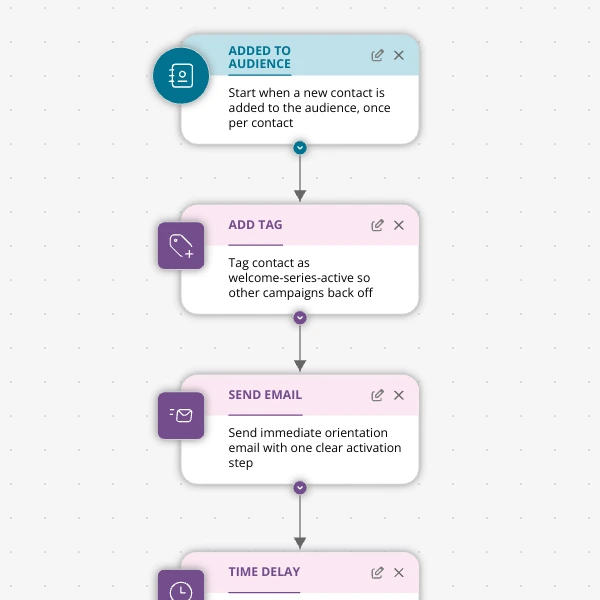
The Shopify app welcome series that turns installs into income
A step-by-step Shopify app welcome email journey for tools like CartSpark, showing how to turn new installs into activated, retained merchants using Spreeflo journeys, tags, and behavioral triggers so fewer trials quietly churn and more trials convert.
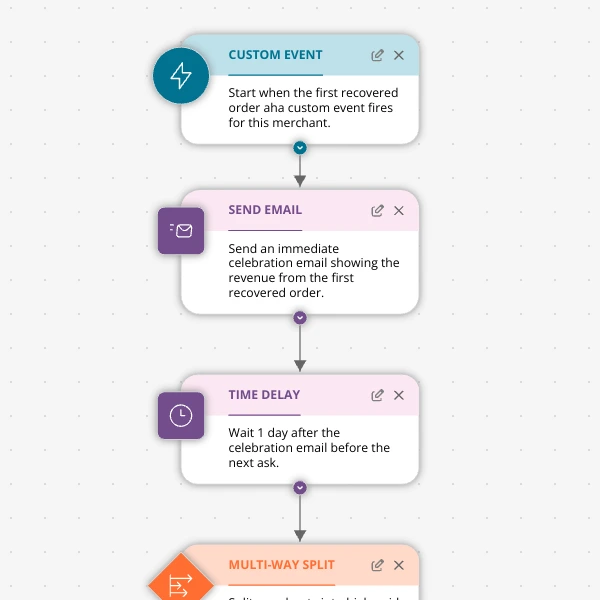
The Aha-Moment Playbook For Shopify Apps: Turn One Magic Action Into Months Of Revenue
A node-by-node playbook for Shopify and e‑commerce apps to center their lifecycle on one aha-moment custom event in Spreeflo, celebrate it, segment merchants by profile and engagement, and turn first recovered value into lasting revenue and retention.
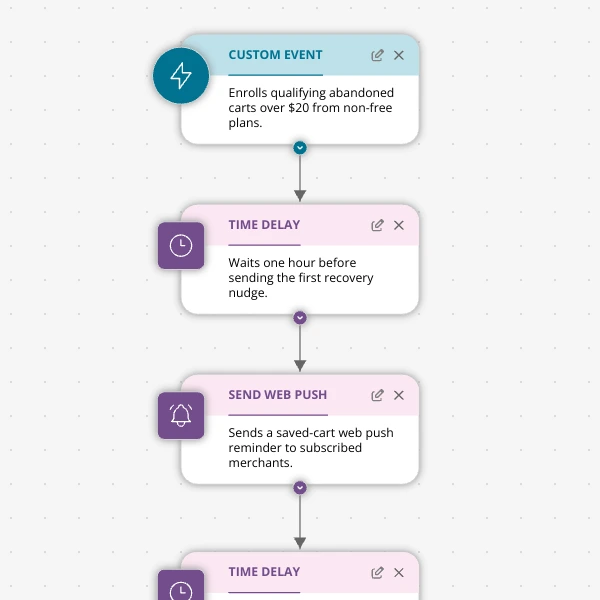
Stop Letting High‑Intent Carts Die: A 3‑Email Recovery Journey for Shopify Apps
A detailed, node-by-node walkthrough of a three-email (plus optional web push) cart-abandonment recovery journey for Shopify apps in Spreeflo, showing how to trigger events, branch on behavior, tag outcomes, and measure recovered carts and revenue.
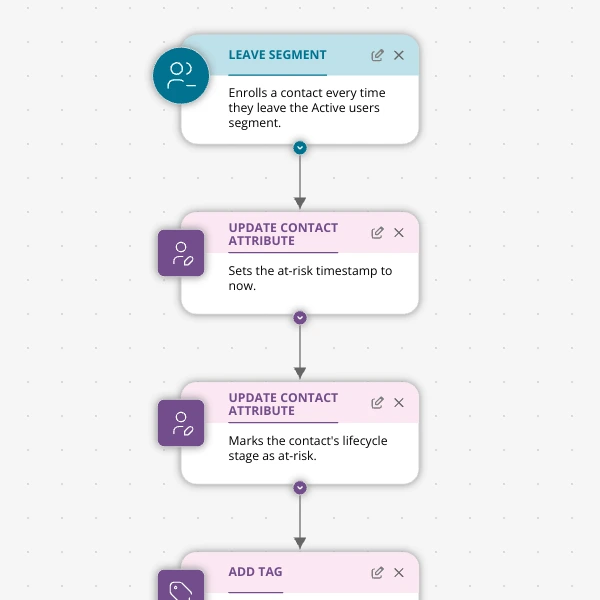
When Active Users Go Dark: A 4‑Touch Win‑Back Journey For Your Shopify App
A detailed, node-by-node Spreeflo journey for winning back previously active Shopify app users who stop engaging, using segment-based triggers, conditional logic, and a four-touch email plus internal alert sequence to recover usage and MRR.