The Trial-Extension Safety Net For Your Best SEO Users
FreeThis playbook walks through building a “trial extension safety net” in Spreeflo for SEO SaaS, using behavioral signals to automatically extend trials for high-intent users, route them based on actions taken, and measure the lift in upgrades and LTV.
Industry
Niche
Pattern
Loading sequence...
A weird thing happens inside most SEO SaaS trials: the people who use your product the most are often the ones who churn quietly.
They add keywords, run site audits, poke at content briefs…then their 14 days are up, the app locks, and they think “I’ll come back to this later.” They rarely do. The sequence at the top of this page is built to catch those users and offer them more time before they disappear.
Let’s ground it with a real example. RankPulse, a three-person rank tracking tool at ~$35k MRR, saw strong engagement during trial for agency users: daily checks, frequent exports, multiple projects set up. But trial-to-paid conversion was stuck around 12%. When they looked closer, a big chunk of those churned trials were clearly interested, just not ready to fight procurement or client approvals within 14 days.
So they did the sensible thing: automatically extended the trial for highly engaged users who hadn’t upgraded or added a card yet.
This article walks through how to build that “trial extension safety net” in Spreeflo using the journey you see above.
The quiet churn you can actually save
Some churn is inevitable: people sign up out of curiosity, bounce after one login, and never come back.
Those aren’t the people you care about here.
The leak that hurts is different:
They installed your Search Console integration.
They added 50+ keywords across multiple projects.
They generated content briefs or ran technical audits.
They opened most of your onboarding emails.
…and then life got in the way. Client work, internal priorities, budget reviews. Your trial window was a timing constraint, not a value problem.
Blasting a generic “Need more time?” email to every trial cheapens your product. Instead, you want a tight filter: only the people whose behavior screams “I care, I’m just not ready yet” should get an automatic extension offer.
That’s exactly what this journey does.
What this journey does, in plain terms
Here’s the high-level behavior before we go node-by-node:
Watch for engaged trials nearing expiry. When a trial user is within a couple of days of their end date, has used core features multiple times, but hasn’t upgraded or added payment details, they enter the journey via a Criteria Match trigger.
Offer a tailored trial extension. They get a single, clear email from you offering more time in exchange for one click.
Wait to see if they accept. If they click through and accept the extension in your app, your product extends their trial and fires a custom event back into Spreeflo.
Route based on behavior.
- If they accept: tag them, optionally notify your team, and drop them into a short “extended trial” nurture.
- If they ignore it: optionally send a final “trial ending” recap or just let the trial close gracefully.
Every part is built with Spreeflo’s campaigns and journeys engine and the segment builder so you’re talking specifically to those high-intent users, not carpet-bombing your list.
First: define “engaged but not converted” in your data
Before you touch the journey canvas, you need signals.
For an SEO SaaS, a solid definition usually spans three dimensions:
Lifecycle state
- Contact attributeplanis"trial".
- Custom TIMESTAMP attributetrial_ends_atexists.
- Custom BOOLEAN attributehas_payment_methodis false.
- Noupgraded_planorsubscription_startedevent yet.
Your backend should setplan,trial_ends_at, andhas_payment_methodwhen a trial starts or billing details change, using the Spreeflo API orSpreeflo.identifyfrom your app.Engagement with core features
- Custom eventchecked_rankingstriggered at least 5 times in the last 14 days, or
- Custom eventgenerated_content_brieftriggered at least 2 times, or
- Custom eventran_site_audittriggered at least once.
These are perfect forSpreeflo.track('checked_rankings', {...})in your frontend or event posts from your backend via the API.Proximity to trial end
- Attributetrial_ends_atis within the next 2 days.
- Email subscription status is Subscribed (no point emailing opt-outs).
All of that is expressible with Spreeflo’s segment builder: a main AND group for “on trial, no payment, not upgraded, subscribed, trial ending soon”, plus an OR subgroup for the feature-usage events.
You can define this criteria inline in the Criteria Match trigger or as a reusable segment and reference it from multiple journeys.
Step-by-step through the Spreeflo journey
Let’s walk the sequence from top to bottom and talk about why each node exists.
1. Trigger: Criteria Match on high-intent trials
Node: Criteria Match trigger
Re-enrollment: usually off
Configuration:
Criteria:
- Contact Attributes:
-planis"trial".
-has_payment_methodis false.
-trial_ends_atis within the next 2 days.
- Email Subscription Status:
- isSubscribed.
- Custom Events (inside a subgroup with OR):
-checked_rankingstriggered at least 5 times in the last 14 days, or
-generated_content_brieftriggered at least 2 times in the last 14 days, or
-ran_site_audittriggered at least 1 time in the last 14 days.
- Custom Events:
-upgraded_planhas not triggered over all time.
Why this matters:
You’re explicitly capturing behavioral signals, not just time. Trial users who never came back don’t enter this journey.
Using a Criteria Match trigger instead of “Add to Audience” means this runs continuously and only for the contacts who newly start matching these conditions as their trial nears the end.
For most SaaS, it’s safe to leave Re-enrollment off: a contact only gets this offer once per trial. If you allow multiple trials per user, you can turn re-enrollment on and rely on your own plan / trial_ends_at logic to keep things sane.
2. Tag and timestamp the offer
Node: Add Tag
Optional Node: Update Contact Attribute
Immediately after the trigger, add an Add Tag action:
Tags:
trial-extension-offered
Optionally follow with Update Contact Attribute on a TIMESTAMP attribute trial_extension_offer_sent_at:
Update type:
SET_NOW.
Why this matters:
The tag lets you quickly build a segment of everyone who was ever offered an extension (for reporting and future experiments).
The timestamp gives you a clear audit trail if you want to analyze timing later (“Offers sent 1 day before expiry vs 3 days before”).
This is cheap data that future-you will be grateful for.
3. Send the extension offer email
Node: Send Email
This is the hero moment. Using Spreeflo’s email builder, create a template that:
Acknowledges their usage: “You’ve run 6 rank checks and 2 content briefs this week.”
Names the friction: “Approvals and budgets don’t always fit into 14 days.”
Makes a specific offer: “Click below and we’ll extend your trial by 10 more days.”
Has a single, prominent CTA that drops them into your app: “Extend my trial.”
In the node:
Pick the email template.
Choose the appropriate sender identity.
Leave Send only once on. If a contact ever re-enters this step, they still only get this email once, which avoids weirdness if you adjust criteria later.
On click, your app should:
Authenticate the user as usual.
Show a clear “Trial extended” confirmation.
Extend
trial_ends_atin your own billing system.Fire a
trial_extension_acceptedevent into Spreeflo viaSpreeflo.trackin the browser or via the Spreeflo API on the backend.
That event is the core signal the rest of the journey reacts to.
4. Wait for them to accept (or not)
Node: Wait Condition
You don’t want to spam follow-ups. You want to give the user time to click, but not wait forever.
Configure a Wait Condition like this:
Condition:
- Custom Eventtrial_extension_acceptedtriggered at least 1 time in the last 3 days.Timeout duration:
- 3 days.
What actually happens:
If they accept the extension and your app fires
trial_extension_accepted, the condition becomes true and the contact moves to the next node immediately.If they ignore the email, the condition never becomes true, so the contact waits for the full 3 days, then progresses.
This node also doubles as your pacing buffer. It sits between the initial Send Email and any potential follow-up email so you never hit someone with back-to-back messages.
5. Branch: accepted vs ignored
Node: If/Else
Immediately after the Wait Condition, add an If/Else process node that checks the same condition:
Condition:
- Custom Eventtrial_extension_acceptedtriggered at least 1 time over all time.
Contacts go down:
The “Yes” branch if they accepted.
The “Else” branch if they didn’t.
Re-using the same logic you used in the Wait Condition keeps behavior predictable and avoids subtle mismatches.
6. For acceptors: tag, notify, and extend their onboarding
Accepted branch nodes might look like this:
Add Tag
- Tags:trial-extended,high-intent.Send Internal Email (optional but powerful)
- Recipients: founder or sales/support inbox.
- Content: “Good news: {{contact.first_name}} just accepted a trial extension. They’ve run {{checked_rankings_count}} rank checks so far. Here’s their site: {{website}}.”
This gives you the option to reach out personally to especially valuable accounts without monitoring dashboards all day.Time Delay
- Value: 2 days.Send Email: “How to get the most from your extra 10 days”
- Walk them through one or two advanced workflows (e.g., combining rank tracking with technical audits, or using your content briefs to build an editorial calendar).
- This email is spaced at least two days after the original extension email thanks to the Time Delay, keeping your pacing healthy.
Behind the scenes, your billing system should already have extended trial_ends_at when the user clicked the CTA. That change flows into Spreeflo through your normal attribute updates, so you don’t need an Update Contact Attribute node to manage the new end date.
If you have a separate “onboarding for extended trials” journey, you can also use the new trial-extended tag or the trial_extension_accepted event as a trigger there.
7. For non-acceptors: close the loop gracefully
On the Else branch (they didn’t accept the extension):
Add Tag
- Tags:trial-extension-ignored.
This lets you compare the behavior of offer-ignores vs never-offered users later.Optional: Send Email “Your RankPulse trial is ending”
- Because you’ve already had a 3-day Wait Condition between the first email and this one, you’re still respecting pacing.
- Focus on recapping what they accomplished and how to come back when ready:
- “You tracked 5 keywords and ran 1 site audit.”
- “Your projects and data will be here if you pick things back up.”
- Light CTA to upgrade when the timing fits.
You might decide to skip this second email entirely if you already have a standard trial-expiry sequence. In that case, the Else branch can simply tag and exit.
If both branches eventually converge on additional shared logic (for example, an evaluation of who upgraded later), drop a Merge node after the two paths and continue from there. That keeps fan-in clean in the journey editor.
Instrumenting the signals correctly
This pattern only works as well as your tracking.
For frontend behavior (feature usage, UI clicks):
Install the Spreeflo SDK in your app as described in the web tracking and analytics documentation.
Call
Spreeflo.identify(email, attributes)once the user signs up or logs in so events map to the right contact.Fire custom events like
checked_rankings,generated_content_brief,ran_site_audit, andtrial_extension_acceptedwithSpreeflo.track(...)whenever those actions occur.
For backend events (billing, subscription changes):
When a trial starts, use the Spreeflo API to:
- Upsert the contact with attributesplan,trial_ends_at,has_payment_method.
- Optionally send astarted_trialevent.When they upgrade or cancel:
- Updateplanandhas_payment_method.
- Fire events likeupgraded_planorcancelled_subscription.
Once that data is flowing, the segment builder lets you express “engaged, near trial end, not yet converted” and “accepted extension” cleanly as criteria in both your triggers and If/Else branches.
Measuring extension acceptance, conversion, and save rate
With the journey running, you can quantify whether it’s worth the effort.
Extension acceptance rate
- Numerator: contacts with eventtrial_extension_accepted(or tagtrial-extended).
- Denominator: contacts who hit thetrial-extension-offeredtag.
- Build each group as a segment, then compare counts.Post-extension conversion rate
- Segment:trial-extendedAND eventupgraded_plantriggered at least once after the extension date.
- Compare against:
- Engaged-but-not-offered users (if you A/B test the criteria).
- Overall trial conversion.Save rate
- Roughly: “How many of these users would have churned without the extension?”
- One practical proxy:
- Users who accepted the extension and upgraded after their originaltrial_ends_atdate.
Why this plugs a hidden LTV leak for SEO SaaS
SEO tools often have a slow burn. It takes time to import sites, set up projects, and see meaningful ranking or traffic movement. A rigid trial window forces your buyers to align their own work rhythms with yours, and many simply can’t.
By:
Capturing detailed behavioral signals (feature usage, project setups, integrations),
Using them to speak uniquely to each user with tailored extensions,
And nurturing extended trials instead of letting them drift,
you stop treating all trials the same and start protecting the users most likely to become high-LTV accounts.
That’s the bigger point behind this pattern: most SaaS doesn’t lose customers because the product is bad. It loses them because engagement fades at critical moments and nobody intervenes. A simple journey like the one at the top of this page, built with campaigns and journeys and fed by accurate tracking, is how a small SEO SaaS team quietly closes that gap.
You design it once. Spreeflo runs it for every trial, every day, catching the people who are already telling you they care through their behavior.
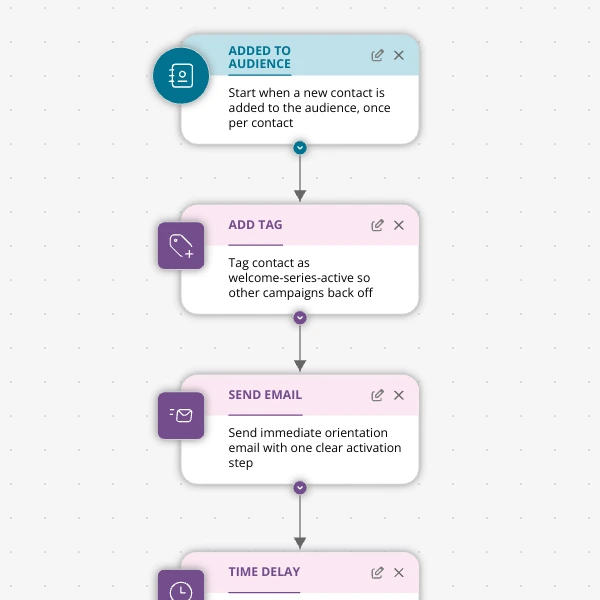
The Shopify app welcome series that turns installs into income
A step-by-step Shopify app welcome email journey for tools like CartSpark, showing how to turn new installs into activated, retained merchants using Spreeflo journeys, tags, and behavioral triggers so fewer trials quietly churn and more trials convert.
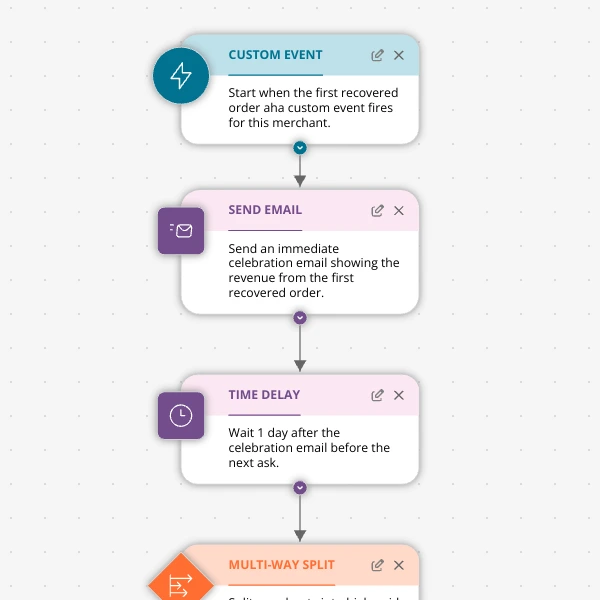
The Aha-Moment Playbook For Shopify Apps: Turn One Magic Action Into Months Of Revenue
A node-by-node playbook for Shopify and e‑commerce apps to center their lifecycle on one aha-moment custom event in Spreeflo, celebrate it, segment merchants by profile and engagement, and turn first recovered value into lasting revenue and retention.
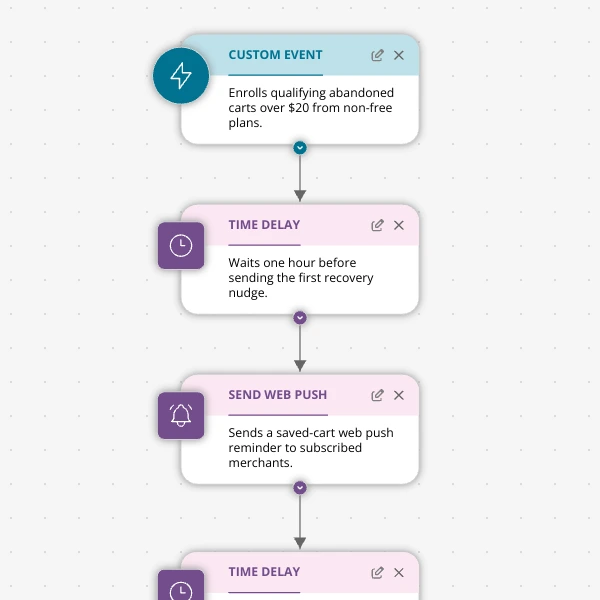
Stop Letting High‑Intent Carts Die: A 3‑Email Recovery Journey for Shopify Apps
A detailed, node-by-node walkthrough of a three-email (plus optional web push) cart-abandonment recovery journey for Shopify apps in Spreeflo, showing how to trigger events, branch on behavior, tag outcomes, and measure recovered carts and revenue.
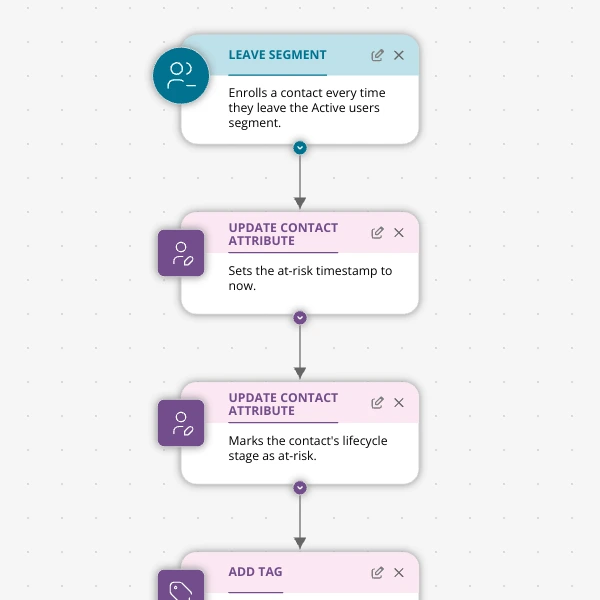
When Active Users Go Dark: A 4‑Touch Win‑Back Journey For Your Shopify App
A detailed, node-by-node Spreeflo journey for winning back previously active Shopify app users who stop engaging, using segment-based triggers, conditional logic, and a four-touch email plus internal alert sequence to recover usage and MRR.