Turn a 2‑Question Survey Into 4 Different Onboarding Paths for Your SEO SaaS
Shows how an SEO SaaS like RankPulse can use a 2‑question in‑app survey, mapped into Spreeflo journeys, to segment new customers by persona and goal, trigger tailored onboarding emails, and measure impact on engagement, activation, and retention.
Industry
Niche
Pattern
Loading sequence...
The moment someone pays you for rank tracking or content briefs, you still don’t know what “success” looks like for them. Agency? In‑house marketer? Founder doing everything at 11pm? Each one should see a different next step, but most tools send them the same generic onboarding email.
This playbook fixes that with a tiny in‑app survey that quietly rewires the rest of their journey. The sequence at the top of this page is the whole flow, end to end.
We’ll walk through how a fictional SEO SaaS, RankPulse (rank tracking + alerts for agencies and in‑house teams, ~35k MRR), uses a 2‑question survey to:
Capture persona and primary goal as structured data.
Tag every contact accordingly.
Fork the journey so each segment gets a different “next touch” email.
The result: higher survey completion, more relevant onboarding, and a clean data model you can reuse across every future campaign.
Why bother with a micro‑survey at all?
RankPulse realised something simple: their churn wasn’t about features, it was about fit.
Agencies cared about white‑label reports and client alerts.
In‑house marketers cared about shareable dashboards and integrations.
Solo founders cared about “tell me what to fix this week” guidance.
Usage data alone (events like added_first_keyword or checked_rankings) hinted at maturity, but not motivation. A one‑time, in‑app survey did what tracking could not: it captured self‑reported intent, directly in the contact record.
Spreeflo is built for exactly this: capture detail on every customer so you can speak to each uniquely. Here, the survey is the capture mechanism, and the journey is how you convert those answers into segmented messaging.
What this journey actually does
Before we go node by node, here’s the idea in plain language:
Wait until a new customer does something meaningful in the app (adds their first keyword).
A day later, show a 2‑question persona survey as a popup form inside the app.
Map each answer to contact attributes (and tags).
Wait for up to three days for them to answer.
Once they do, fork the journey into separate paths based on their persona.
Send one highly targeted email per persona as the next touch.
Everything else is details.
We’ll build this as a Journey inside Spreeflo. If you haven’t used journeys before, this is a good moment to skim how to build a journey in the visual editor.
Step 1: Trigger off a real behavior, not just signup
You could trigger this survey right after account creation, but responses are better once users have seen any value at all. RankPulse chose “added first keyword” as the moment that proves intent.
In Spreeflo, that’s modelled as:
A Custom Event in your product instrumentation, e.g.
added_first_keyword.Fired either from the frontend via the Spreeflo SDK, or server‑side via the Spreeflo API when your backend processes the action.
In the journey, the first node is:
Trigger: Custom Event
Event name:added_first_keyword
Re‑enrollment: off (you only want to ask this survey once per contact)
Why this trigger?
It’s behavioural, not time‑based.
It filters out tyre‑kickers who create an account and never touch the core feature.
It aligns with when users are most ready to answer “who are you and what are you trying to do with SEO?”
If in your own product the “aha” moment is different (e.g. connected_search_console or generated_content_brief), use that event instead.
Step 2: Give them a little time, then show the in‑app survey
You don’t want to pop a survey the instant they add a keyword. Let them explore for a bit.
Right after the Custom Event trigger, RankPulse adds:
Action: Time Delay
Duration: 1 day
After that delay, they show the form:
Action: Popup Form
Form: “Persona survey – RankPulse”
Popup embed: a modal shown on app pages only
Page targeting: include URLs that match the logged‑in app (e.g./app/paths)
Frequency cap: show up to 3 times over 3 days
The important part isn’t the embed configuration, it’s the form itself.
In the Forms section, RankPulse creates a new form (this is on the forever‑free tier in Spreeflo):
Map to contacts: on, with a required Email field (for visitors who aren’t yet identified).
Question 1 (Multiple Choice): “Which best describes you?”
Options: “SEO agency”, “In‑house marketer”, “Founder doing my own SEO”, “Freelancer/consultant”
Map to attribute:user_persona(TEXT)Question 2 (Multiple Choice or Dropdown): “What’s your top SEO job right now?”
Options: “Track rankings for clients”, “Grow organic traffic to our blog”, “Fix technical SEO issues”, “Improve ecommerce product visibility”
Map to attribute:primary_seo_goal(TEXT)
Because the popup runs through the full Spreeflo SDK, any logged‑in user identified with Spreeflo.identify doesn’t need to re‑enter their email. Their answers map directly onto their existing contact record.
If you’ve never set up forms in Spreeflo, this is covered in detail in the guide on how to create and embed forms.
Why Popup Form instead of linking to a survey in email?
You stay within the product context, where intent is high.
You avoid the drop‑off of “click from email → load survey page → maybe respond.”
You respect Spreeflo’s model: forms are in‑app (inline or popup), not emailed.
Step 3: Wait for the answer (without stalling the journey)
Some users will answer immediately. Some will dismiss the popup twice then answer on the third show. A few will never answer.
You don’t want your journey stuck forever waiting on them, so after the Popup Form action, RankPulse adds:
Action: Wait Condition
Condition: contact attributeuser_personais not blank
Timeout: 3 days
This tells Spreeflo:
Move on as soon as
user_personahas any value (survey submitted).If three days pass and the attribute is still blank, proceed anyway for the “no‑answer” path.
This design has a few benefits:
You don’t spam late responders with outdated emails. As soon as they answer, they fall into the right branch.
You also don’t block the journey for people who never answer; they just go to the generic branch.
Under the hood, both the condition and timeout use the same engine as Spreeflo’s segment builder, so you can set much richer logic if needed (for example, also check that Email Subscription Status is Subscribed before emailing).
Step 4: Split by persona with a Multi‑way Split
Now comes the important part: survey response branching.
After the Wait Condition, RankPulse drops in a Multi‑way Split process node. Each branch uses criteria based on the user_persona attribute you mapped from the form.
Branches:
Agency
Condition: Contact Attributes →user_personais “SEO agency”In‑house
Condition:user_personais “In‑house marketer”Founder
Condition:user_personais “Founder doing my own SEO”Else branch
No condition; this catches everyone else (freelancers, “Other”, or no survey response)
Order matters because conditions are evaluated top to bottom. In this example, persona values are mutually exclusive, so it’s straightforward.
Why Multi‑way Split over several If/Else nodes?
The logic is visible in one place.
It’s easier to maintain when you tweak personas later.
You can reuse similar patterns elsewhere (e.g. split on
primary_seo_goalfor future campaigns).
Again, the conditions here use the same underlying segment builder, so you can easily expand them later (e.g. “Agency AND Email opened at least 3 times in last 30 days” for a high‑engagement cohort).
Step 5: Tag and email each persona with a different playbook
Inside each branch, RankPulse does two things:
Persist the persona as tags.
Send a persona‑specific email as the next touch.
For example, in the Agency branch:
Action: Add Tag
Tags:persona:agency,goal:{value of primary_seo_goal}(you might split goals into separate tags likegoal:client-reporting)Action: Send Email
Template: “Agency onboarding – turn RankPulse into a client reporting engine”
From: your usual sending identity
Send only once: on
The In‑house branch might use:
Tags:
persona:in-house, plus goal‑related tags.Email: focus on dashboards, team alerts, and integration tips.
The Founder branch:
Tags:
persona:founder.Email: highlight quick wins, “Friday SEO checklist”, and simplified reporting.
The Else branch:
Tags:
persona:unknown.Email: a more generic “3 ways customers use RankPulse” that nudges them to self‑identify later.
Those Send Email nodes are built with our email builder. Because persona and goal are attributes on the contact, you can personalise subject lines and body content easily. If you’re using AI‑assisted copy, Spreeflo’s AI variables for personalization can pull in user_persona, primary_seo_goal, and event data automatically.
You now have:
At least one tag per persona, for quick segmentation.
Attributes you can use in any future journey or campaign.
A first post‑survey touch that aligns with what each customer actually cares about.
Importantly, there is a spacing node (the Wait Condition) before any Send Email, and there’s only one email per immediate branch in this pattern, so you avoid the spammy “back‑to‑back email” anti‑pattern.
From here, you can extend each branch into its own mini‑series, as long as you insert a Time Delay or Wait Condition between every email on a path.
Step 6 (optional): React to how they engage with that first targeted email
If you want to go deeper, you can drop a Check Email Activity node after each branch’s email and react differently based on opens or clicks.
Example for the Agency branch:
Time Delay: 3 days
Check Email Activity
Email: “Agency onboarding – reporting engine”
Activities:
- Link Clicked → high‑intent follow‑up (offer a “done‑with‑you” setup call or advanced tutorial)
- Opened but not clicked → resend with a different angle or shorter CTA
- Not Opened → try a very short, plain‑text style “quick question” email
That’s beyond the core survey‑response branching pattern, but it’s where you start to compound the value of the data you captured.
What to measure (and how to know this is worth it)
For RankPulse, the win was clear within a few weeks. Here are the metrics they tracked:
Survey response rate
- Numerator: contacts who haveuser_personaset.
- Denominator: contacts who triggered the journey.
- Good target: 40–60% for a 2‑question in‑app survey.Email performance per branch
- Open and click rates for each persona’s onboarding email vs your previous one‑size‑fits‑all message.
- BrieflySEO, a similar content‑briefs SaaS, saw a 30–40% lift in click‑through for founder‑specific onboarding vs generic.Downstream activation / retention
- For agencies: proportion who set up recurring rank reports in first 14 days.
- For in‑house: proportion who invited a colleague or connected Google Search Console.
- For founders: return visits in weeks 2–4.
Because every branch lives inside one journey, you don’t need a spreadsheet to compare. You can build segments per persona and watch how their metrics differ over time.
What if my survey lives in Typeform or another tool?
Sometimes the survey isn’t in your app: maybe you run a quarterly “State of SEO” survey in Typeform or a conference registration form you don’t control. When you genuinely can’t host it as a Spreeflo form, use events instead.
The pattern looks like this:
Your external form collects responses and writes them into your backend.
For each completed response, your backend POSTs to the Spreeflo events endpoint via the Spreeflo API.
Event name:persona_survey_completed.
Properties:user_persona,primary_seo_goal, maybecompany_sizeormonthly_traffic.In your journey, the trigger is:
Custom Event
Event name:persona_survey_completed
Optional property conditions (e.g. only agency responses).Inside the journey, you still:
Update tags based on event data (either by having your backend also update contact attributes, or by segmenting on event properties).
Use a Multi‑way Split on attributes or event properties to fork the next touch.
Use this route only when the form surface is truly outside your control. If you can embed or pop up a Spreeflo form in your app or site, prefer that: you get automatic mapping to contact attributes, form analytics, and the Form Submission trigger without extra backend work.
The bigger win: a shared language with every customer
For a small SEO SaaS team, this journey is more than a clever survey trick. It creates a shared language between you and your users:
You know who is an agency, who is in‑house, who is a founder.
You know what each one is actually trying to achieve.
You can speak to them in their words across every channel from now on.
That’s the heart of Spreeflo’s first brand belief: capture detail on every customer so you can speak to each uniquely. A two‑question survey, mapped correctly and wired into a journey, is one of the fastest ways to get there.
You build this once. It quietly runs in the background, segmenting every new user who hits their first “aha” moment and steering them into the right path. For a team of two to seven people trying to push MRR up while headcount stays flat, that kind of compounding leverage is exactly what you want your marketing automation to deliver.
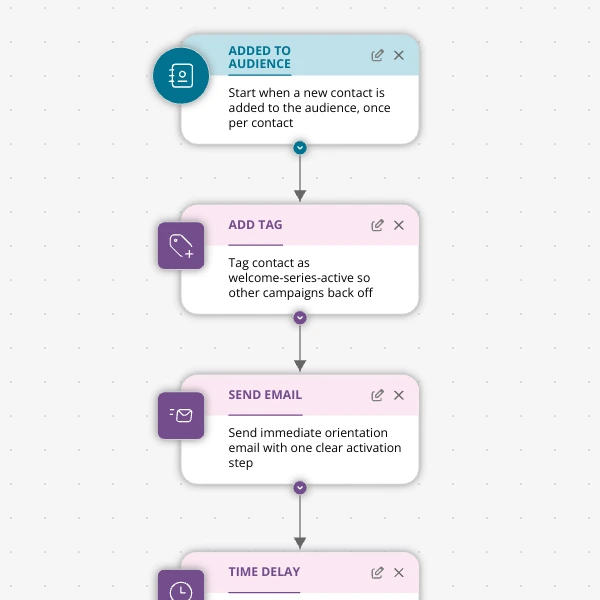
The Shopify app welcome series that turns installs into income
A step-by-step Shopify app welcome email journey for tools like CartSpark, showing how to turn new installs into activated, retained merchants using Spreeflo journeys, tags, and behavioral triggers so fewer trials quietly churn and more trials convert.
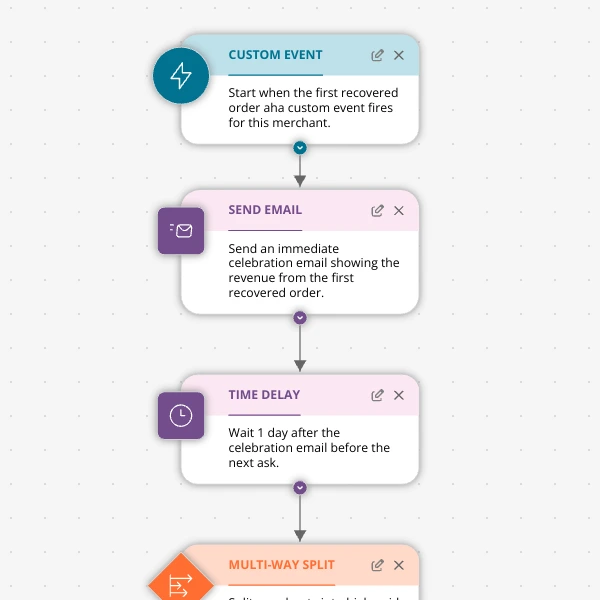
The Aha-Moment Playbook For Shopify Apps: Turn One Magic Action Into Months Of Revenue
A node-by-node playbook for Shopify and e‑commerce apps to center their lifecycle on one aha-moment custom event in Spreeflo, celebrate it, segment merchants by profile and engagement, and turn first recovered value into lasting revenue and retention.
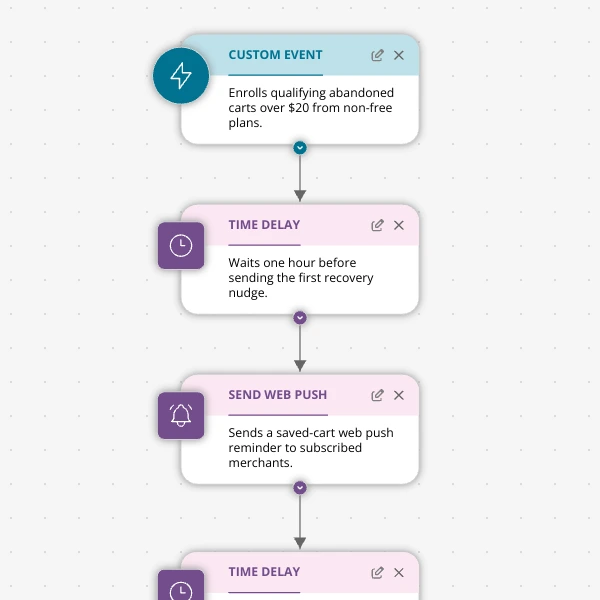
Stop Letting High‑Intent Carts Die: A 3‑Email Recovery Journey for Shopify Apps
A detailed, node-by-node walkthrough of a three-email (plus optional web push) cart-abandonment recovery journey for Shopify apps in Spreeflo, showing how to trigger events, branch on behavior, tag outcomes, and measure recovered carts and revenue.
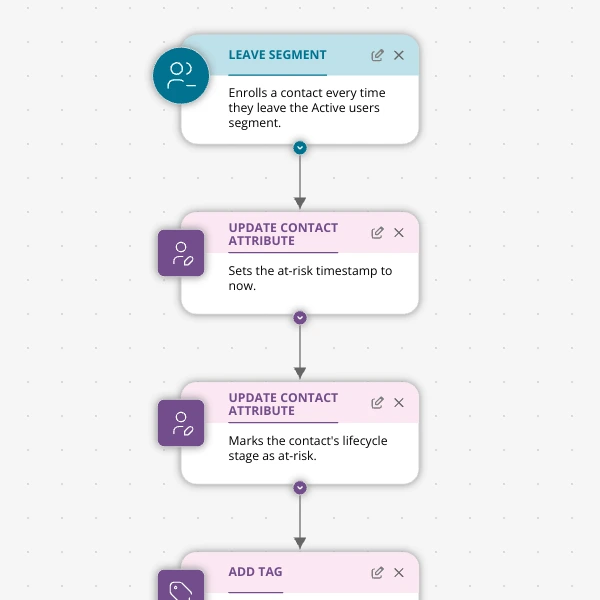
When Active Users Go Dark: A 4‑Touch Win‑Back Journey For Your Shopify App
A detailed, node-by-node Spreeflo journey for winning back previously active Shopify app users who stop engaging, using segment-based triggers, conditional logic, and a four-touch email plus internal alert sequence to recover usage and MRR.