Turn Your First SEO “Win” Into a Retention Engine
Design an always-on Spreeflo journey for an SEO SaaS that detects each user’s first real “aha” moment, stamps it on the contact, and triggers tailored trial, upgrade, and retention paths so early wins turn into long-term, habit-driven revenue.
Industry
Niche
Pattern
Loading sequence...
The most important email your SEO SaaS sends usually isn’t the welcome email. It’s the “you just got real value” message the first time a customer sees rankings, a content brief, or an audit that actually changes what they do next.
For most products, that aha moment passes silently. The user exports their first report, feels a small jolt of “oh wow, this is useful,” and then… nothing. No reinforcement, no guidance on what to do next, no nudge to turn that first success into a habit. The sequence at the top of this page is the whole journey, end to end, for fixing that.
In this playbook, we’ll design a Spreeflo journey for an SEO SaaS like “RankPulse” (rank tracking + content briefs, ~$35k MRR) that detects the first meaningful win and celebrates it with targeted, behavior-aware email. The goal: shorten time-to-aha, lift trial-to-paid, and keep post-aha users from drifting away.
Step 1: Decide what “aha” actually means for your product
“User logged in” is not an aha moment. Neither is “created an account”.
For SEO tools, the real moment is when the product does something the user could not easily do on their own. Some examples:
Rank tracker: first batch of keywords added and first ranking snapshot generated.
Content brief tool: first brief generated and viewed.
Technical SEO tool: first full-site audit run and issues listed.
Pick one, maybe two, for your primary aha. You can always add more journeys later, but this one should be the clearest “they’ve seen real value” signal.
For RankPulse, let’s define:
Aha event: user creates their first project, adds at least 10 keywords, and views their first ranking report.
We’ll fire a backend event called
aha_rank_report_createdwhen that condition is met.
This forces you to be precise about value. It’s also what makes the journey work: you’ll be talking only to users who hit that bar, not every casual trial.
Step 2: Wire your aha event into Spreeflo (SDK + API)
You can’t celebrate what you don’t track.
Spreeflo supports two event sources:
Frontend (browser) via the Spreeflo SDK: perfect for things the user explicitly does in your app UI: “clicked Run Audit”, “generated brief”.
Backend via the Spreeflo API: ideal for server-side decisions, like “first full crawl finished” or “report emailed”.
For our aha_rank_report_created example:
In your React/Vue SPA, when the user clicks “View report” and the project meets your keyword threshold, your frontend can call
Spreeflo.track('aha_rank_report_created', { projectId, keywordCount: 23 }).If your backend is the one that knows the conditions (for example, once the report rendering job completes), have that server POST to the events endpoint of the Spreeflo API with
{ event: 'aha_rank_report_created', email: user.email, properties: { projectId, keywordCount: 23 } }.
Two important data design choices that pay off later:
Identify the contact with context early. When users sign up or log in, call
Spreeflo.identify(email, { plan_type, role, company_size, is_agency })from the SDK, or mirror the same data through the API. These become contact attributes you’ll use in segmentation and personalization.Capture engagement events beyond the aha. Track events like
invited_teammate,connected_search_console,created_additional_project, andgenerated_content_brief. These feed the “what next?” logic inside the journey and help you distinguish “bare-minimum aha” from “on the way to power user.”
This is how you “capture detail on every customer so you can speak to each uniquely,” not just blast a generic onboarding series.
Step 3: Build the aha celebration journey in Spreeflo
We’ll now walk through the sequence you see at the top of the page, node by node, as a Spreeflo journey (not a campaign). Journeys are always-on automations that react to behavior in real time; you can read more about that distinction on the campaigns and journeys page.
3.1 Trigger: Custom Event = aha moment
Node: Custom Event trigger
Event name:
aha_rank_report_createdProperty conditions: none (we’ve already baked the logic into when we fire the event).
Re-enrollment: off (
isReEnrollment = false)
Why:
This journey should run once per contact, the first time they see real value. Turning re-enrollment off ensures someone who generates multiple reports doesn’t get the same sequence again and again.
If you want different aha journeys for different product lines (e.g.,
aha_content_brief_created), use separate journeys rather than reusing this one.
3.2 Stamp the moment on the contact
Node: Update Contact Attribute
Attribute:
aha_rank_report_at(custom TIMESTAMP attribute you create beforehand)Update type:
SET_NOW
Why:
You’ll use
aha_rank_report_atfor analytics (“average time from signup to aha”) and more advanced cohorts later.Using
Set to nowensures the timestamp is accurate to when the journey runs. Remember that Update Contact Attribute writes static values or “now”; it doesn’t pull numbers from the event payload automatically.
Node: Add Tag
Tags:
aha-rank-report,aha-reached
Why:
These tags power quick segments such as “has hit aha” vs “still pre-aha”.
They’re also handy to suppress other onboarding sequences once someone passes this milestone.
At this point, every user who hits the trigger is marked as “aha reached”, with a recorded timestamp.
3.3 Split: trial vs paying customers
Node: If/Else
Condition (using the segment builder):
Group: AND
Rule 1: Contact Tags
contact is tagged withtrial(or Contact Attributeplan_typeistrial)
If true → “Trial branch”
Else → “Paying branch”
Why:
Trial users at aha are prime upgrade candidates.
Paying customers at aha are prime retention and expansion candidates. They need different messages, even if the underlying event is the same.
Step 4: Trial branch – from first win to paid plan
This branch is for users still on a free trial or freemium tier.
4.1 Email 1: Celebrate and point to the next action
Node: Send Email
Content: Built in Spreeflo’s email builder.
Goal: Celebrate the first ranking snapshot and guide them into a concrete next step that deepens usage and nudges toward paid.
Example angles for the copy:
Subject: “Your first rankings are in for [Project Name]”
Body:
- Call out one or two specific wins (e.g., “You’re already on page 2 for ‘[keyword]’”).
- Show what to do next: “Add competitors to watch,” “Turn this into a content brief,” “Set up alerts.”
- Subtly frame the paid plan as how to keep that momentum going (more projects, more keywords, alerts, etc.).
Because this is the first email in the branch, there’s no pacing issue yet.
4.2 Give them breathing room before the next touch
Node: Time Delay
Value: 2
Unit: days
Why:
You want to see who naturally upgrades or explores more features in the couple of days after the first big win.
It also respects pacing; you avoid back-to-back messages that feel like a sales chase.
4.3 Branch again: did they become a paying user?
Node: If/Else
Condition:
Group: OR
Rule 1: Contact Attribute
plan_typeispaidRule 2: Contact Tags
contact is tagged withcustomer
If true → “Converted since aha”
Else → “Still trial”
Why:
This keeps your messaging honest. Someone who already upgraded because of the first aha email shouldn’t get another “please upgrade” nag.
It also lets you celebrate their decision in context: “You upgraded after seeing your rankings move—here’s how to get the most from your plan.”
4.4 Email 2a: Onboarding for new payers
Branch: Converted since aha
Node: Send Email
Goal:
Acknowledge that aha → upgrade path.
Lay out a 7–14 day “quick wins” plan tied to their use case.
Content ideas:
“You saw your first rankings; now let’s protect and grow them.”
Steps like:
- Connect Google Search Console.
- Add your second project (e.g., a new client site for agencies).
- Set up weekly email digests and keyword alerts.
Because there’s a 2-day Time Delay between emails, you’re within healthy pacing even if someone converts fast.
Optional: you can follow this with an Add Tag action like onboarding-quick-wins to capture who received this more advanced track.
4.5 Email 2b: Nudge non-converters with proof, not pressure
Branch: Still trial
Node: Send Email
Goal:
Turn the first aha into a story: “Here’s what people like you did next and the results they saw.”
Address common objections (time, complexity, doubt about data) with real examples.
Content angles:
Case study snippet: “An agency using RankPulse started with exactly one client project, just like you. Within 30 days of adding competitor tracking and alerts, they…”
Clear call-to-action to upgrade or book a quick “audit of your data” call, if you offer it.
Again, pacing is protected by that 2-day delay. And because the journey is behavior-triggered, this email only goes to users who have seen value, which keeps it from feeling like a cold pitch.
Step 5: Paying branch – turn aha into habit and expansion
Now for users who were already on a paid plan when they hit the aha moment.
5.1 Email 1: Reinforce why they’re paying you
Branch: Paying users
Node: Send Email
Goal:
Reflect back the value they just unlocked.
Guide them into behaviors that increase stickiness: team invites, more projects, more keywords, deeper features.
Content ideas:
Subject: “This is where [Product] starts to pay for itself”
Body:
- Screenshot-style visuals of their first report.
- Tips like “Add your content team to see briefs directly,” “Set up client-facing dashboards,” “Turn this report into tasks.”Here you can use attributes captured via
Spreeflo.identify(likeis_agencyorrole) and AI variables to adjust examples for agencies vs in-house teams.
5.2 Timebox the next milestone
Node: Time Delay
Value: 7
Unit: days
Why:
You want to see whether they deepen engagement after the aha.
A week is long enough for most SEO workflows to cycle through planning, implementation, and review at least once.
5.3 Branch on engagement: power users vs at-risk
Node: If/Else
Condition (again using the segment builder):
Group: OR
Rule 1: Custom Events
invited_teammateAT_LEAST1 timein the last7 days.Rule 2: Custom Events
created_additional_projectAT_LEAST1 timein the last7 days.Rule 3: Custom Events
generated_content_briefAT_LEAST1 timein the last7 days.
If true → “Engaged after aha”
Else → “Bare-minimum aha”
Why:
Users who keep exploring after the first win are your future case studies and expansion revenue.
Users who don’t budge after aha are quietly heading for churn, even though they’ve technically seen value.
5.4 Email 2a: Turn engaged users into champions
Branch: Engaged after aha
Node: Send Email
Goal:
Accelerate them from “engaged” to “champion”.
Content ideas:
Show them a checklist of advanced features they haven’t used yet.
Invite them to a “pro user” webinar or loom-style walkthrough focused on automation, API usage, or white-label reporting.
If you sell by seat or client count, this is where you point out how close they are to the next plan in a way that feels like opportunity, not threat.
5.5 Email 2b: Rescue bare-minimum users before they fade
Branch: Bare-minimum aha
Node: Send Email
Goal:
Stop the slide into “I’ll get back to this later” territory.
Remove friction and surface one low-effort next step.
Content angles:
A simple, single CTA: “Reply with your main domain and we’ll suggest three keywords to track,” or “Here’s a 5-minute video showing how agencies like you use reports in client calls.”
Reassure them that they don’t need to become power SEO users overnight. The point is: keep logging in, keep seeing small wins.
This is where many SaaS tools quietly lose lifetime value. The user did get to aha, but no one nurtured them afterwards. Most businesses leak lifetime value by not nurturing engagement beyond that first win; this branch exists to plug that hole.
Step 6: Measure time-to-aha, aha-to-paid, and retention by aha status
Once the journey is live, Spreeflo’s data model lets you answer the three key questions for this pattern.
6.1 Time-to-aha
Because you wrote aha_rank_report_at on the contact:
Export contact data or create reporting segments that bucket users by
Contact Added Dateandaha_rank_report_at.Even a simple average (“aha within 2.3 days on average”) is a powerful onboarding KPI.
You can also use web tracking and analytics to see how many visitors reach the aha-triggering pages but never fire the event, which points to UX issues.
6.2 Aha-to-paid conversion
Create two segments:
“Aha & Paid”: Tag
aha-reachedANDplan_type is paid“Pre-aha & Paid”: Tag
aha-reachedNOT present ANDplan_type is paid
Comparing their counts and growth over time tells you:
How much revenue is effectively “aha-driven”.
Whether your journey is moving the needle on trial-to-paid.
6.3 Retention by aha status
Similarly, track churned contacts with and without the aha-reached tag:
If “never hit aha” users churn at 18% monthly and “hit aha” users churn at 4%, you know exactly where to focus product and marketing efforts.
You can even send separate win-back campaigns to each group, again powered by the segment builder.
This is the heart of data-driven lifecycle marketing: you’re no longer treating everyone as one flat list; you’re talking differently to people based on the specific value they have or haven’t seen.
Why this journey earns its place in your stack
For a small SEO SaaS team, this isn’t about adding “one more email flow.” It’s about building a system that does three things on autopilot:
Captures the moment your product truly clicks for each user. You track a precise aha event, stamp it on the contact, and keep that knowledge forever.
Speaks differently to people based on that moment. Trial vs paid, engaged vs bare-minimum users all get messages that reflect their reality, not a generic drip.
Prevents quiet, unnecessary churn. Instead of assuming “aha = safe,” you continue to nurture engagement after the first win, where a lot of revenue is quietly lost.
You design this journey once in Spreeflo and it runs for new users every day, which is exactly how founder-led businesses win: not by hiring a huge marketing team, but by putting thoughtful automation in place that compounds with every new sign-up.
If you already know what your aha moment is, you now have a clear blueprint for celebrating it. If you don’t, building this journey is a good forcing function to find out—and your retention numbers will tell you when you’ve got it right.
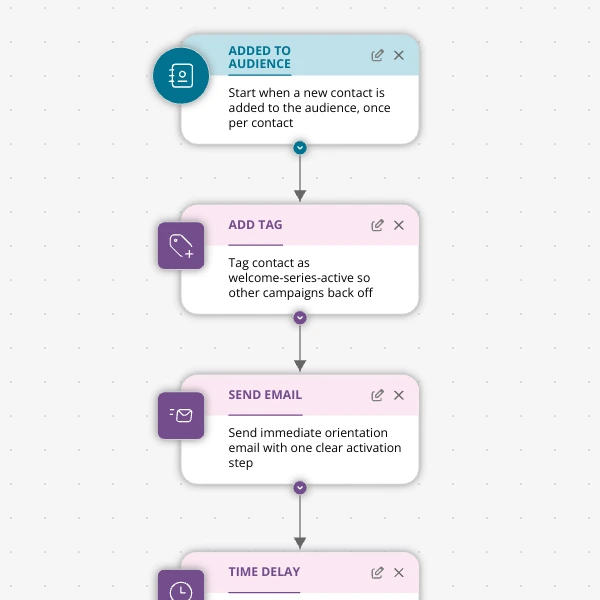
The Shopify app welcome series that turns installs into income
A step-by-step Shopify app welcome email journey for tools like CartSpark, showing how to turn new installs into activated, retained merchants using Spreeflo journeys, tags, and behavioral triggers so fewer trials quietly churn and more trials convert.
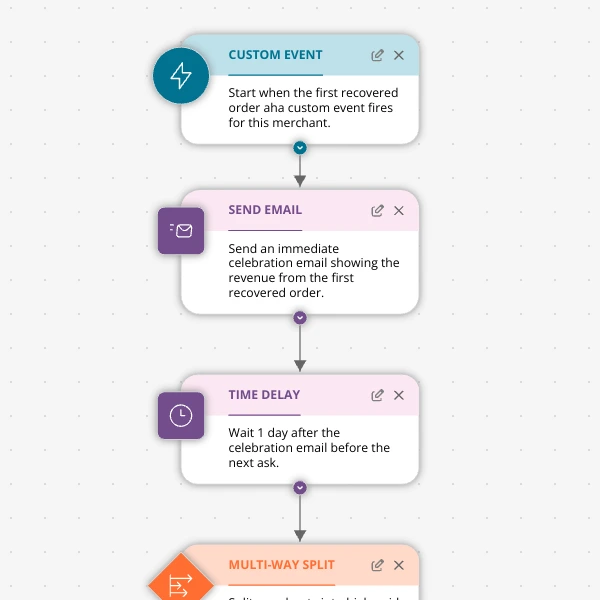
The Aha-Moment Playbook For Shopify Apps: Turn One Magic Action Into Months Of Revenue
A node-by-node playbook for Shopify and e‑commerce apps to center their lifecycle on one aha-moment custom event in Spreeflo, celebrate it, segment merchants by profile and engagement, and turn first recovered value into lasting revenue and retention.
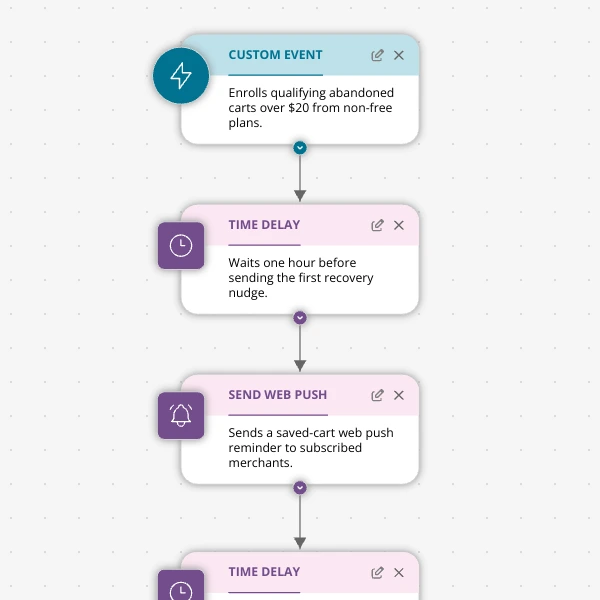
Stop Letting High‑Intent Carts Die: A 3‑Email Recovery Journey for Shopify Apps
A detailed, node-by-node walkthrough of a three-email (plus optional web push) cart-abandonment recovery journey for Shopify apps in Spreeflo, showing how to trigger events, branch on behavior, tag outcomes, and measure recovered carts and revenue.
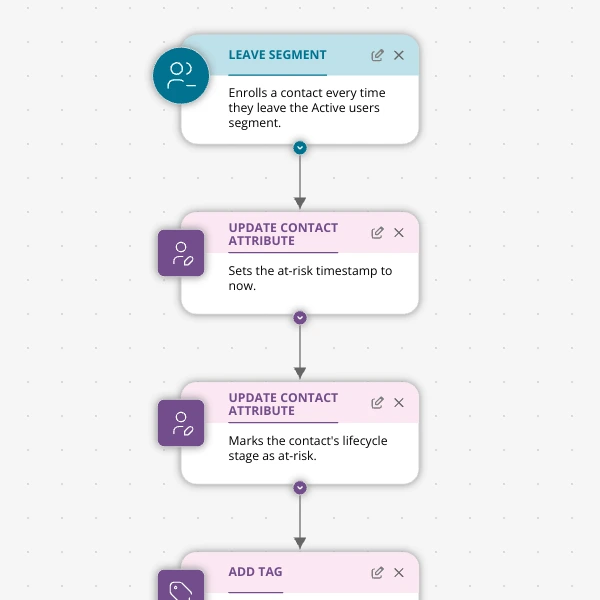
When Active Users Go Dark: A 4‑Touch Win‑Back Journey For Your Shopify App
A detailed, node-by-node Spreeflo journey for winning back previously active Shopify app users who stop engaging, using segment-based triggers, conditional logic, and a four-touch email plus internal alert sequence to recover usage and MRR.