Turn your SEO deep-dives into a gated content ladder that converts
This playbook shows how to turn an SEO deep-dive or lead magnet into a behavior-gated content ladder using Spreeflo journeys, so only truly engaged subscribers progress and become high-intent trials, upgrades, and revenue.
Industry
Niche
Pattern
Loading sequence...
Your “ultimate SEO guide” probably pulls in signups. The problem is what happens next: most readers skim the first email, maybe click once, then disappear into the inbox void.
This playbook turns that dead-end into a gated content ladder: each piece of content only unlocks after a real engagement signal, so the people who make it to the end are your sharpest, most ready-to-buy leads. The sequence at the top of this page is the whole journey, end to end.
We’ll walk through it using a fictional SEO SaaS, RankFrame: a 4‑person team selling rank tracking and content briefs to agencies, sitting at ~$40k MRR. Their goal: take cold newsletter subscribers and turn the most engaged into trials and upgrades, on autopilot.
Why “gated by behaviour” beats one-shot lead magnets
RankFrame used to send a 40‑page “Technical SEO Playbook” PDF as a lead magnet. Opt‑ins were decent. Trial signups from that list were not.
The problem was structural:
Everyone got the same follow-up, regardless of whether they actually read anything.
There was no way to tell “skimmed and bounced” from “obsessed and ready for a trial”.
The list kept growing, but engagement and revenue flatlined.
A gated content series fixes that by doing two things:
It captures detail on each subscriber: who actually clicks, how far they progress, who stalls.
It nurtures engagement step by step, instead of dumping everything in one shot.
Spreeflo’s journeys are built for exactly this kind of behavior-driven flow. You send educational content, and the automation rebuilds your funnel based on what each person actually does, not what you hope they did.
Let’s break down how the journey works.
The high‑level structure of the gated series
RankFrame designs a three‑part series:
Part 1: “The 3 ranking levers you can’t see in Search Console” (open to everyone)
Part 2: “How to build briefs that move those levers” (unlocked only after engaging with Part 1)
Part 3: “How agencies turn this into a retainer offer” (unlocked only after engaging with Part 2, with a strong product tie‑in and CTA)
Part 1 goes out as a normal marketing email (a campaign or another journey). The gated unlock logic lives in its own journey, built in Spreeflo’s campaign and journey automation editor:
Primary trigger: Email Action on the Part 1 email
Internals: Time Delays and Check Email Activity nodes to gate Parts 2 and 3
Actions: Send Email, Add Tag, Update Contact Attribute, Wait Condition, optional Send Internal Email for sales alerts
By the end, RankFrame knows:
Who received Part 1
Who unlocked Part 2
Who completed Part 3
Who converted to trial or upgrade after finishing
Those aren’t just stats; they’re segments they can reuse everywhere.
Entry point: Email Action trigger on your first content email
You start by sending the Part 1 email using Spreeflo’s email builder. That email is a standard marketing email with one primary CTA: a tracked link to the Part 1 article or lesson.
Now wire the gated series:
Create a new journey in the visual editor (see build a journey for the basics).
Add an Email Action trigger:
- Email type: Marketing email
- Marketing email: select your Part 1 email
- Email action: Delivered (or Opened, if you only care about opens)
- Re-enrollment: off (you want each contact to go through this ladder once)
Using “Delivered” means every contact who actually received Part 1 enters the journey. You’ll gate progression later based on engagement; the trigger just gives you a clean starting cohort.
Stage 1: Give them time, then check if they touched Part 1
Right after the trigger, drop in a Time Delay:
Time Delay: 2 days, unit: Day(s)
Two days is usually enough for busy SEO folks to get to your email without feeling hounded.
Next, add a Check Email Activity process node pointing at the same Part 1 email:
Marketing email: your Part 1 email
Activities to branch on:
- Branch A: Link Clicked
- Branch B: Link Not ClickedElse branch: auto-created for odd cases (not delivered, bounced)
This node is the core of “gated by behaviour.” It turns one monolithic list into three groups:
People who actually clicked through to Part 1 (your core audience for deeper content)
People who saw the email but didn’t click (some interest, but friction)
People who never really got it (deliverability or hard ignore)
Each branch gets its own path.
The “clicked Part 1” path: unlock and send Part 2
For the Link Clicked branch, you assume genuine interest. Treat them like insiders.
Add Tag action
- Tag: something likecontent_series_part1_clickedSend Email action: Part 2 unlocked
- Content: your Part 2 email, framed as “Unlocking Part 2”
- Toggle “send only once” on, so re-entries never duplicate this emailTime Delay before the next gate
- Time Delay: 3 days
This tag is simple, but important. Later you’ll use tags and attributes in the segment builder to measure “unlock rate” and build future campaigns (“everyone who ever made it past Part 1”).
The copy here does two jobs:
It recaps one key idea from Part 1 (for reinforcement).
It positions Part 2 as a reward for engagement: “because you went deep on X, here’s the next step.”
Spreeflo’s AI content tools and AI variables help you tailor subject lines and body copy to each reader’s use case (agency vs in‑house, technical vs content focus) without rewriting emails from scratch.
This keeps spacing healthy. They’ve now had three separate touches over a week: Part 1, the unlocked Part 2 email, and the Part 2 content itself.
Stage 2: Only serious readers unlock Part 3
After the delay, add another Check Email Activity node, this time on the Part 2 email:
Marketing email: Part 2
Activities:
- Branch A: Link Clicked
- Branch B: Link Not Clicked
Again, the Link Clicked branch is your progression path.
On the clicked branch:
Update Contact Attribute
- Attribute: a custom TEXT attribute likecontent_series_stage
- Update type: Update
- Value:part2_unlockedSend Email: Part 3 (the “retainer mechanics” piece)
- Make this explicitly higher stakes. It should show how the exact ideas in Parts 1 and 2 translate into revenue for them.
- Include a strong in‑product CTA: “See how RankFrame tracks these levers automatically in a 14‑day trial” or “Book a teardown of your top 10 pages.”Time Delay: 4–5 days
- Give them room to consume Part 3 and poke around your site.
Because Update Contact Attribute writes a static literal, you predefine the exact string you want to store. That’s fine here; you just want a clean label for stage.
Now you’re ready for the money step: did this education sequence move them closer to becoming (or staying) a customer?
Stage 3: Wait for conversion signals, then react
After the delay, add a Wait Condition node. This is where you connect educational engagement to product behaviour.
Define a condition using the Segment Builder:
Condition group (AND):
- Custom eventstarted_trialtriggered at least 1 time in the last 7 days
OR
- Custom eventupgraded_plantriggered at least 1 time in the last 7 days
You’ll track those events either from your web frontend using the Spreeflo SDK or from your backend using the Spreeflo API. Either way, once they happen, this Wait Condition sees them.
Configure the node:
Condition: that event-based rule
Timeout: 7 days, unit: Day(s)
Two outcomes:
If the contact starts a trial or upgrades within a week of Part 3, they flow straight to your “success” branch.
If nothing happens, the timeout fires, and they move on anyway.
On the “conversion happened” path, you might:
Update Contact Attribute
- Attribute:content_series_outcome
- Value:convertedOptionally Send Internal Email to yourself or a teammate with context:
- “This contact read all three parts of the SEO Retainer series and started a trial. Here’s their plan, company, and which content piece they clicked most.”
On the “no conversion yet” path:
Update Contact Attribute:
content_series_outcome = no_conversionSend Email: a final, softer CTA
- Summarise the three parts in one narrative.
- Share one client story or case study.
- Give a low‑friction next step: “Hit reply with your domain; we’ll send back 3 pages you should fix first.”
Then end the journey. Anyone who’s gone all the way through but hasn’t converted gets treated as a high‑intent lead for other campaigns, but you don’t keep hammering this same series.
The “didn’t click Part 1” path: low pressure, high signal
Go back to the Link Not Clicked branch on the first Check Email Activity node.
These people saw the subject line and maybe opened, but they didn’t click through. Treat this as mild interest with friction.
A simple path:
Time Delay: 2 days
Send Email: alternate angle on Part 1
- Change the subject line and framing.
- Bring 1–2 key insights into the email body itself, then link to the full piece for those who want depth.
You can add an Add Tag action here (content_series_part1_reminder_sent) to avoid hitting them with the same reminder elsewhere.
Optionally, after another delay and Check Email Activity on this reminder, you could let people who finally click through join the main “Part 2 unlocked” path, or simply end the journey to avoid fatigue. The sequence at the top of this page shows the simpler version: one reminder, then done.
The edge cases: bounces and unreachables
The Else branch on your first Check Email Activity node catches odd cases where the email wasn’t delivered or had serious issues.
In most SEO SaaS lists this will be a small minority, but it’s still good hygiene:
Add Tag:
delivery_issueOptionally exclude this tag from future educational flows
You don’t need to overthink this branch. The main job is to protect your sender reputation and keep metrics on list quality.
Measuring unlock rate and progression
By this point, the journey has quietly stamped contacts with tags and attributes that describe how far they got:
content_series_part1_clickedcontent_series_stage = part2_unlockedcontent_series_outcome = converted | no_conversion
You can now use Spreeflo’s segment builder to define:
“Unlocked Part 2”: tag contains
content_series_part1_clicked“Completed series”:
content_series_stage is part2_unlockedAND they clicked Part 3“Completed series but didn’t convert”:
content_series_outcome is no_conversion
Those segments give you:
Unlock rate: Unlocked Part 2 / Delivered Part 1
Completion rate: Completed series / Unlocked Part 2
Conversion rate: Converted / Completed series
More importantly, they give you audiences you can reuse:
Send a “What should we build next?” survey only to people who completed the series.
Run a focused win‑back experiment on “completed but didn’t convert” with a tighter trial and onboarding offer.
Treat “completed and converted” as power users to invite into betas or testimonial requests.
This is the payoff of capturing detail on every customer: the data isn’t just a report; it shapes who you talk to and how.
Adapting the pattern to your own SEO SaaS
The same scaffolding works for different goals:
Lead magnets for specific features: a three-part content brief mini‑course before pitching your content‑brief generator.
Onboarding for trials: a “First 7 days with RankFrame” series gated by
created_first_projectoradded_first_keywordevents instead of email clicks.Agency‑only tracks: a series gated by a “company type is agency” attribute collected via a Spreeflo form embedded on your pricing page (the form is inline on your site; emails simply nudge them back to it).
You can always start with just email plus events and add extras later:
Web tracking: use Spreeflo’s web tracking and analytics to gate on “visited /pricing at least once in the last 7 days” instead of only email clicks.
Popup Form: once someone completes all three parts and returns to your app, show a Popup Form asking their monthly traffic or SEO budget, and map the answers to attributes for even sharper targeting.
The core idea stays the same: content progression is earned, not assumed. Every step forward is powered by a specific behavioural proof that they care.
Why this pattern matters for small SEO SaaS teams
Founder‑led teams like RankFrame don’t have the headcount to manually sort “hot” from “cold” leads. Without automation, everyone either gets the same blast or nothing at all. Both waste the effort you put into your content.
A gated content ladder fixes that in a way that compounds:
You write a series once.
You build this journey once.
From then on, the system quietly promotes readers up the ladder, collects rich engagement data, and routes your most serious prospects to the right next step.
Most SEO SaaS businesses are already creating content. The difference between blogs that “build brand” and content that reliably drives trial and expansion MRR is this kind of scaffolding.
Set up the gated series once in Spreeflo, let it run for a month, and watch the numbers: unlock rate, completion, and conversion at the end. That’s where you see how much lifetime value you were leaving on the table when every subscriber looked the same.
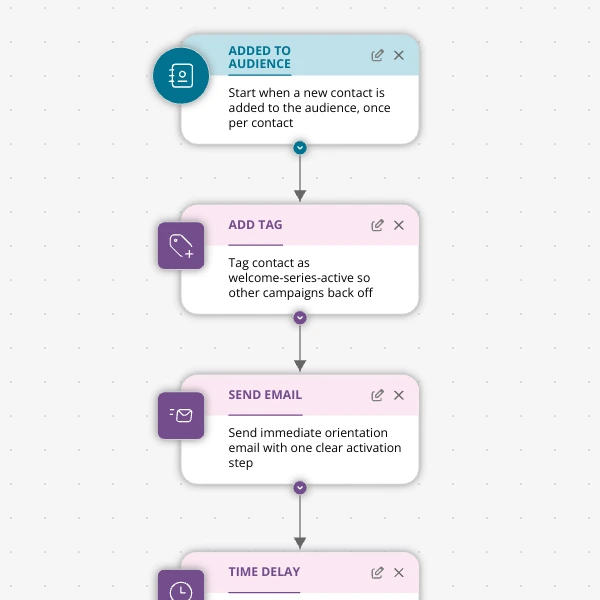
The Shopify app welcome series that turns installs into income
A step-by-step Shopify app welcome email journey for tools like CartSpark, showing how to turn new installs into activated, retained merchants using Spreeflo journeys, tags, and behavioral triggers so fewer trials quietly churn and more trials convert.
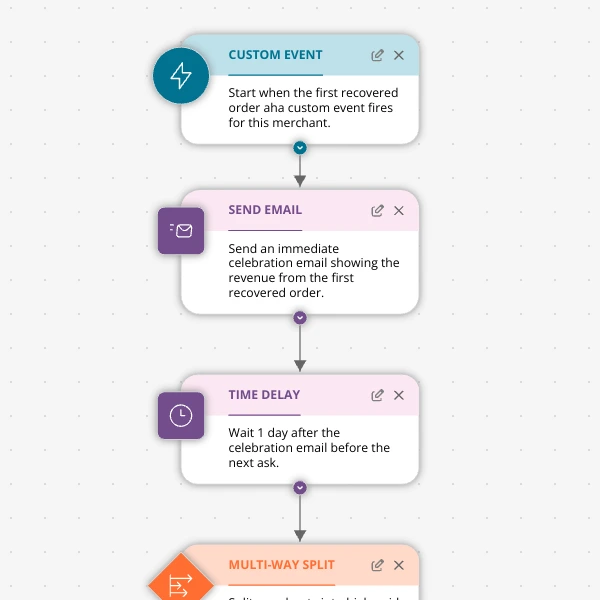
The Aha-Moment Playbook For Shopify Apps: Turn One Magic Action Into Months Of Revenue
A node-by-node playbook for Shopify and e‑commerce apps to center their lifecycle on one aha-moment custom event in Spreeflo, celebrate it, segment merchants by profile and engagement, and turn first recovered value into lasting revenue and retention.
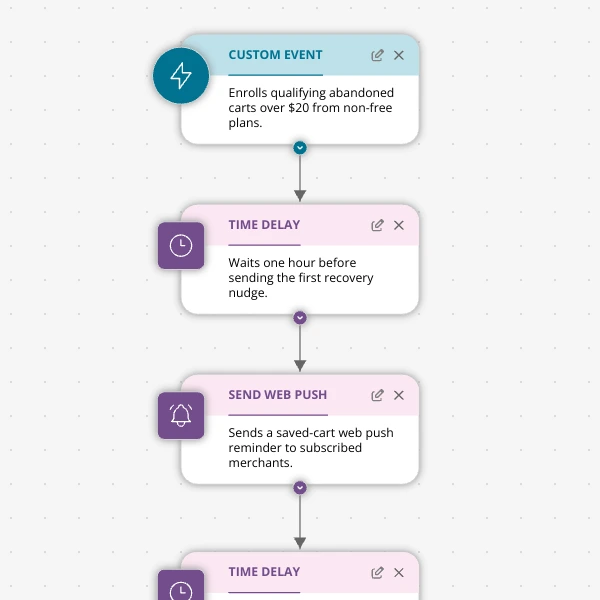
Stop Letting High‑Intent Carts Die: A 3‑Email Recovery Journey for Shopify Apps
A detailed, node-by-node walkthrough of a three-email (plus optional web push) cart-abandonment recovery journey for Shopify apps in Spreeflo, showing how to trigger events, branch on behavior, tag outcomes, and measure recovered carts and revenue.
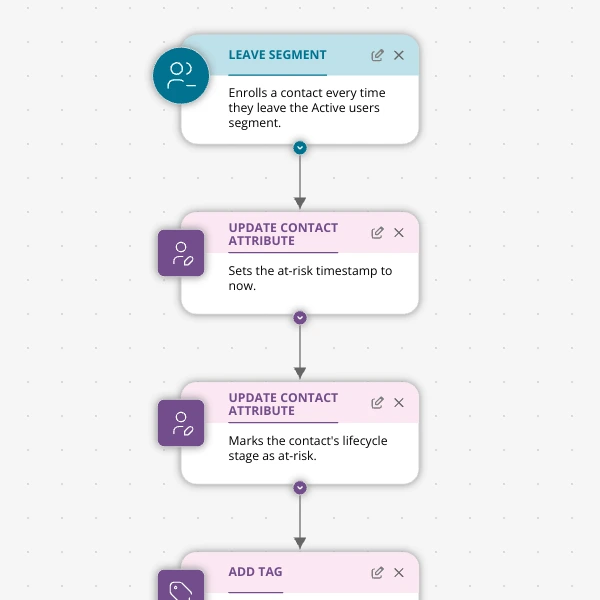
When Active Users Go Dark: A 4‑Touch Win‑Back Journey For Your Shopify App
A detailed, node-by-node Spreeflo journey for winning back previously active Shopify app users who stop engaging, using segment-based triggers, conditional logic, and a four-touch email plus internal alert sequence to recover usage and MRR.