When Your SEO Lead Magnet Gets Clicked but Not Read (And the Journey That Saves It)
Shows how to build a behavior-driven Spreeflo journey that detects when SEO lead-magnet downloads aren't actually consumed, then automatically re-delivers them with contextual email nudges, improving asset completion rates and turning more content consumers into MQLs.
Industry
Niche
Pattern
Loading sequence...
Someone hits your “Technical SEO audit checklist” page, fills the form, clicks the download button…and then vanishes. Your analytics say the CTA worked. Your pipeline says otherwise.
For an SEO SaaS, that “ghost download” is a quiet leak: you paid to attract the visit, convinced them to opt in, and then never actually got your ideas in front of them. The sequence at the top of this page is the whole journey, end to end, that plugs that leak inside Spreeflo.
This playbook walks through a small, behavior-driven journey that spots when a lead magnet is requested but never consumed, then automatically re-delivers it with a short, contextual email. The goal: lift completion rate after a nudge and push more of those leads into MQL territory.
Why ghost downloads are a real revenue problem
Take a typical SEO SaaS like our fictional RankPulse:
They gate a “30‑Point Technical SEO Audit” PDF.
1,000 people opt in each month.
Maybe half actually open the PDF or scroll past page one.
Only a fraction of those ever start a trial.
Most teams treat that as “good enough” because the landing page converts and the list is growing. But if your best content never gets read, those leads never see why your rank tracker or content-brief generator is worth trying.
That’s classic lifetime-value leakage:
You spend to acquire the lead (content, backlinks, partner mentions).
They raise their hand by requesting your asset.
A basic delivery failure (they missed the email, the PDF didn’t open on mobile, they got distracted) kills the opportunity.
The fix is mundane but powerful: watch for “download started” vs “download completed,” and politely step in when completion never happens. That’s what this Spreeflo journey does.
Step zero: define “started” and “completed” for each asset
Before the journey, you need clear behavioral signals.
Most SEO SaaS apps can capture two distinct events for each hero asset:
A “started” event when the user clicks the download button.
A “completed” event when the PDF actually loads or the asset page is viewed.
In Spreeflo terms:
On your site, when a visitor clicks the “Download checklist” button, your frontend fires a
download_startedcustom event via the Spreeflo SDK. Setup for this lives under web tracking and analytics.When the PDF is actually delivered (for example, via a CDN URL or a hosted viewer page), your backend can POST a
download_completedevent into the Spreeflo API. That keeps the “completed” signal honest even if the file loads outside the browser where the SDK runs.
To keep things manageable, scope each journey to a single high-value lead magnet by tagging events with a property such as asset_slug = "technical_seo_audit".
You can reuse the same pattern across assets; you’ll just tune the event filters per journey.
If your download is gated by a form, this is a natural place to move it onto a Spreeflo form so submissions automatically create contacts and map answers into attributes. The create and embed forms guide covers that in detail.
With “started” and “completed” defined, you’re ready to turn those signals into automation.
The journey at a glance
Conceptually, the flow does three things:
Watch for
download_startedfor a specific asset.Give the lead some time to actually open it.
If they don’t, send a short, context-rich email that re-delivers the asset and explains why it’s worth their time.
Everything else is tagging and measurement.
You’ll build this as a journey in Spreeflo (not a one-off campaign) so it runs continuously. If you’re new to the sequence editor, the campaign and journey automation doc is a good primer, and the platform page on how to build a journey shows what you’ll see in the UI.
Let’s walk the nodes in the order they appear in the sequence at the top of this page.
1. Custom Event trigger: “download started” is your entry point
Node: Custom Event trigger (download_started)
Configuration:
Event name:
download_startedProperty conditions:
asset_slug is "technical_seo_audit"(or whatever you call the asset)Re-enrollment: On
Why this matters:
You don’t want every random download to fire this journey. Scoping by
asset_slugkeeps it specific to your high-intent checklist or guide.Re-enrollment should be on so someone who requested the asset months ago and comes back for it again can still benefit from the flow, as long as they’ve exited the previous run.
This trigger is what ties the journey to real behavior instead of a flat “everyone who filled the form” list. It’s one of the core advantages of acting on events instead of just attributes: you react to what someone did, not what they once said.
2. Optional tagging: mark “requested but not yet completed”
Node: Add Tag
Configuration:
Tags:
requested_technical_audit
Why use it:
This tag gives you a quick way to:
See how many contacts requested this specific asset over time.
Build segments like “requested the asset but never became a trial user.”
You could also use an Update Contact Attribute node instead (for example, set latest_lead_magnet to a static string like "technical_audit"). Tags are simple and visible; pick whichever matches how you already organize contacts.
3. Time Delay: give them a fair shot before intervening
Node: Time Delay
Configuration:
Delay: 1 hour
Why this sits here:
Someone who just clicked “Download” may already be reading the PDF in another tab. Nudging again immediately is annoying and unnecessary. The one-hour delay creates breathing room:
It respects people who are acting without your help.
It makes the eventual follow-up feel thoughtful rather than robotic.
4. Wait Condition: watch for real consumption
Node: Wait Condition
Configuration (using the segment builder inline):
Condition group:
Type: Custom Events
Event name:
download_completedFrequency: at least 1 time
Time window: in the last 1 day
Property filter:
asset_slug is "technical_seo_audit"Timeout: 1 day
What this does:
For up to 24 hours after the initial delay, Spreeflo pauses the contact at this node and checks periodically:
“Has this contact fired download_completed for this asset at least once in the last day?”
Two outcomes are possible:
They open the PDF or view the asset page → the condition becomes true and the contact moves on immediately.
They never do → the timeout expires after a day and the contact moves on anyway, with the condition still false.
Why not just use a fixed delay?
Because behavior is variable. Some people will open within 10 minutes. Others wait until tomorrow morning. A Wait Condition lets engaged people move through quickly and keeps the subsequent branching logic honest.
Under the hood, this condition uses the same segment builder engine you use for standalone segments, just embedded in the node.
5. If/Else: split by “completed vs not completed”
Node: If/Else
Configuration (again using the segment builder):
Condition: same rule as the Wait Condition above:
Custom event
download_completedAt least 1 time
In the last 1 day
With
asset_slug is "technical_seo_audit"
Branches:
Then (yes): “Completed the asset”
Else (no): “Did not complete in time”
Why repeat the condition?
The Wait Condition controls timing; it doesn’t know what you want to do next. By reusing the same criteria in the If/Else node, you turn “completed vs timed out” into explicit branches:
If the event happened, the condition is true, so they go down the completion path.
If it never happened, the condition is false, so they go down the recovery path.
This is the fork that prevents you from nagging people who already did the thing you hoped for.
6. Completed path: quietly mark high-intent consumption
Node: Add Tag (on the “completed” branch)
Configuration:
Tags:
consumed_technical_audit
What this gives you:
A ready-made segment of people who not only requested but actually consumed the asset.
A proxy for intent that’s often stronger than a single pricing-page visit.
You can use this tag later to:
Target a more advanced nurture sequence.
Hand off “hot” leads to sales via a Send Internal Email node.
Build a segment like “consumed audit checklist AND visited pricing in last 7 days” for a more pointed conversion push.
From a lifecycle perspective, this is one of the ways you stop leaving lifetime value on the table: you treat active content consumers as a distinct, valuable cohort instead of burying them in your general newsletter.
After tagging, this branch can end. The main work here is data enrichment, not more outreach.
7. Recovery path: the re-delivery email with context
Node: Send Email (on the “did not complete” branch)
Configuration:
Template: “Your Technical SEO Audit Checklist — direct download inside”
From: your usual marketing identity
Send only once: On (keep this from firing multiple times for the same journey run)
How to write this email:
Use Spreeflo’s email builder to keep it short and specific:
Subject ideas:
“Still want that Technical SEO audit checklist?”
“Here’s your audit checklist (no form, just a direct link)”
Body outline:
One line that jogs memory: “Yesterday you requested our 30‑Point Technical SEO Audit checklist but might not have had a chance to open it.”
A big, clear button or link that goes straight to the asset. No extra gating.
2–3 bullets setting expectations:
Soft pivot toward your product: “If you’d rather have this tracked automatically, there’s a 14‑day trial of RankPulse linked at the end of the checklist.”
“Scan for duplicate content, redirect chains, and crawl traps in under 15 minutes.”
“See which issues actually move rankings vs what’s noise.”
“Built for agencies auditing new clients.”
This is not an apology email; it’s a helpful reminder plus frictionless access. The tone should be matter-of-fact: you’re assuming they’re busy, not lazy.
Because this is the only Send Email node on this path, you’re also within good pacing — no back-to-back email blasts that feel spammy.
8. Post-nudge tracking: did the email actually help?
After the re-delivery email, you can add a small measurement-only tail.
a) Wait Condition: “did they complete after the nudge?”
Configuration:
Condition:
Custom event
download_completedAt least 1 time
Time window: in the last 3 days
asset_slug is "technical_seo_audit"Timeout: 3 days
b) If/Else: same condition, branches:
Then: “Completed after nudge”
Else: “Still didn’t complete”
On the “completed after nudge” branch, you might:
Add Tag:
completed_after_nudge_technical_audit
On the “still didn’t complete” branch, you typically end the journey. If someone ignored the asset twice (once on their own, once with your help), more reminders will just irritate them.
This tail doesn’t add more messaging, but it powers your reporting:
Completion rate after nudge = contacts with
completed_after_nudge_technical_audittag ÷ contacts who went down the recovery path.Overall completion rate for this asset = (completed on their own + completed after nudge) ÷ total
download_startedevents.
Once this is in place, you can answer questions like “Is this checklist actually compelling?” without guessing.
Turning content consumers into MQLs
The pattern so far is about asset completion. To connect it to “asset-to-MQL rate,” you plug it into the rest of your lifecycle logic.
Some simple extensions:
Define what “Marketing Qualified Lead” means for you in Spreeflo as a saved segment: for example, “consumed_technical_audit tag AND visited /pricing at least 2 times in the last 7 days” or “consumed_technical_audit AND started_trial in the last 30 days.”
Use that segment inside other journeys (via the Join Segment trigger) to start higher-intent nudges — a short onboarding sequence, a demo offer, or an advanced technical SEO webinar invite.
Because everything runs on the same contact record, you’re not guessing about intent. You’re stacking signals:
Requested the asset (download_started)
Actually read it (download_completed)
Took a follow-on step (trial, pricing page, feature exploration)
That’s how you stop treating every download as equal and start nurturing the people who are genuinely leaning in.
Adapting this pattern across your SEO content library
Once you have the flow working for one flagship asset, you can clone it for others:
An “SEO content brief template” download for content teams
A “Core Web Vitals troubleshooting guide” for technical SEOs
A “Local SEO audit checklist” for agencies focused on SMBs
Each journey:
Points at its own
download_startedanddownload_completedevents (or uses anasset_slugproperty filter with a different static value).Uses copy tailored to the audience segment that asset targets.
Tags completion in a way that’s meaningful later (for example,
consumed_local_seo_assetvsconsumed_content_brief_asset).
Because you’re a small team, you don’t want to drown in setup. The advantage of Spreeflo here is compounding: once you’re comfortable with Custom Event triggers, Wait Conditions, and the segment builder, cloning and tweaking is a five-minute job per asset, not a half-day project.
Why this pattern earns its keep
From a distance, this is a tiny automation — one trigger, a couple of waits, an If/Else, and a single email. It won’t look exciting on a roadmap.
But for founder-led SEO SaaS products, patterns like this are exactly where most of the lost lifetime value hides:
You already did the hard work of ranking the landing page and building the magnet.
You already paid the attention cost to get someone to opt in.
You lose them because a PDF didn’t get opened.
Plugging that gap once and letting it run forever is the kind of leverage small teams live on. It’s the difference between a list that grows on paper and a list that actually feeds your trial funnel.
Spreeflo’s job is to make patterns like this trivial: events in via web tracking or the API, logic mapped visually with triggers and Wait Conditions, emails built quickly, and segments defined centrally. Once you’ve shipped one download-recovery journey, you’ll start seeing similar quiet leaks everywhere in your product — and you’ll have a practical way to close them.
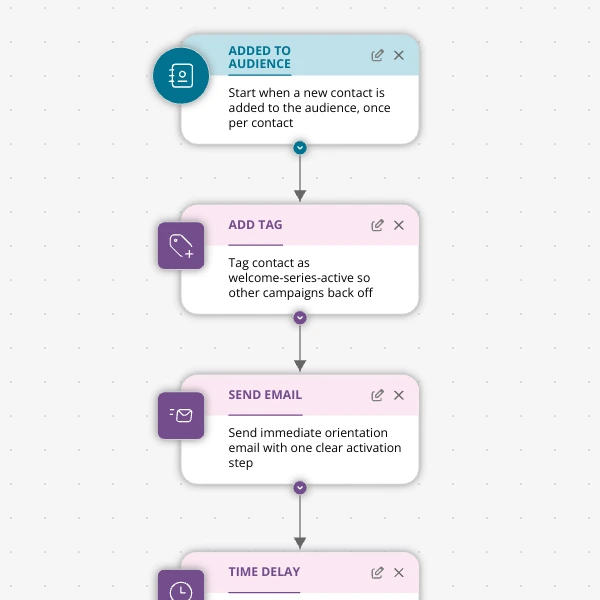
The Shopify app welcome series that turns installs into income
A step-by-step Shopify app welcome email journey for tools like CartSpark, showing how to turn new installs into activated, retained merchants using Spreeflo journeys, tags, and behavioral triggers so fewer trials quietly churn and more trials convert.
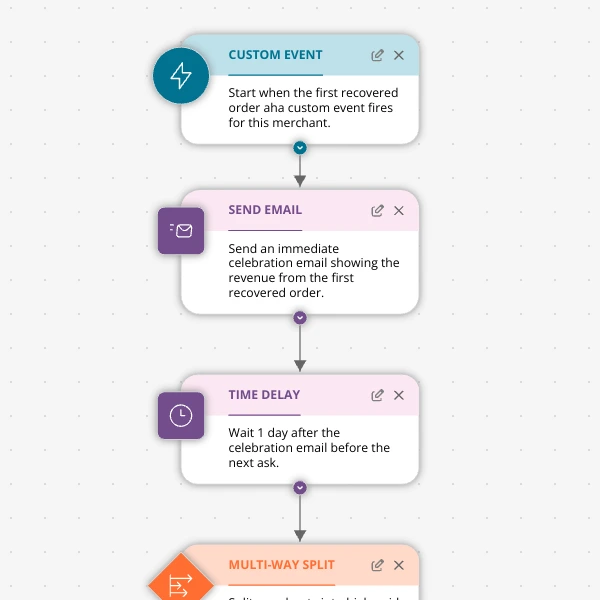
The Aha-Moment Playbook For Shopify Apps: Turn One Magic Action Into Months Of Revenue
A node-by-node playbook for Shopify and e‑commerce apps to center their lifecycle on one aha-moment custom event in Spreeflo, celebrate it, segment merchants by profile and engagement, and turn first recovered value into lasting revenue and retention.
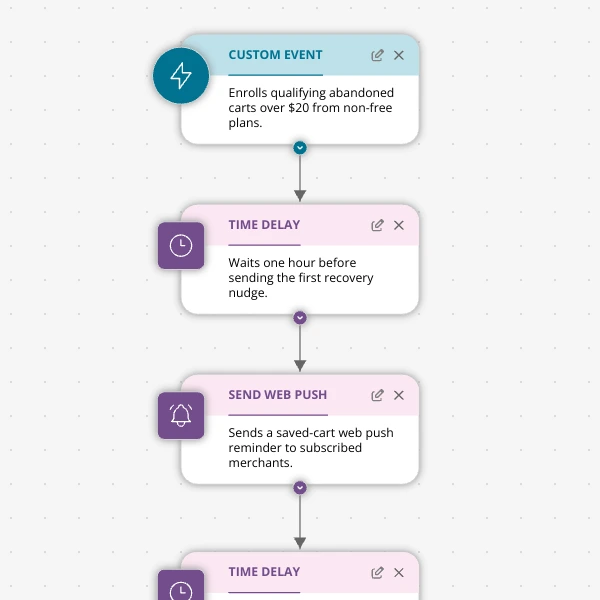
Stop Letting High‑Intent Carts Die: A 3‑Email Recovery Journey for Shopify Apps
A detailed, node-by-node walkthrough of a three-email (plus optional web push) cart-abandonment recovery journey for Shopify apps in Spreeflo, showing how to trigger events, branch on behavior, tag outcomes, and measure recovered carts and revenue.
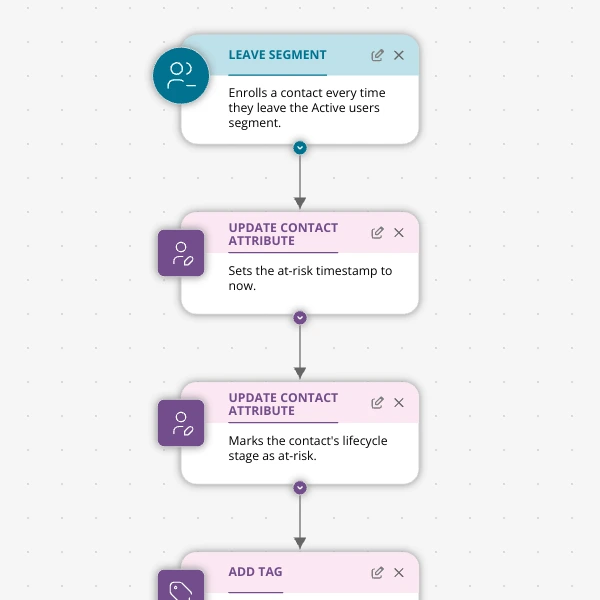
When Active Users Go Dark: A 4‑Touch Win‑Back Journey For Your Shopify App
A detailed, node-by-node Spreeflo journey for winning back previously active Shopify app users who stop engaging, using segment-based triggers, conditional logic, and a four-touch email plus internal alert sequence to recover usage and MRR.