Win Back Quiet SEO Customers Before They Churn For Good
Design an inactivity-based win-back journey in Spreeflo for SEO SaaS customers, using behavior-triggered segments, multi-touch email, and human follow-up to reactivate at-risk accounts, recover MRR, and reduce quiet churn.
Industry
Niche
Pattern
Loading sequence...
Your worst churn isn't when someone hits “cancel,” it’s when they quietly stop logging in and forget you exist.
For an SEO SaaS like RankPulse or BrieflySEO, that’s where MRR quietly dies: agencies finish a project, in‑house marketers get pulled into other priorities, and three months later you realize a whole cohort slid from “power user” to “credit card on file, zero activity.” The sequence at the top of this page is the whole journey, end to end, for catching those users the moment they slip and pulling them back before they’re gone.
Imagine BrieflySEO at ~$60k MRR: strong sign‑ups, solid trial‑to‑paid, but early‑month churn is stubbornly at 7–8%. Most cancels are predictable in hindsight: people stopped generating briefs, stopped checking rankings, then quietly stopped paying. This playbook is built for that exact gap.
Let’s walk through how to design an “inactive customer win‑back” journey in Spreeflo that’s opinionated enough to work out of the box, but flexible enough to fit whatever you sell: rank tracking, content briefs, audits, or full SEO suites.
Start by defining “Active Users” like a grown‑up product team
The primary trigger for this pattern is Leave Segment (Active users). That means your first job is to define a real “Active users” segment, not just “anyone with a subscription.”
In Spreeflo, that segment lives in the segment builder. For an SEO SaaS, you want it driven by meaningful product events, not logins alone.
For example:
Custom event
checked_rankingstriggered at least 1 time in the last 14 daysOR custom event
generated_content_brieftriggered at least 1 time in the last 14 daysOR custom event
ran_site_audittriggered at least 1 time in the last 30 days
Each of those events is tracked either from your frontend via the Spreeflo SDK (Spreeflo.track('checked_rankings', …) in your app) or from your backend via the Spreeflo API when an action completes server‑side.
That “Active users” segment becomes your source of truth. Anyone who leaves it has effectively gone dark.
This is where most teams quietly leak lifetime value. They assume “still paying = still safe.” In reality, disengagement precedes cancellation. The win‑back journey exists to catch that state change and respond with intent.
What this win‑back flow is trying to do
Before we go node by node, zoom out:
It listens for “was active, now not” and enrolls the contact instantly.
It flags them as at‑risk so you can see the problem cohort clearly.
It escalates high‑value accounts to a human.
It runs a four‑touch email sequence over a few weeks:
Touch 1: gentle nudge and value reminder.
Touch 2: product‑led “here’s what you’re missing.”
Touch 3: offer or concession that lowers friction to coming back.
Touch 4: respectful check‑in and expectation reset.
Done well, this gives you three key metrics:
Reactivation rate: % of inactive users who become active again during the flow.
Recovered MRR: MRR attributable to reactivated accounts that otherwise would have churned.
Time‑to‑reactivate: how long people typically sit inactive before coming back.
Now let’s map that story to the actual nodes in Spreeflo.
1. Trigger: Leave Segment (Active users)
The journey starts with a Leave Segment trigger:
Segment: your “Active users” segment defined earlier.
Re‑enrollment: turn this on.
Why re‑enrollment on? Because customers can fall in and out of healthy usage multiple times a year. You don’t want to run this once for the life of the contact and then stay silent if they go dark six months later. The journey‑level mid‑journey lock still keeps them from getting double‑enrolled if they bounce in and out rapidly.
Configuration‑wise, you create the segment under Audiences → Segments, then wire it into the trigger in the campaign and journey automation UI.
The second they no longer meet your “Active users” rules, the trigger fires and they enter the win‑back.
2. Mark them at‑risk the moment they slip
First, you want your CRM view to tell you “this user is a churn risk” at a glance. Two quick action nodes handle that.
Add Tag — Tag:
at-risk(orinactive-formerly-active). This lets you filter your audience or build other journeys off the same state later.Update Contact Attribute — Attribute: a custom text attribute like
lifecycle_stage. New value:"at_risk_inactive".
Because the Update Contact Attribute node writes a static literal, you set that string once at design time and every inactive user gets the same marker. Downstream, you can segment on lifecycle_stage is at_risk_inactive for reporting.
This is part of Spreeflo’s core idea: capture detail on every customer so you can speak to each uniquely. An “at‑risk inactive” former power user deserves different messaging than a net‑new trial who never set up a project.
3. Split high‑value accounts for human follow‑up
Next comes a Multi‑way Split to separate high‑value accounts from everyone else.
Example condition for the “High value” branch:
Contact attribute
plan_type is AgencyOR
Contact attribute
monthly_mrr greater than 200
Everyone else falls into the default “Else” branch.
On the “High value” branch:
Add a Send Internal Email node
Recipient: founder, success inbox, or whoever owns key accounts.
Content: include the contact’s company, plan, and last key action so a human can send a truly personal note or reach out on LinkedIn.
On the “Else” branch, you skip the internal email.
Both branches then feed into a Merge node so the rest of the flow is shared. This pattern hits the “email + internal” channel mix: automation does the bulk of the work, but your biggest customers still get a human touch.
4. Touch #1: soft nudge back to the “aha”
From the Merge, everyone goes into Send Email #1.
You create this in Spreeflo’s email builder as a saved marketing template, then pick it in the node.
The goal of this email:
Remind them of the outcome your product delivers, not just the feature list.
Give them a single, clear call‑to‑action back into the app.
For an SEO rank tracker, that might be:
A quick snapshot of “keywords that moved since you last checked.”
A deep link to their ranking dashboard.
For a content brief tool, it might be:
“You have 3 content opportunities queued based on your target keywords.”
One big button: “Review your briefs.”
Because Spreeflo can personalize with contact attributes and behavior, you can inject plan, company, or key use case into the copy using AI variables from the AI personalization help doc. A former power user at a 20‑person agency should see different language than a solo consultant.
Set “Send only once” on this node so a contact never gets duplicate copies even if they re‑enter the journey months later.
5. Delay, then check if they fixed it themselves
After Email #1, insert a Time Delay of 3 days.
That keeps you from hammering someone who just got busy for a couple of days. It also gives them time to act on the first email.
Then add an If/Else process node with this condition:
Contact is member of segment
Active users.
In other words: “did they become active again after that first nudge?”
Two branches:
Then (they’re active again) — Add Tag
reactivated_winback. Optionally send another internal email for high‑value accounts: “Good news, this at‑risk customer is back in the product.” End the journey for them. No more win‑back emails.Else (still inactive) — They continue on to Touch #2.
This pattern—delay, then check for self‑serve recovery—keeps the journey respectful. You’re not dragging active users through a “we miss you” gauntlet when they already came back.
6. Touch #2: show what they’re missing, not what you do
On the “still inactive” path, add Send Email #2, then a Time Delay of 5 days.
Email #2 shifts from gentle reminder to a more concrete “here’s what you’re missing” angle:
For ranks: show “keywords losing ground you might want to rescue” or “competitors that started outranking you last month.”
For briefs: highlight “topics your competitors are covering that you haven’t briefed yet.”
For audits: surface “critical technical issues we’ll keep monitoring for you.”
You’re still not discounting yet. You’re reframing the tool as an always‑on SEO analyst that’s still working behind the scenes. The CTA is again a single, focused path back into the app.
After the 5‑day delay, repeat the If/Else on “member of Active users”:
If yes: tag as
reactivated_winback, then exit.If no: move on to Touch #3.
7. Touch #3: lower the friction with a targeted offer
On the persistent‑inactive path, add Send Email #3, then a Time Delay of 7 days.
This email is where you introduce an offer. Because your audience is B2B, discounting isn’t the only move:
Extend their current billing period by a month if they come back and set up X projects.
Offer a 1:1 onboarding or SEO strategy call for agency plans.
Increase their keyword or project limits temporarily so they can test more use cases.
The important thing is that the offer is anchored to engagement, not just price. You want to reward users who come back and use the product, not train everyone to wait for discounts.
Again, one focused CTA: “Book your onboarding call” or “Reactivate your projects.”
After the 7‑day delay, run the same If/Else check on Active users:
If they’re back, tag and exit.
If they’re still inactive, they go to the final touch.
8. Touch #4: respectful check‑in and expectation reset
The last step on the “still inactive” branch is Send Email #4.
This isn’t a “beg for attention” email. It’s a reset:
Acknowledge that your product might not be a fit right now.
Give them options:
Make the unsubscribe link obvious. If they don’t want to hear from you, that’s important data.
Pause their account if that’s part of your billing model.
Downgrade to a cheaper plan.
Adjust email frequency so they only get major updates.
After Email #4, add a couple of clean‑up actions:
Add Tag
disengaged_after_winbackso you can exclude them from future broad campaigns or run separate research projects.Optionally, set a
last_winback_cycle_attimestamp attribute via Update Contact Attribute with “Set to now” to help you avoid hammering the same contact too often.
You do not forcibly flip their email subscription to unsubscribed here—that’s their choice. But you are clearly signalling “we’ll back off unless you tell us otherwise.”
Measuring reactivation, recovered MRR, and time‑to‑reactivate
Once this journey has been running for a few weeks, pull three simple reports.
Reactivation rate Build a segment of contacts who entered the win‑back journey and later rejoined the
Active userssegment within, say, 45 days. Divide by the total number of contacts who entered the journey in that period. That’s your win‑back reactivation rate.Recovered MRR For the same segment, sum their current monthly MRR. Compare that to a baseline cohort of similar users before you ran win‑back. Every month of extra retention from those users is recovered revenue that would have quietly slipped away.
Time‑to‑reactivate Add a
reactivated_winback_attimestamp when you tag them as reactivated. The difference between that and theleft_active_segment_attimestamp (you can add this as another attribute at journey start) gives you a per‑contact time‑to‑reactivate. Median days tells you how quickly this flow does its job.
This is where founder‑led businesses win: you build this once in the visual journey builder, let it run, and your MRR graph quietly bends in the right direction without a weekly “who should we email?” ritual.
Adapting the pattern to your SEO SaaS
A few practical variations to make this yours:
Change the Active users definition. If your “aha” is connecting Google Search Console and setting up alerts, make that the core event. Your win‑back success criteria should mirror what you know predicts long‑term retention.
Segment by use case. Add another Multi‑way Split early in the journey to route “rank tracking‑only” customers vs “content” vs “technical.” Each path can use different examples and screenshots in the same four‑email skeleton.
Tighten or relax the delays. If your product is daily‑use (e.g., SERP volatility monitors), shorter delays between touches might be appropriate. If you’re more monthly‑cadence (deep technical audits), keep them longer.
Experiment with subject lines and offers. Use small Random Split tests inside individual emails to compare a pure value reminder vs a deadline‑anchored offer. Spreeflo makes it straightforward to A/B these with Random Split nodes and saved templates.
As you iterate, remember the underlying principle: most SaaS businesses lose lifetime value not on the signup page, but in the quiet middle, when once‑engaged customers stop hearing from you in a way that feels relevant.
This journey plugs that hole by tying your outreach directly to behavior, and by treating a lapsed BrieflySEO power user differently from a RankPulse freeloader who never added a keyword.
The quiet compounding of a good win‑back
If you looked at your billing system today and filtered for “hasn’t logged in for 30 days but is still paying,” how many rows would you see? For most SEO SaaS founders in the $10k–$150k MRR range, the answer is “more than I’m comfortable with.”
The inactive‑customer win‑back flow you’ve just walked through is how you stop that from being an accident.
You:
Capture richer detail about every customer—their plan, behavior, and lifecycle stage—so your messaging fits where they actually are.
Treat disengagement as a concrete state change you can react to, not a vague feeling six months later.
Use automation and a handful of smart emails to do what a full customer‑success team would do by hand.
Set this up once in Spreeflo, let it run for a quarter, and watch how many “we were about to cancel but gave it another shot” accounts quietly show up in your reactivated cohort. That’s recovered MRR you no longer have to chase with more acquisition—and for a founder juggling product, support, and growth, that’s the kind of compounding that matters.
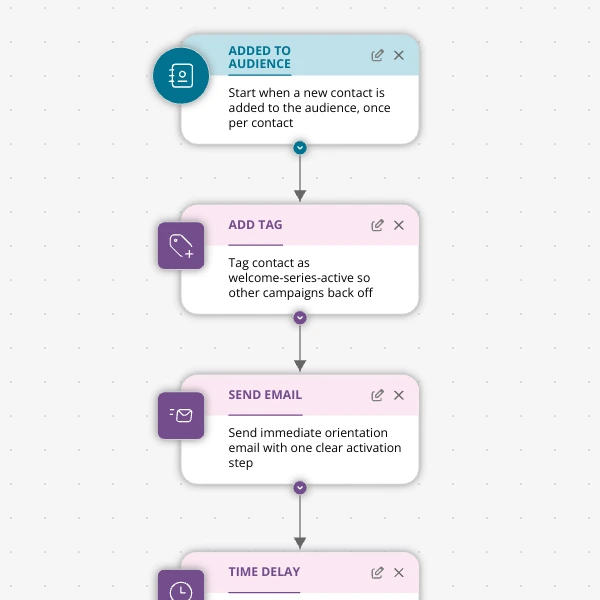
The Shopify app welcome series that turns installs into income
A step-by-step Shopify app welcome email journey for tools like CartSpark, showing how to turn new installs into activated, retained merchants using Spreeflo journeys, tags, and behavioral triggers so fewer trials quietly churn and more trials convert.
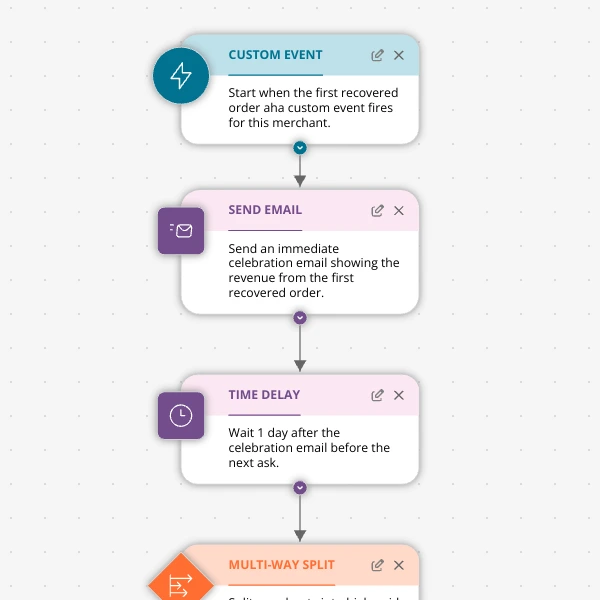
The Aha-Moment Playbook For Shopify Apps: Turn One Magic Action Into Months Of Revenue
A node-by-node playbook for Shopify and e‑commerce apps to center their lifecycle on one aha-moment custom event in Spreeflo, celebrate it, segment merchants by profile and engagement, and turn first recovered value into lasting revenue and retention.
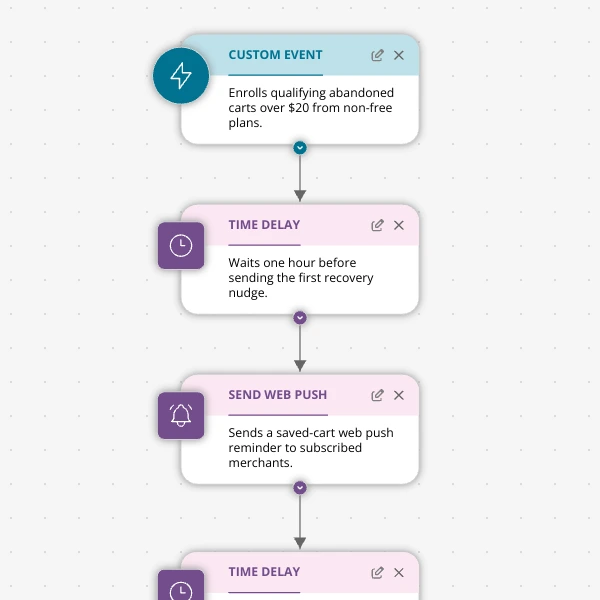
Stop Letting High‑Intent Carts Die: A 3‑Email Recovery Journey for Shopify Apps
A detailed, node-by-node walkthrough of a three-email (plus optional web push) cart-abandonment recovery journey for Shopify apps in Spreeflo, showing how to trigger events, branch on behavior, tag outcomes, and measure recovered carts and revenue.
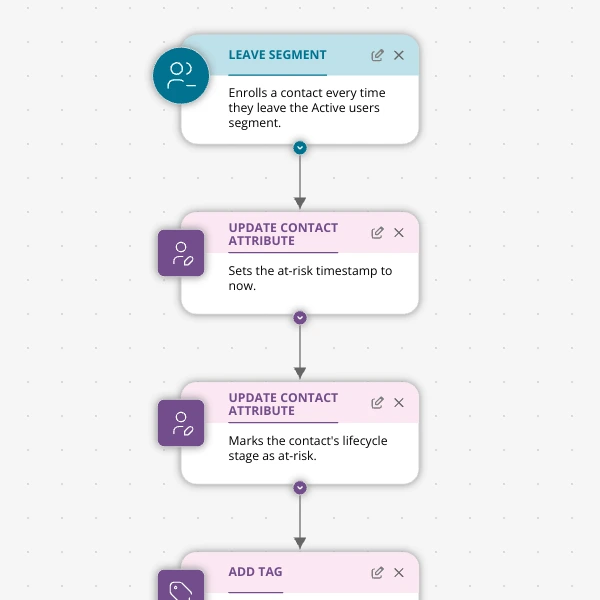
When Active Users Go Dark: A 4‑Touch Win‑Back Journey For Your Shopify App
A detailed, node-by-node Spreeflo journey for winning back previously active Shopify app users who stop engaging, using segment-based triggers, conditional logic, and a four-touch email plus internal alert sequence to recover usage and MRR.