Guides
•23 min read
Email Subject Lines: 150+ Examples Sorted by the Job They Do
152 original email subject lines for welcome, onboarding, sale, newsletter, win-back and follow-up emails, each with a character count and why it works.

By Cyril Nie, founder of Spreeflo · Sources checked on 27 October 2026
Published · Updated
A founder with no audience can't wait a year for SEO. A founder with a working blog shouldn't be cold-emailing all day either.
Inbound marketing attracts people who are already looking, through content, search, referrals and sign-up forms, so they come to you. Outbound marketing goes to people who haven't asked, through cold email, cold calls, ads and events. Outbound gets results faster; inbound gets cheaper over time. Most small teams need a little of both, usually outbound first.
The difference is who starts the conversation. Inbound means the buyer starts it: they find your article, join your list or book a demo, and your job is to be findable, useful and quick to follow up. Outbound means you start it: you pick who to reach and contact them first.
| Inbound | Outbound | |
|---|---|---|
| Who starts the conversation | The buyer | You |
| Typical channels | Search, blog posts, guides and templates, newsletters, referrals, communities, sign-up forms | Cold email, cold calls, LinkedIn outreach, paid ads, trade shows, direct mail |
| Who you reach | People already looking for a solution | People you chose, who may not be looking yet |
| Time to first result | Months for search and content | Days to weeks |
| What it costs | Mostly time up front; each extra lead gets cheaper | Time or money for every lead, roughly the same each month |
| What it needs to run | Content, a sign-up form, a follow-up system | A target list, good copy, a sending setup, persistence |
| What breaks it | Slow follow-up, nothing to convert visitors into subscribers | Poor targeting, spam complaints, burnout |
Paid ads sit in between: search ads reach people who are looking, so they behave like inbound; display and social ads behave like outbound.
Speed: outbound wins. Send your first 50 cold emails this afternoon and have replies by Friday. In our experience, a new blog post takes months to rank.
Cost over time: inbound wins. A good guide keeps bringing in sign-ups for years; outbound costs about the same for every lead, every month. The often-quoted data is old and from an inbound software vendor: in HubSpot's 2012 State of Inbound Marketing survey of 972 business professionals, companies spending more than half their lead-generation budget on inbound reported an average cost per lead of $135, against $346 for outbound-heavy spenders (MarketingProfs). Treat it as a direction, not a 2026 benchmark.
Effort: different kinds. Outbound is a daily habit of list-building, writing and follow-ups; inbound is a burst up front, then upkeep that's easier to batch.
Control: outbound wins. Inbound brings whoever finds you, so it needs qualification where outbound needs targeting.
Risk: both have one. Inbound risks months of content that might not rank; outbound risks your reputation. Gmail asks senders to keep their reported spam rate below 0.1% and to stop it from reaching 0.3% (Google), and cold email is where complaints come from, so send it from a separate domain.
Start with outbound when:
You have no audience yet. Inbound has nothing to amplify.
You need to talk to customers now. In our experience, twenty calls from cold outreach teach you more than 2,000 page views.
Your buyers are few and easy to name, say 500 companies you could list in a spreadsheet.
Your deal size can pay for the effort: a $10,000 contract absorbs outbound's time per lead far more easily than a $10-a-month plan.
Nobody searches for what you sell yet.
Outbound has rules. In the US, CAN-SPAM covers business-to-business email: accurate headers, an honest subject line, your physical postal address and a working opt-out, honored within 10 business days (FTC). In the UK, corporate bodies can be emailed without prior consent, but sole traders and some partnerships need consent unless they're existing customers who didn't opt out (ICO). Check other countries' rules before you send.
Lean into inbound when:
People already search for the problem you solve. Someone will capture that demand.
Your price is low and your market is wide. A $20-a-month product can't absorb a researched cold email per lead.
Buyers want to try before they talk, via free plans and trials.
You're in it for the long run. This month's guide still works next year; this month's cold emails don't.
The trap is building traffic and nothing after it: visitors who never subscribe, and subscribers who never hear from you.
With inbound vs outbound leads in sales, the question is who reached out first: the buyer (a demo form, a newsletter reply, a trial help request) or your team.
| Inbound sales | Outbound sales | |
|---|---|---|
| First contact | The buyer asks for a demo, quote or call | Your team reaches out |
| What matters most | Speed of response and good qualification | Targeting, research and persistence |
| Typical first step | Reply, qualify, book a call | Sequence of 3 to 5 touches until a reply |
| Typical roles in bigger teams | Inbound reps, or account executives taking demo requests | SDRs or BDRs doing prospecting |
| What a founder-led team does | The founder answers every demo request fast | The founder sets aside fixed hours for outreach |
Either way, a lead that agrees to a real conversation becomes a deal in the same sales pipeline; MQL vs SQL covers when an inbound lead is ready for one.
The inputs below are made up to show the math, not benchmarks; swap in your own. A two-person B2B SaaS sells a $100-a-month plan. The founder has about 6 hours a week for growth.
Months 1 to 3: outbound first. The founder spends 4 hours a week sending 25 researched cold emails a week, about 100 a month. Say 5% reply positively and half of those take a call:
100 emails × 5% = 5 positive replies a month
5 replies × 50% = 2.5 calls a month
If 1 in 5 calls becomes a customer, that's 0.5 customers a month, or about 1.5 customers by month 3
That's slow, but the calls teach the founder what buyers ask, which objections come up and what words they use.
Months 2 to 6: inbound built from what outbound taught. The other 2 hours a week go into one guide a month, written around the questions from those calls, with a sign-up form offering a template. Say the guides bring 1,000 visitors a month by month 6 and 3% sign up:
1,000 visitors × 3% = 30 new subscribers a month
If a welcome series turns 5% of subscribers into trials, that's 1.5 trials a month
If 1 in 3 trials converts, about 0.5 customers a month, from content that keeps working without new hours
Month 6 onwards: shift the hours. Outbound produces about the same for the same 4 hours, while inbound grows as more guides rank. Then move an hour or two to inbound, keeping outbound for larger accounts worth a personal approach.
Inbound and outbound share one weak point: the handoff. A cold reply or a guide download comes in, then nothing happens for four days because the founder is busy. Here's the fix in Spreeflo, with the plan each part needs.
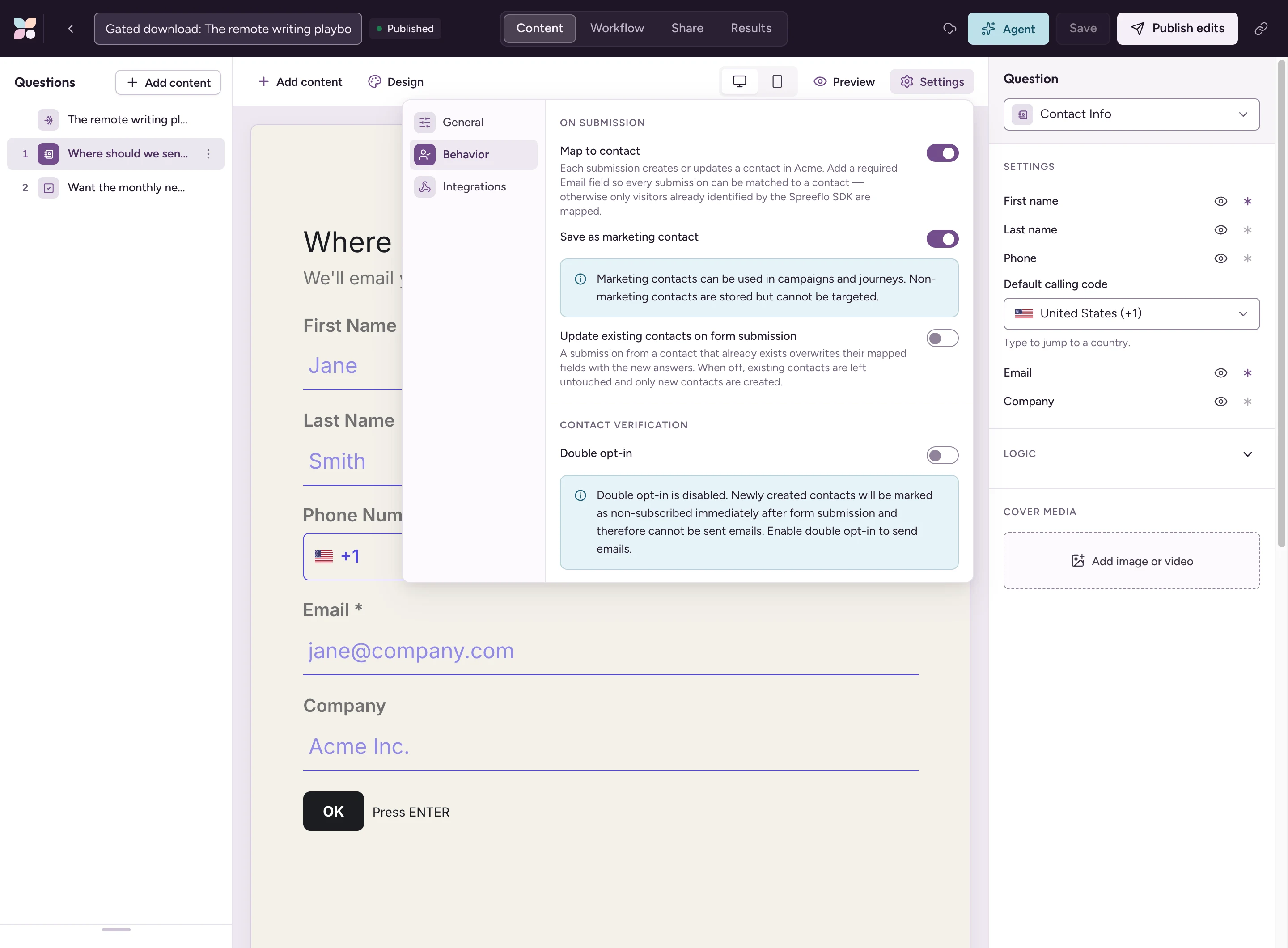
1. A form that captures more than an email (Free). Ask for an email plus one question, such as role or company size, and use Map to contacts and Map to attribute so the answer lands on the contact. Embed it under each guide. Forms have unlimited responses on the free plan; a popup on exit intent or after a scroll is on Professional.
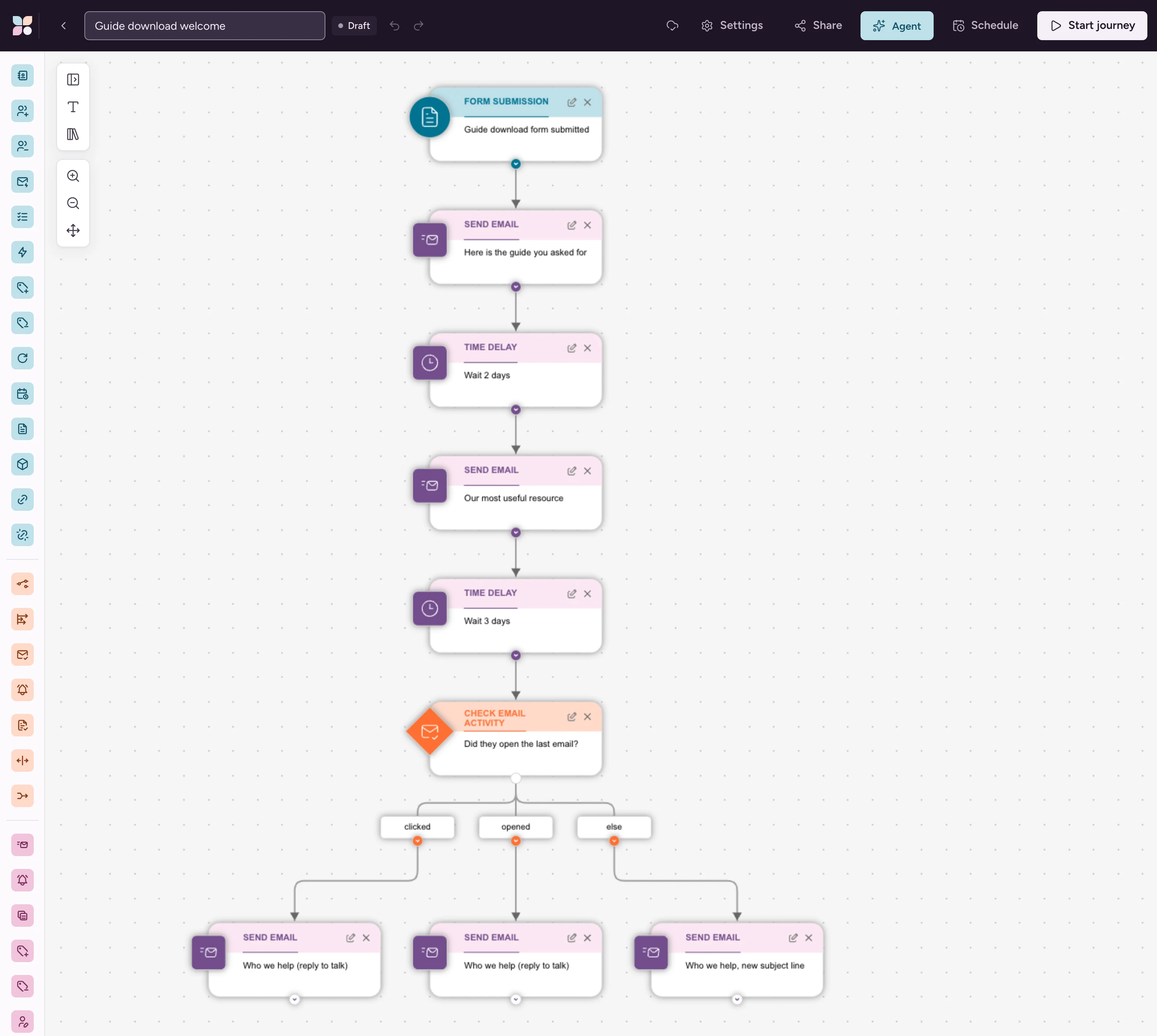
2. A welcome journey that starts on submit (Starter). A Form Submission trigger starts three emails: what they asked for, your most useful resource, then who you help, with a reply prompt. A Time Delay after the second email, then Check Email Activity, sends non-openers a different subject line. Our email marketing automation guide has it node by node.
3. Lead scoring that tells you who's ready (Starter). Lead scoring gives every contact a Fit score (who they are) and an Intent score (what they've done) from rules you set, such as "company_size is 11-50: +30" or "clicked any email at least 2 times in the last 14 days: +20". Points on time-windowed rules fall away as activity ages. Rules on website visits, like "visited the pricing page", score on Professional.
4. A hand-off you can't forget (Starter). A second journey starts with Join Segment on "Intent score is greater than 74". Update Contact Attribute sets the Lifecycle stage to MQL, Assign owner gives the lead to you, and Create task puts "Call {{ contact.first_name }}" in My queue, due in one business day.
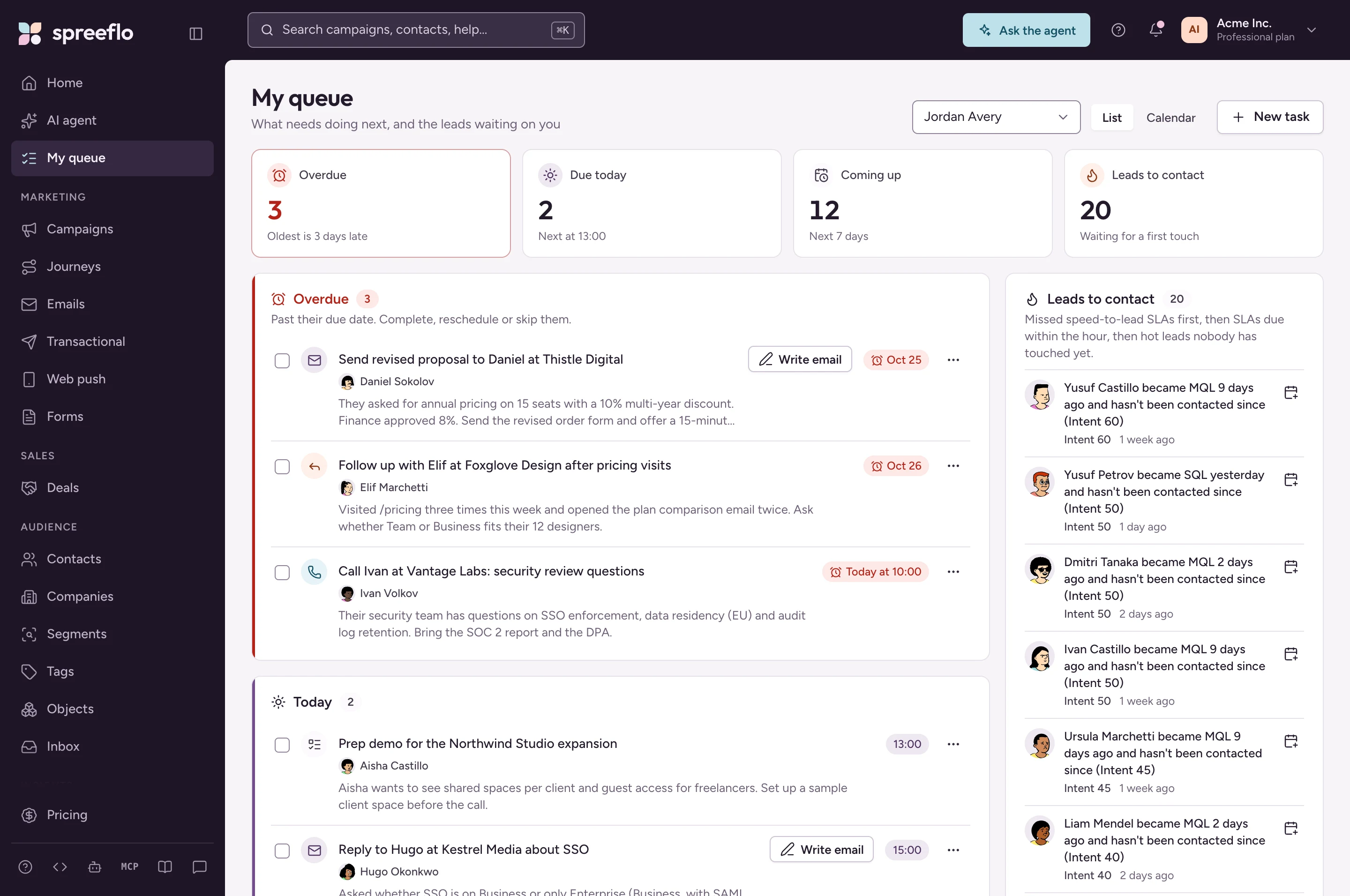
5. Outbound replies land in the same place (Starter). Add a cold prospect who agrees to talk as a contact: the same pipeline, tasks and Convert step apply, and you can email them 1:1 from the Spreeflo inbox.
Budget an hour each for the form, the emails, and scoring plus the hand-off. After that it runs without you.
See it in Spreeflo: the CRM, forms and journeys share one contact record, so the person who downloaded your guide on Monday is the record you call on Wednesday. Click around a live workspace in the tour →
Spreeflo puts forms, welcome journeys, lead scoring and a CRM on one contact record. Start with forms on the free plan, then add journeys and the CRM on Starter from $16 a month.
Start free, no card → · Take the live tour
It depends on who asked first. Email to people who opted in, such as newsletters and welcome series, is inbound: they gave you permission. Cold email to people who never signed up is outbound. The rules, tools and metrics differ, so run them separately, on different sending domains.
Inbound: a blog post or guide people find through search, a downloadable template, a newsletter sign-up form, referrals and community posts. Outbound: cold email, cold calling, LinkedIn outreach, display and social ads shown to people who weren't searching, trade show booths, direct mail and sponsorships.
Yes, wherever people search for the problem you solve. A good guide written once can keep bringing in sign-ups for years. It isn't fast, though: in our experience a new blog post takes months to rank, so run some outbound while your inbound builds.
Email marketing for small business: the five automations to set up first
MQL vs SQL: the difference, the handoff, and how to automate it
Email marketing automation: how it works, with 6 journeys to copy
Sales follow-up emails that get replies: 25 templates for leads, demos and quotes
Customer journey map template: a free template, filled in for a SaaS
MarketingProfs: Inbound marketing leads cost 61% less than outbound (reporting HubSpot's 2012 State of Inbound Marketing survey), read 27 October 2026
Google: Email sender guidelines FAQ, read 27 October 2026
FTC: CAN-SPAM Act compliance guide for business, read 27 October 2026
ICO: Electronic mail marketing, read 27 October 2026
Discover more insights on similar topics
152 original email subject lines for welcome, onboarding, sale, newsletter, win-back and follow-up emails, each with a character count and why it works.
80 business email subject lines for introductions, meetings, proposals, invoices, follow-ups and updates, each with a character count and the situation it fits.
60 original sales email subject lines for inbound deals, sorted by stage: demo requests, trials, proposals and renewals, each with its character count.