Guides
•23 min read
Email Subject Lines: 150+ Examples Sorted by the Job They Do
152 original email subject lines for welcome, onboarding, sale, newsletter, win-back and follow-up emails, each with a character count and why it works.

By Cyril Nie, founder of Spreeflo · Updated 27 October 2026
Published · Updated
Marketing says it sent plenty of good leads. Sales says none of them were ready. Both are usually right.
An MQL (marketing qualified lead) is a lead marketing judges ready for sales, based on who they are and how engaged they've been. An SQL (sales qualified lead) is a lead someone in sales has spoken to, checked for a real need, budget and timeline, and accepted as worth pursuing. The MQL is a prediction; the SQL is a confirmation.
The difference is who decides and on what evidence. Marketing calls an MQL from fit and engagement data; sales calls an SQL after a conversation confirms they could buy.
| MQL | SQL | |
|---|---|---|
| Stands for | Marketing qualified lead | Sales qualified lead |
| Who decides | Marketing, usually by a score or rule | Sales, after talking to the lead |
| Based on | Fit plus engagement data | A conversation: need, budget, authority, timing |
| What it predicts | This person is worth a salesperson's time | This person could buy, soon |
| Typical next action | Hand to sales; book a first call | Open a deal; demo or proposal |
| Common mistake | Threshold too low, so sales ignores MQLs | Accepted without a next step, so it stalls |
Both are lifecycle stages, describing a person rather than a single sale. The usual order is Subscriber, Lead, MQL, SQL, Opportunity, Customer. Once an SQL has a live deal, it becomes an opportunity and enters your sales pipeline.
A lead becomes an MQL when it's both a good fit and engaged enough to be worth a salesperson's time. A score with a threshold makes that call consistently.
Fit answers "could this person buy from us?": a role like founder or head of marketing (not a student), a company size you sell to, a country you can serve, a work email rather than free mail, and not a competitor.
Engagement (some tools call it intent) answers "are they interested right now?": pricing-page visits (especially repeats), a demo, quote or trial request (often an instant MQL, or even straight to SQL), recent email clicks or replies, and bottom-of-funnel downloads like a comparison or buyer's guide. Engagement should fade, so score it over a rolling window, like the last 14 or 30 days.
Write the definition down and get sales to agree. "Fit score of 50 or more and engagement of 75 or more in the last 30 days" is an MQL definition; "seems keen" isn't.
An MQL becomes an SQL when someone in sales has made contact and confirmed a real need, the ability to buy and a reason to do it soon. BANT is a simple checklist for it:
Budget: can they afford it, or get the money?
Authority: are they the decision maker, or do they know who is?
Need: do they have the problem you solve?
Timeline: do they plan to act soon enough to matter?
You don't need all four: a founder with a clear need and a 30-day timeline is an SQL even before the budget conversation. What matters is that a person made the call, and that the SQL leaves with a next step: a demo, a proposal or a trial with a check-in date. Leads that don't qualify get a disqualified reason, or go back to nurture if timing was the only problem.
A PQL (product qualified lead) is a user who reached a meaningful moment in your product during a free plan or trial, like inviting a teammate or hitting a usage limit. It replaces or sits beside the MQL in self-serve businesses, because, in our experience, product behavior predicts buying better than email clicks do. Self-serve teams can skip MQL and SQL and track Trial, PQL, Customer. If you sell both ways, a PQL from a larger company is often the best SQL candidate you'll get.
In our experience it breaks in four places, and only one is about lead quality.
Nobody agreed the definition. Fix it with a written definition both sides signed, reviewed each quarter.
The lead waits. An MQL created on Friday gets its first call on Wednesday, after the person has cooled off or talked to someone else. Research reported in "The Short Life of Online Sales Leads" (Harvard Business Review, 2011) found that firms that tried to contact a lead within an hour were nearly seven times as likely to qualify it as firms that tried even an hour later.
No owner. "Sales" isn't a person. Without a named owner and a task, everyone assumes someone else has it.
No feedback loop. Sales rejects leads without saying why, so marketing keeps sending the same kind. A rejection reason on every disqualified lead fixes this within a quarter.
There's no universal number, because teams define MQL differently. The agency Visionary Marketing's April 2026 funnel benchmarks tracked 28,400 B2B leads across 47 of its own client accounts in 14 industries and reported a median MQL-to-SQL rate of 13.7%, with the top quartile at 28.4% and the bottom quartile at 5.2%. It's one agency's client base, skewed (it says) toward mid-market and growth-stage B2B, so treat it as a rough reference. Your own trend matters more. A falling rate usually means your MQL threshold is too loose or your follow-up got slower. A rate near 100% usually means it's too strict and you're starving sales.
Track one conversion rate and one speed number per step:
| Stage change | Conversion rate to watch | Speed to watch |
|---|---|---|
| Lead to MQL | Share of new leads that reach MQL | Days from first touch to MQL |
| MQL to SQL | Share of MQLs that sales accepts | Time from MQL to first contact |
| SQL to opportunity | Share of SQLs that get a live deal | Days from SQL to deal created |
| Opportunity to customer | Win rate | Sales cycle length |
The numbers are illustrative, but the math is what you'd run on your own funnel. A B2B SaaS gets 1,200 new leads a quarter and sells a plan worth $6,000 a year.
| Stage | Rate | Before | After faster handoff |
|---|---|---|---|
| Leads | 1,200 | 1,200 | |
| MQLs | 10% of leads | 120 | 120 |
| SQLs | 25%, then 35% of MQLs | 30 | 42 |
| Opportunities | 50% of SQLs | 15 | 21 |
| Customers | 20% of opportunities | 3 | 4.2 |
| New annual revenue | $6,000 each | $18,000 | $25,200 |
Calling MQLs within an hour instead of within days lifts the MQL-to-SQL rate from 25% to 35%, and that alone turned one quarter's leads into $7,200 more new annual revenue, a 40% increase. That's why we think the handoff is often the cheapest place to find growth.
Here's how to run all this every day in Spreeflo, where the CRM sits on the same contact record as your emails, forms and web activity.
Step 1: set the MQL line with lead scoring. Lead scoring gives every contact two scores from 0 to 100: Fit (who they are) and Intent (what they've done). Each rule is a segment condition plus points, like "Country is one of the countries you sell to: +20" or "Opened any email at least 3 times in the last 30 days: +15", and time windows make intent points fall away by themselves. By default, 50 is Warm and 75 is Hot. Website-visit rules need Professional; on Starter they score 0, so Starter intent rules use email and form activity.
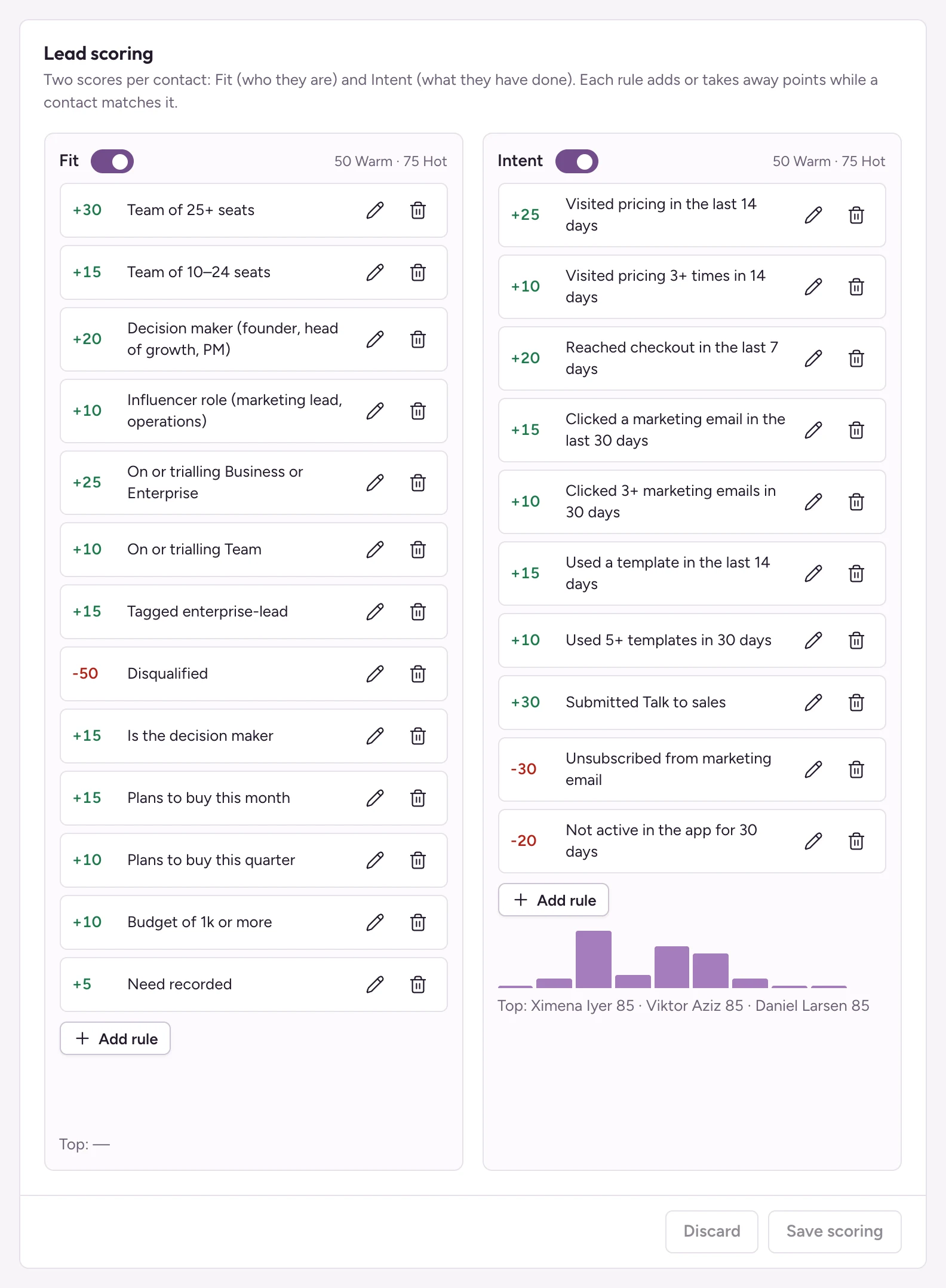
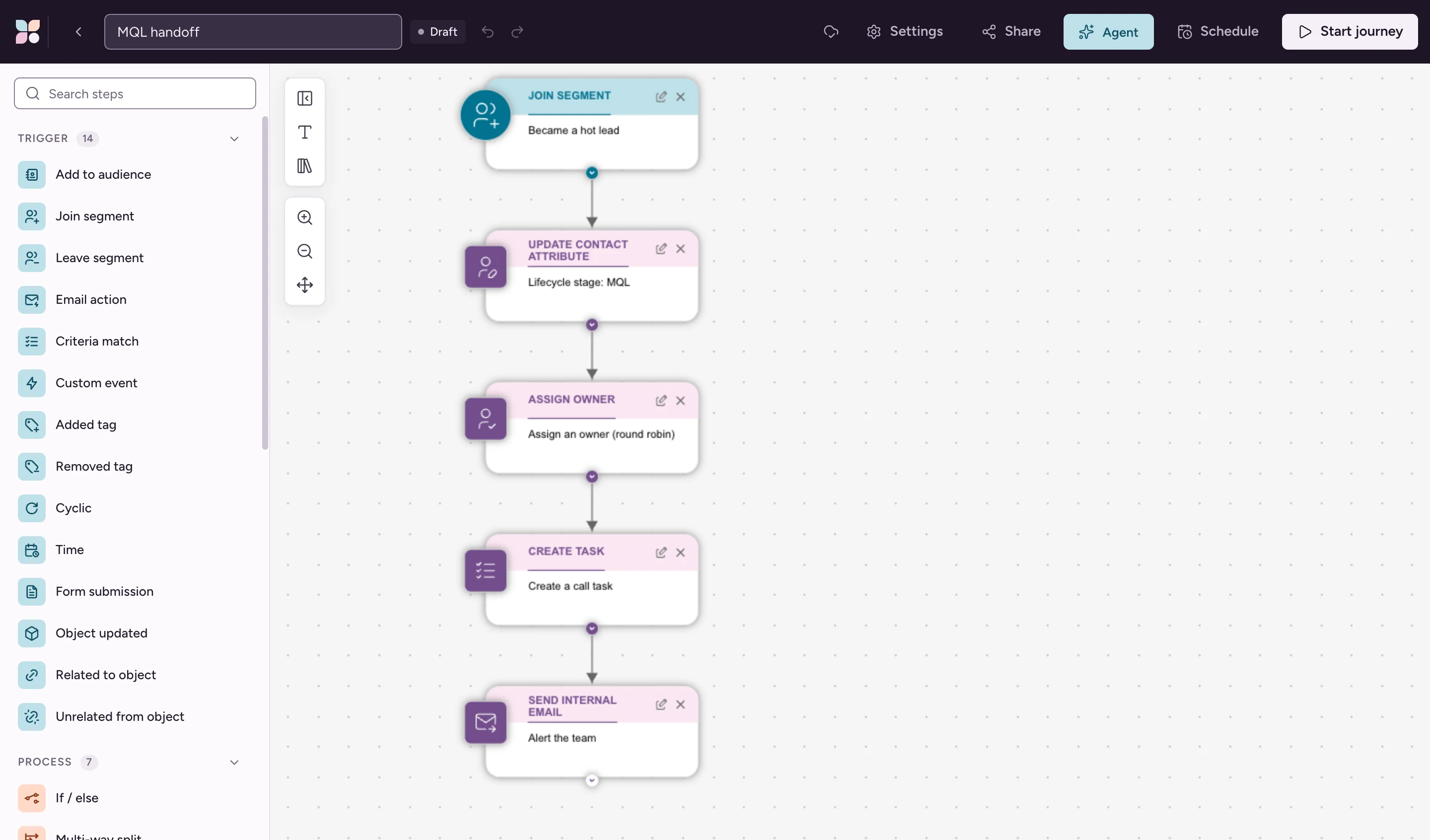
Step 2: promote to MQL with a journey. The lifecycle stage never changes on its own. A Join Segment trigger on a segment like "Lifecycle stage is Lead AND Fit score is greater than 49 AND Intent score is greater than 74", then Update Contact Attribute, sets the stage to MQL. The MQL handoff journey template (Settings, CRM, Journey templates) installs a draft to start from.
Step 3: give every MQL an owner and a task. Assign owner hands the lead to a specific member on Starter; on Professional it can also use round robin or company owner first. Create task then puts "Call {{ contact.first_name }}" in the owner's My queue, due within the hour.
Step 4: hold the handoff to a clock. On Professional, a speed-to-lead SLA sets "first touch within" a time per lifecycle stage, like one business hour for MQLs. A first touch is a 1:1 email from the Spreeflo inbox or a completed Call or Email task; miss it and the owner is notified, the lead jumps to the top of My queue, and the Speed-to-lead escalation template can reassign it.
Step 5: turn SQLs into deals. When the first call confirms the lead, Convert sets the stage, links the company, sets the owner and opens a deal in one step, with an optional "Send proposal" task. MQLs and SQLs with no activity for 30 days get an automatic follow-up task.
See it in Spreeflo: "Why these scores" on each contact lists every rule that matched and its points, so sales can see why a lead is an MQL. Click around a live CRM in the tour →
Spreeflo puts lead scoring, lifecycle stages, owners, tasks and deals on the same contact record as your email and forms. Starter is from $16 a month for one seller, CRM included; Professional, from $24, adds team routing, speed-to-lead SLAs and scoring on website activity.
Take the live tour → · See pricing
MQL is short for marketing qualified lead and SQL for sales qualified lead. Outside sales and marketing, SQL also stands for Structured Query Language, the standard programming language for working with relational databases (IBM), which is unrelated.
It depends on how strictly you define an MQL. One agency, Visionary Marketing, reported a median of 13.7% across 28,400 B2B leads from its own client accounts in 2026, with the top quartile at 28.4%. Track your own rate; a sudden drop usually means slower follow-up or a looser threshold.
Neither works alone. MQL volume shows whether marketing produces enough interest; SQL volume shows whether it's real. If you can only track one, track the MQL-to-SQL rate, because it shows both lead quality and how fast sales follows up.
HubSpot lead scoring: how it works, what it costs, and a simpler setup
Sales follow-up emails that get replies: 25 templates for leads, demos and quotes
Inbound vs outbound marketing: which one a small team should run first
Visionary Marketing: Demand Gen Funnel Benchmarks 2026, April 2026, the agency's own client data, February 2025 to February 2026 (28,400 leads, 47 accounts, 14 industries; MQL-to-SQL median 13.7%, top quartile 28.4%, bottom quartile 5.2%), read 27 October 2026
SmartCompany: "Are you letting online leads go cold?", 1 July 2011, quoting the authors' article "The Short Life of Online Sales Leads" (the seven-times finding), read 27 October 2026
BYU ScholarsArchive: "The Short Life of Online Sales Leads", Oldroyd, McElheran and Elkington, Harvard Business Review, 2011, read 27 October 2026
IBM: What is Structured Query Language (SQL)?, read 27 October 2026
Spreeflo pricing, read 27 October 2026
Discover more insights on similar topics
152 original email subject lines for welcome, onboarding, sale, newsletter, win-back and follow-up emails, each with a character count and why it works.
80 business email subject lines for introductions, meetings, proposals, invoices, follow-ups and updates, each with a character count and the situation it fits.
60 original sales email subject lines for inbound deals, sorted by stage: demo requests, trials, proposals and renewals, each with its character count.