Build a Weekly “What’s Stuck?” Digest So Your SEO SaaS Pipeline Stops Quietly Dying
Playbook for SEO SaaS founders to build a weekly “what’s stuck?” digest in Spreeflo that surfaces stalled trials and customers, routes internal emails, tags accounts, and tracks resolution so your pipeline stops silently decaying.
Industry
Niche
Pattern
Loading sequence...
Every SEO SaaS founder knows the feeling: Stripe looks fine, trials are rolling in, but a month later churn ticks up and a couple of “sure thing” agency deals have gone dark.
What killed them wasn’t a clear “no.” It was silence. A stuck trial that nobody noticed in time. A high‑intent buyer who stalled after a demo and never got nudged.
The sequence at the top of this page is the antidote: a simple, always‑on journey that sends you a weekly internal “what’s stuck?” digest so nothing high‑value sits idle for long.
In this playbook, we’ll build that journey end to end for an SEO SaaS product, then show you how to adapt it for your own stack and sales motion.
Why a “what’s stuck?” digest beats another dashboard
If you’re doing ~$30k–$150k MRR with a 3–5 person team, your constraint isn’t data. It’s attention.
You already have dashboards:
A CRM view of open deals
Trial lists in Stripe or Paddle
Product analytics for active vs inactive users
The problem is that nobody on a small team has the discipline to go run those reports at 9am every Monday, filter for “high value and stalled,” and then methodically follow up.
Dashboards are pull‑based. But your attention is already maxed.
The weekly “what’s stuck?” digest flips that around. It’s push‑based:
Once a week, Spreeflo scans your audience for trials, deals, and accounts that look stalled beyond your threshold.
It sends an internal email with everything you need to act: who’s stuck, why they’re stuck, and what to do next.
You or your sales/CS lead simply work that list down.
This is exactly where founder‑led businesses win on leverage, not headcount. You don’t hire a full‑time RevOps person to police the pipeline. You build one journey once, and it quietly protects your MRR every week.
Let’s set it up.
Step 1: Decide what “stuck” means for your SEO SaaS
Before you drag a single node onto the canvas, define the signals that actually matter for your product.
For a rank tracker (like our fictional “RankPulse”):
Trial started ≥ 10 days ago
Fewer than 2 projects created
Has not added any keywords
Has not set up email alerts
Visited
/pricingat least once in the last 7 daysHas not upgraded
For a content‑brief tool (like “BrieflySEO”):
Trial started ≥ 7 days ago
Generated fewer than 3 briefs
Has not connected Google Search Console
Has not invited any teammates
Has opened but never clicked your “how to get value” onboarding emails
Still on trial or low‑tier plan
You don’t have to use all of these, but you want a definition of “stuck” that:
Is based on behavior, not vibes
Clearly separates casual tourists from accounts worth saving
You can express using the data you already track
To feed that data into Spreeflo:
Client‑side product events (e.g.
added_first_keyword,generated_content_brief) should be tracked via the Spreeflo SDK. When a user clicks “Add keyword” in your React app, your frontend callsSpreeflo.track('added_first_keyword', {...})behind the scenes.Backend events (e.g.
started_trial,upgraded_plan,cancelled_subscription) should be sent via the Spreeflo API. Your server or billing webhook posts to the events endpoint withevent: 'started_trial', the user’s email, and relevant properties.
If you haven’t done this wiring yet, Spreeflo’s web tracking and analytics guide walks through adding the SDK and validating that events are coming in.
Once those events exist, you can define “stuck” once and reuse it everywhere.
Step 2: Build a “Stuck accounts” segment once, reuse it forever
Now you’ll capture your definition of “stuck” inside a reusable segment.
In your Spreeflo workspace:
Go to Audiences → Segments and create a new segment called “Stuck accounts”.
Use the segment builder to express your criteria. For a RankPulse‑style app, a clean starting point might be:
If you serve multiple customer types, nest logic:
Save the segment.
Custom event
started_trialtriggered at least 1 time over all timeAND custom event
upgraded_planhas not triggered over all timeAND custom event
added_first_keywordhas not triggered in the last 10 daysAND Email subscription status is Subscribed
A sub‑group for “Agencies”: tag contains
agencyAND generated fewer than 3 projects in last 14 daysA sub‑group for “In‑house teams”: tag contains
inhouseAND no teammates invited
Now you have a living slice of your audience: anyone who currently counts as “stuck” according to the behaviors that matter for your product.
You could already use this segment for ad‑hoc outreach. But the real power comes when you plug it into a journey that runs every week without you.
Step 3: Wire up the weekly Cyclic trigger
This pattern is a Journey, not a one‑off campaign. You want it to run forever, pulling in new stuck accounts as they appear.
If you’re new to the automation side of Spreeflo, the campaign and journey automation guide is a useful primer. The short version:
Campaigns send something once to a fixed list.
Journeys stay on, reacting to behavior or schedules over time.
Create a new Journey called “Weekly what’s stuck digest”.
The first node in the sequence at the top of this page is a Cyclic trigger. Configure it like this:
Repeat interval: every 1 week
Time of day: Monday 09:00 (or whatever matches your review rhythm)
Timezone: your team’s primary timezone
Criteria: use the Segment Membership filter in the embedded segment builder:
Re-enrollment: ON
Segment membership is member of segment “Stuck accounts”
What this does:
Every Monday at 9am, Spreeflo asks: “Who currently belongs to the ‘Stuck accounts’ segment?”
Every matching contact enters the journey and flows to the next node.
With re-enrollment on, the same contact can be processed again in future weeks, as long as they still match the criteria and aren’t already mid‑journey.
You’ve turned a saved segment into a weekly, proactive sweep of your pipeline.
Step 4: Compose the internal email that makes action easy
The next node in the sequence is Send Internal Email. This is where the digest becomes useful instead of noisy.
You’re not sending a generic “these 83 accounts are stuck” message. You’re sending one focused email per account, each with exactly the context a human needs to unblock them.
Inside the Send Internal Email node:
Set the recipient to your sales lead, CS lead, or a shared address like
pipeline@yourcompany.com.Use Spreeflo’s email builder to structure the message.
Practical content for each internal email:
Who this is:
Why they’re in the digest:
Last engagement:
Suggested next move:
Contact name and company
Plan / trial type
MRR potential (if you track it as an attribute)
Trial started on [date]
Has not added any keywords
Has not connected Google Search Console
Has visited
/pricing3 times in the last 7 days
Last login date or “inactive for X days”
Last email opened/clicked (if relevant)
“Send them this 3‑sentence follow‑up nudging them to add their first 20 keywords.”
“Invite them to a 15‑minute setup call; they’ve done the research but not the integration.”
Because Send Internal Email can reference contact attributes and activity, you can make these notifications very specific without writing them by hand.
This is where the leverage shows up: every Monday, your human brain is pointed directly at the 10–20 accounts where a short, thoughtful message might turn into $2k–$10k of LTV.
Step 5: Tag and wait so you can measure resolution
A digest you don’t measure quickly becomes noise.
The last part of the journey adds just enough structure to track “Did we actually unstick this account?” without building a full attribution model.
Right after the Send Internal Email node, add an Add Tag action:
Tag:
stuck_digest_surfaced
This marks that the account was surfaced in at least one weekly digest.
Next, add a Wait Condition node. Configure it to:
Condition: Segment membership is not member of segment “Stuck accounts”
Timeout: 14 days (or whatever feels like a fair window for your team to act and the user to respond)
What this means:
If the account exits the “Stuck accounts” segment (because they added keywords, connected GSC, upgraded, etc.) within 14 days, the wait releases early.
If nothing changes, the contact moves on after 14 days anyway.
After the Wait Condition, drop in an If/Else process:
Condition: Segment membership is not member of segment “Stuck accounts”
Two paths come out of this:
Resolved path (condition true):
Unresolved path (condition false):
Add Tag:
stuck_digest_resolvedOptionally, use Update Contact Attribute to set a timestamp attribute like
stuck_resolved_atto “now” so you can later compare it tostuck_flagged_atin your reporting stack.
Add Tag:
stuck_digest_unresolvedOptionally, Send Internal Email to escalate: “We flagged this account two weeks ago and it’s still stuck.”
Now you have:
A way to count how many accounts were ever surfaced by the digest (tag
stuck_digest_surfaced).A way to count how many of those moved forward within your chosen window (tag
stuck_digest_resolved).A handle for accounts that never budged (tag
stuck_digest_unresolved).
All without creating messy, overlapping journeys or manual spreadsheets.
Step 6: Variants for trials vs existing customers
The sequence at the top of this page shows a single main path, but you might want slightly different handling depending on who’s stuck.
Two common variations:
Branch by lifecycle stage
Branch by account potential
Insert a Multi‑way Split right after the Cyclic trigger with conditions like:
Branch “Trial”: plan attribute is Trial
Branch “Customer”: plan attribute is Paid
Else: ignore
Each branch can have its own Send Internal Email:
Trials → send to sales with a “convert them” lens
Customers → send to CS with a “save and expand them” lens
Both branches can then merge back into the shared tagging and Wait Condition flow.
If you track estimated LTV or company size, use an If/Else:
If
company_size≥ 50 orestimated_LTV≥ $2,000 → “High priority” branchElse → “Standard” branch
High‑priority accounts might:
Get escalated to the founder’s inbox
Have a shorter Wait Condition window and a more aggressive follow‑up playbook
Standard accounts follow the usual path.
These tweaks cost you minutes to add, but they keep your team’s time focused where it moves the revenue needle most.
Step 7: How to know if this journey is earning its keep
Two simple metrics tell you whether your weekly digest is working:
Stuck‑deal resolution rate
Time‑to‑unblock
Among all contacts with stuck_digest_surfaced, how many later:
Have the tag
stuck_digest_resolved, orTrigger an
upgraded_planevent, orHit your internal “activated” milestone (e.g. added 20+ keywords, generated 5+ briefs)?
You can build a segment like “Rescued by digest” that combines:
Tag contains
stuck_digest_surfacedAND custom event
upgraded_plantriggered at least 1 time afterstuck_flagged_at(if you track those timestamps)
Watching that segment grow month over month is a direct read on the journey’s impact.
This is more of a reporting question than an automation one, but the plumbing is handled:
When you first surface an account, use Update Contact Attribute to set a timestamp attribute
stuck_flagged_atto now.When it resolves (in the resolved branch), set
stuck_resolved_atto now.
In your analytics or data warehouse, you can compute stuck_resolved_at – stuck_flagged_at to see how quickly your team moves after the digest lands.
If these numbers look good and your team actually works the emails, you’ve earned yourself a high‑ROI system that requires almost no ongoing maintenance.
A small automation that protects a big chunk of revenue
Most SEO SaaS founders obsess over acquisition: more content, more organic traffic, more trials.
That matters. But a fair share of your future MRR is already sitting inside your product and CRM as “stuck” opportunities: half‑activated trials, stalled agency deals, quiet but valuable customers who haven’t touched a new feature.
You don’t need a bigger team to protect that revenue. You need a system that notices when something is stuck and puts it in front of a human who can fix it.
This weekly “what’s stuck?” digest journey is that system:
One Cyclic trigger
One saved “Stuck accounts” segment
A couple of tags and a Wait Condition
A focused internal email your team learns to trust
Built once, it runs every week, nudging you to have the right conversations at the right time.
If you’re already capturing product events and contact data, you have everything you need to implement the sequence at the top of this page using campaigns and journeys in Spreeflo. And if you’re not, wiring those events in via the Spreeflo API and web tracking and analytics will pay for itself long before your next MozCon ticket.
Founder‑led businesses win on leverage, not headcount. A quiet, dependable automation that keeps your pipeline from silently decaying is exactly the kind of leverage you want.
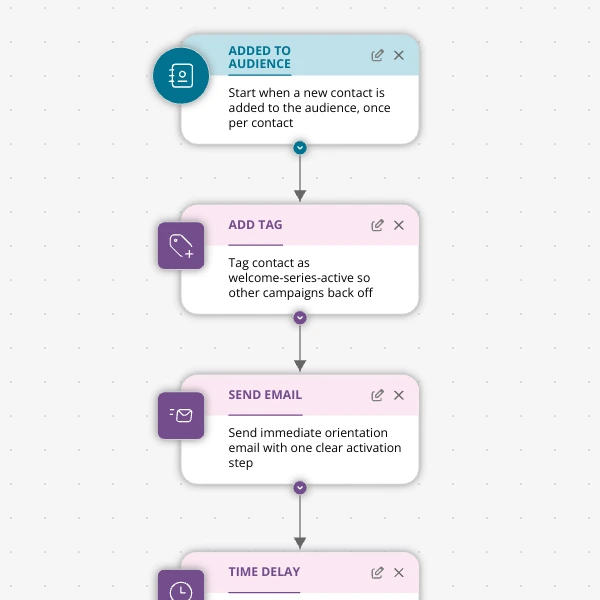
The Shopify app welcome series that turns installs into income
A step-by-step Shopify app welcome email journey for tools like CartSpark, showing how to turn new installs into activated, retained merchants using Spreeflo journeys, tags, and behavioral triggers so fewer trials quietly churn and more trials convert.
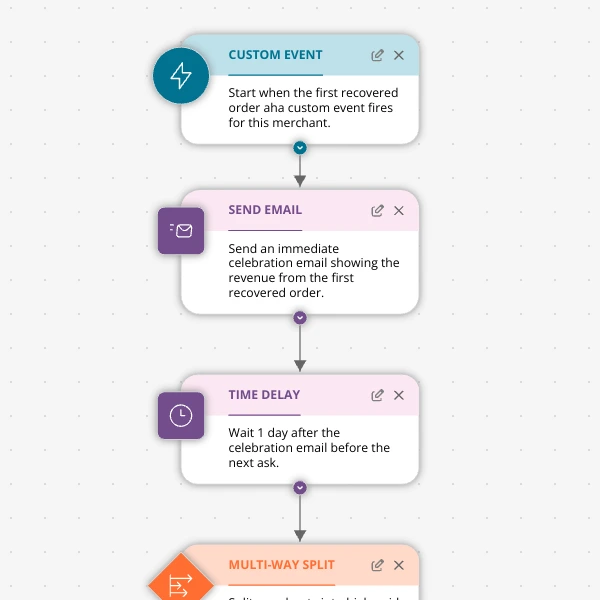
The Aha-Moment Playbook For Shopify Apps: Turn One Magic Action Into Months Of Revenue
A node-by-node playbook for Shopify and e‑commerce apps to center their lifecycle on one aha-moment custom event in Spreeflo, celebrate it, segment merchants by profile and engagement, and turn first recovered value into lasting revenue and retention.
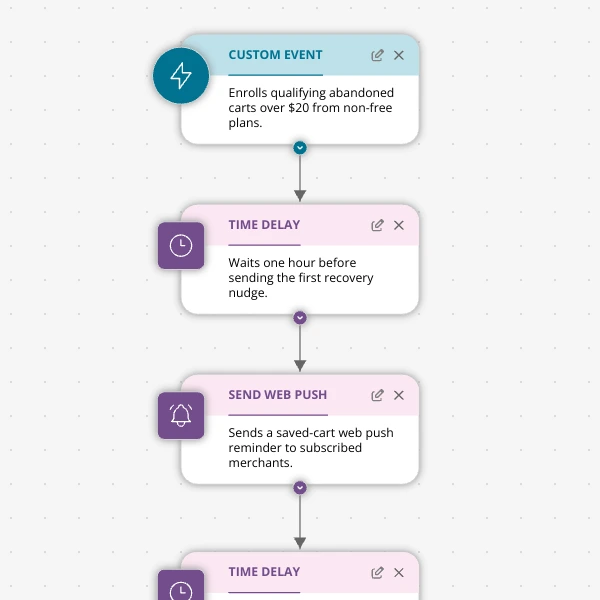
Stop Letting High‑Intent Carts Die: A 3‑Email Recovery Journey for Shopify Apps
A detailed, node-by-node walkthrough of a three-email (plus optional web push) cart-abandonment recovery journey for Shopify apps in Spreeflo, showing how to trigger events, branch on behavior, tag outcomes, and measure recovered carts and revenue.
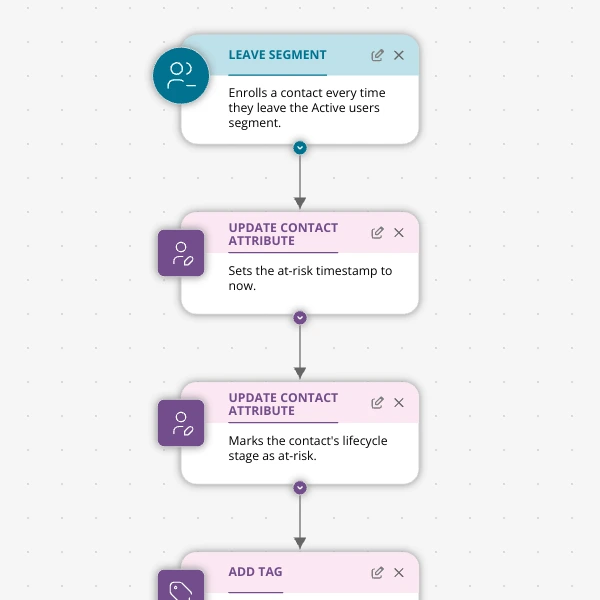
When Active Users Go Dark: A 4‑Touch Win‑Back Journey For Your Shopify App
A detailed, node-by-node Spreeflo journey for winning back previously active Shopify app users who stop engaging, using segment-based triggers, conditional logic, and a four-touch email plus internal alert sequence to recover usage and MRR.