How to Win Back Canceled SEO SaaS Accounts Without Sounding Desperate
A practical Spreeflo journey for SEO SaaS founders to quietly win back canceled accounts using a 30-day delay, low-pressure “what’s new” emails, and precise tagging so you can track reactivations and win-back revenue automatically.
Industry
Niche
Pattern
Loading sequence...
A customer clicks “Cancel subscription,” and you know exactly what happens next: you mutter a few words at Stripe, maybe export a churn report, then move on to the next trial signup.
That quiet “move on” is where a lot of SEO SaaS profit dies.
For tools like rank trackers, content brief generators, and technical crawlers, most cancellations aren’t “we’ll never need this again.” They’re “not right now,” “budget got cut,” or “we tried another tool.” In other words: recoverable.
The play here isn’t a frantic same‑day “please come back” coupon. It’s a calm, well‑timed reminder that lands after they’ve lived without you for a while, shows them what’s new, and makes it painless to return. The sequence at the top of this page is the whole journey, end to end.
We’ll walk it node by node, using a fictional SEO SaaS called RankPilot (a $40k MRR rank tracker + content brief tool) as our example.
Why post‑cancellation is your easiest revenue to recover
For a founder running an SEO tool, churn has a predictable pattern:
Agency client churns when a project ends, then comes back six months later for the next big client.
In‑house marketer cancels when budgets tighten, then realizes two quarters later that manual rank checks and DIY briefs are a time sink.
Power users test a competitor, discover its quirks, and quietly wish they could bring your reports back.
You’ve already paid the CAC on these people. They know what your product does. They’ve integrated some of your workflows into their process.
Yet most teams let them drift into the void with nothing more than a “your subscription has ended” transactional email.
That’s the leak this journey plugs. It turns “cancelled” into “cool, see you in a month when you miss us” and automates the check‑in so your tiny team doesn’t have to remember.
The core idea of this journey
The pattern is simple:
Detect when someone cancels.
Wait around 30 days.
Before contacting them, check if they’ve already come back.
If they’re still gone, send a single, low‑pressure “here’s what’s new, here’s why people come back” email, tailored to their plan type.
Track who actually reactivates after that email so you can see whether the journey earns its keep.
Spreeflo turns that into a self‑running journey built on a Custom Event trigger, a couple of Process nodes, and one carefully written Send Email step.
Let’s break down each node in the sequence at the top of this page.
Step 1: Capture cancellations as a Custom Event
Everything starts with data. The journey’s primary trigger is a Custom Event for cancellation.
In practice:
Your billing provider (Stripe, Paddle, Chargebee, etc.) fires a webhook when a subscription is canceled.
Your backend job receives that webhook and POSTs to the Spreeflo API’s events endpoint with an event like
subscription_cancelled, including properties such as:plan_tier(Starter / Pro / Agency)mrrormonthly_amountcancellation_reason(if you capture it in‑app)was_trial(boolean)
Because this runs on your server, it must use the Spreeflo API, not the JavaScript SDK.
In Spreeflo, the journey’s trigger is:
Type: Custom Event
Event name:
subscription_cancelledRe-enrollment: on
Re‑enrollment is important here. If someone churns twice over a few years, you want them to go through this journey each time, not just the first time they ever canceled.
You can optionally add property conditions if you only want to target paid subscribers (e.g., exclude trials that expired without ever paying).
Step 2: Tag them as recently churned
As soon as the Custom Event trigger fires, the journey moves into an Add Tag action:
Tags:
churned_recently,winback_cohortForce tag trigger: off (you don’t need downstream tag triggers here)
Why tag?
You can easily exclude
churned_recentlyfrom some evergreen marketing.You get clean reporting: “How many people are in this recent churn pool?”
It gives you a simple way to build cohorts later, using the tags as reference points.
If you’re new to tags in Spreeflo, the getting started with tags guide is a quick read and worth five minutes.
Step 3: Wait 30 days before you say anything
Next is a Time Delay:
Delay value: 30
Delay unit: Day(s)
Why a full month?
For most SEO SaaS products, a churned user doesn’t feel the loss immediately. Their scheduled rank checks keep running in your tool (until the subscription actually ends), old reports are still in their drive, and they likely just signed up for a competitor’s free trial.
The pain hits later:
When the new tool’s UX annoys them.
When the client asks for a report your templates made trivial.
When they realize they stopped tracking new keywords entirely.
Thirty days is a good default for that “honeymoon wears off” moment. If your data says otherwise, adjust the Time Delay to match your typical project cycles (agency project length, average trial length on the competing tools you hear about, etc.).
Step 4: Check if they already came back
After the delay, you don’t want to blindly email everyone who ever canceled. Some will have re‑subscribed in the meantime.
You handle this with an If/Else node:
Condition: “Is this contact an active subscriber right now?”
There are two clean ways to express this condition using the segment builder:
Maintain a custom contact attribute, e.g.
subscription_status, which your app sets toactiveorcanceledvia the API or frontend. Condition: Contact Attributes →subscription_status→ isactive.Or, create a saved segment called “Active subscribers” that encodes your own rules (e.g. has tag
paying_customerAND email subscription status is Subscribed). Then: Condition: Segment Membership → is member of segmentActive subscribers.
In the journey’s If/Else:
“Then” branch: condition is true (they’re active again).
“Else” branch: condition is false (they’re still churned).
This single check is what keeps you from embarrassing “come back!” emails that land a week after someone already reactivated.
Step 5: Quietly exit for people who reactivated on their own
On the “Then” branch (already active again), keep it light:
Remove Tag:
Add Tag:
Optional: Send Internal Email to a founder or CSM inbox if the account is high value (you can gate that with another If/Else on MRR or plan tier).
- Tags: churned_recently
- Tags: reactivated_without_winback
Then end the branch.
You don’t need to send them any customer‑facing message here. The tag combo alone (winback_cohort + reactivated_without_winback) gives you a clean comparison group against the people you’ll actually send a win‑back email to.
Step 6: Split by plan tier for more relevant messaging
On the “Else” branch (they’re still churned), we want slightly different stories depending on who they are.
An agency account on a $199 plan cares about things like client reporting and white‑label exports. A solo content marketer on a $39 plan cares about “I need quick briefs and ranking checks without thinking.”
So the next node is a Multi-way Split on plan tier:
Branch A:
agencyCondition: Contact attribute
plan_tierisAgencyBranch B:
proCondition: Contact attribute
plan_tierisProElse branch: everyone else (Starter, legacy plans, people who churned from a trial)
In Spreeflo, each branch of the Multi-way Split gets its own condition built with the same segment builder interface. The else branch needs no condition; it just catches everything not matched above.
Order matters: put the most valuable or specific tiers first.
Step 7: Send a low‑pressure “what’s new” email, tailored by branch
Each branch now flows into its own Send Email action. This is the core of the journey.
Configuration for each Send Email:
Template: a marketing email built in the email builder
From: whatever sender identity you normally use for lifecycle messages
Send only once: on (the default)
The content is what makes this feel respectful instead of needy. A good post‑cancellation win‑back email for an SEO SaaS usually has:
A clear subject that acknowledges their decision without drama - “What you’ve missed in RankPilot since you left” - “A quick update from the RankPilot team”
A short reminder of what your tool helped them do - “You used RankPilot to track 137 keywords across 12 projects and ship 34 briefs.”
Three to five concrete product updates since they left - New SERP features you support (FAQ, how‑to, video). - Better competitor tracking. - New integrations (Search Console, Data Studio, Looker Studio).
One clear, low‑friction way to come back - A one‑click restart of their old plan. - A “restart your account with your old settings intact” button. - Optional: a small, time‑bound offer (e.g. a month at their old price if your pricing went up).
Tone matters. This isn’t a guilt trip. It’s a “we’ve been busy; if you’re still doing SEO, these changes probably matter to you.”
Make the details match the branch:
Agency branch: lean into client reporting, user management, audit exports.
Pro branch: emphasize personal productivity, rank alerts, and on‑page suggestions.
Else branch: keep it simple and stick to the biggest visible wins.
Each of these Send Email nodes points to the same next step: a Merge node.
Step 8: Merge branches and tag everyone who got the win‑back
The three branches (Agency, Pro, Else) all connect into a Merge node, which exists specifically so multiple paths can flow back into one without breaking the “one incoming edge per node” rule.
From the Merge, add an Add Tag action:
Tags:
winback_email_sent
Now you have a clean marker on every contact who has actually received the win‑back email, regardless of plan.
Later, you can build segments like:
winback_email_sentANDwinback_reactivatedwinback_email_sentAND NOTwinback_reactivated
This is how you calculate reactivation rates and win‑back revenue without pulling exports into spreadsheets.
Step 9: Give them 14 days to react, then record the outcome
Last piece: did the email work?
Right after tagging, add a Wait Condition action:
Condition: same “Active subscribers” logic you used earlier
(either
subscription_statusisactiveor member of segmentActive subscribers)Timeout duration: 14
Timeout unit: Day(s)
This node will pause each contact until either:
They become active again, or
Two weeks pass without a reactivation.
Next, add another If/Else node with the same “is active subscriber” condition.
At this point:
If the condition is true, they reactivated sometime in that 14‑day window.
If the condition is false, they didn’t.
On the “Then” (reactivated) branch:
Add Tag:
winback_reactivatedOptional: Send Internal Email to your inbox with key context:
Plan tier
MRR
How long after cancellation they came back
On the “Else” branch:
Add Tag:
winback_unresponsive
Both branches then end the journey for that contact.
These tags give you exactly what you need to measure:
Reactivation rate among those who received the win‑back.
Additional MRR tied to win‑back reactivations.
Time delay from cancellation to reactivation.
Reading the numbers that matter
With that structure in place, Spreeflo’s audience and segmentation features do the rest.
Because you’ve consistently tagged churn events and outcomes, you can now:
Build a segment of all contacts with
winback_email_sentto see aggregate performance.Slice by plan tier using contact attributes to see whether the Agency win‑back performs differently from the Pro one.
Compare churns who reactivated without the journey (
reactivated_without_winback) vs. those taggedwinback_reactivated.
On the audiences and segments page, you can turn these into saved segments that feed dashboards, experiments, or follow‑up journeys.
Over time, you’ll see patterns like:
“Agency accounts almost never come back without a nudge, but the win‑back email recovers 8% of them.”
“Starter accounts reactivate quickly or not at all; maybe we reduce the delay for them to 14 days.”
“People who chose ‘budget’ as cancellation reason in our in‑app survey react better to a 3‑month discount than a feature rundown.”
Those insights compound. You don’t need a growth team to get them; you just need the right journey tags set up once.
Adapting this pattern to your own SEO SaaS
The backbone of this journey is stable, but details should match your product and customers.
Ways to adapt:
Adjust the delay based on your average usage cycle. If agencies run 3‑month retainers, a 60‑day delay might be better.
Split branches by cancellation reason instead of plan tier, if you reliably capture it.
Add a Random Split before the Send Email to A/B test “feature‑only” vs. “feature + discount” messaging.
For annual contracts, you might want a softer delay (e.g. 7 days) plus a check‑in from a human via Send Internal Email, with this automated win‑back at 30 or 45 days.
The structure in the sequence at the top of this page is flexible enough to handle all of that without becoming unmanageable.
If you want to see how these building blocks fit together more broadly, the overview on campaigns and journeys is a good companion read.
Why this matters more for founder‑led teams
Most SEO SaaS businesses don’t bleed out from Google algo updates or a new competitor. They bleed from quietly losing customers they already convinced once.
That’s lifetime value left on the table because no one had time to keep talking to those people after they clicked “Cancel.”
A journey like this is how a small, founder‑led team wins on leverage instead of headcount. You build it once. It runs forever, picking up lost accounts, one calm email at a time, while you focus on shipping features and acquiring the next batch of users.
You can keep buying new trials to replace churn. Or you can let a well‑designed post‑cancellation win‑back do its quiet, profitable work in the background.
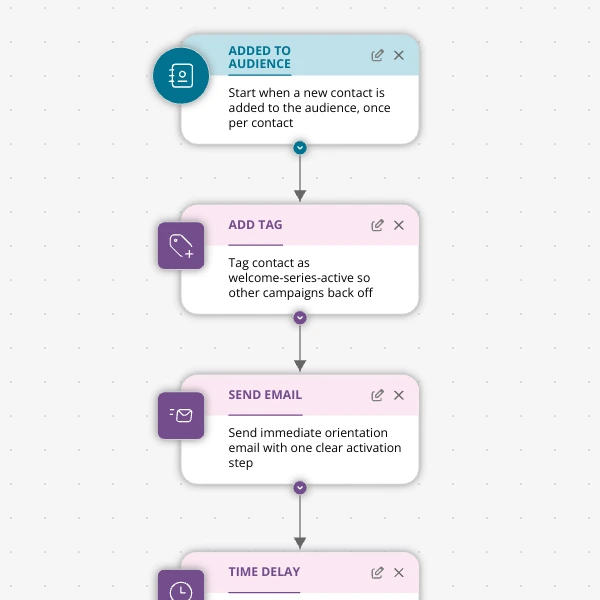
The Shopify app welcome series that turns installs into income
A step-by-step Shopify app welcome email journey for tools like CartSpark, showing how to turn new installs into activated, retained merchants using Spreeflo journeys, tags, and behavioral triggers so fewer trials quietly churn and more trials convert.
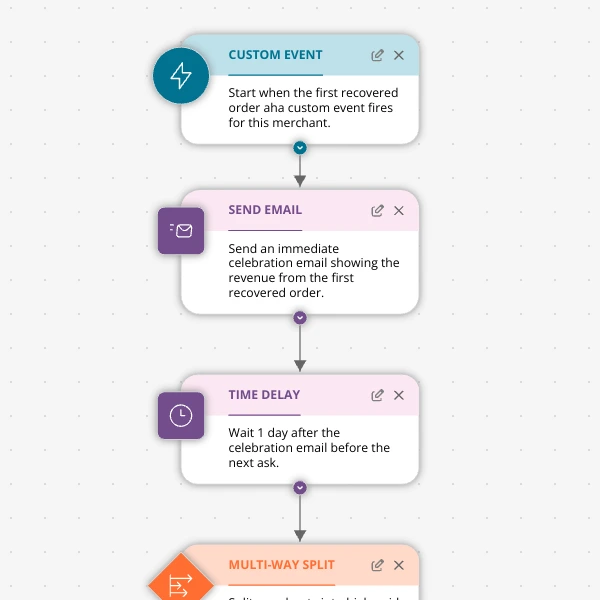
The Aha-Moment Playbook For Shopify Apps: Turn One Magic Action Into Months Of Revenue
A node-by-node playbook for Shopify and e‑commerce apps to center their lifecycle on one aha-moment custom event in Spreeflo, celebrate it, segment merchants by profile and engagement, and turn first recovered value into lasting revenue and retention.
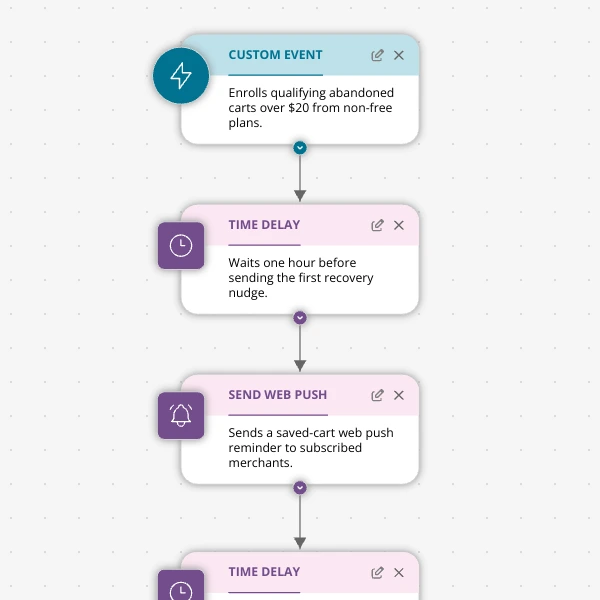
Stop Letting High‑Intent Carts Die: A 3‑Email Recovery Journey for Shopify Apps
A detailed, node-by-node walkthrough of a three-email (plus optional web push) cart-abandonment recovery journey for Shopify apps in Spreeflo, showing how to trigger events, branch on behavior, tag outcomes, and measure recovered carts and revenue.
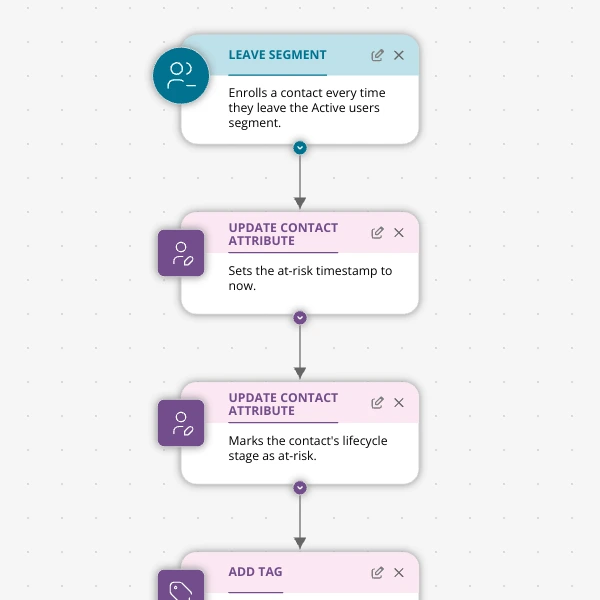
When Active Users Go Dark: A 4‑Touch Win‑Back Journey For Your Shopify App
A detailed, node-by-node Spreeflo journey for winning back previously active Shopify app users who stop engaging, using segment-based triggers, conditional logic, and a four-touch email plus internal alert sequence to recover usage and MRR.