Let Your SEO SaaS Users Rewrite Their Own Email Journey
A step-by-step Spreeflo journey pattern for SEO SaaS teams that lets users control their email experience via a preference center, automatically updating tags, subscription status, and content streams to keep messages relevant and reduce churn.
Industry
Niche
Pattern
Loading sequence...
Someone clicks “manage preferences,” ticks “billing only,” and then… keeps getting rank-tracking tips from you for three more weeks. That’s how you turn a mildly annoyed user into a churn risk.
For an SEO SaaS like RankPulse (a fictional 3-person rank-tracking tool doing ~$35k MRR), those preference clicks are gold. They’re telling you exactly what they want to hear from you. If your system doesn’t react within hours, you’re wasting that intent and burning trust.
The sequence at the top of this page is the whole journey, end to end. It listens for preference changes, rewrites tags and subscription status, and quietly steers each contact into the right email path.
This post walks through that journey step by step and shows how to adapt it to your own SEO SaaS without rewriting your entire marketing stack.
Why your preference center is more than a “please stop” page
SEO SaaS audiences are rarely one homogeneous blob:
Agencies want client-case-study content and usage alerts.
In-house SEOs want content brief best practices and rank reports.
Solo founders might only want “what changed in Google this month.”
Some people really do want “billing only.”
Treat all of them the same and you get three things: high unsubscribes, low CTR, and a list you can’t really trust.
A preference center is the obvious first step. The mistake is stopping there. If those choices live only in your app’s database or your email tool’s list settings, they’re not steering the rest of your automation.
The goal of this pattern is simple:
Treat a preference update as a high-signal product event.
Sync it into Spreeflo within minutes.
Let one journey rewrite tags, subscription status, and content paths automatically.
That’s how you capture detail on every customer so you can speak to each uniquely, instead of blasting “latest technical SEO guide” to someone who said “billing only.”
The outcome this journey creates
Back to RankPulse.
They have three main content streams:
Product updates and roadmap.
Rank-tracking tactics and “how we got this SERP win” breakdowns.
Agency-focused content around reporting and client retention.
Plus the escape hatch: “billing only – no marketing emails.”
A typical story:
Jamie, an agency owner, is getting everything. She likes the case studies but doesn’t care about dense technical posts.
She hits “manage preferences” from the footer, unchecks “Product updates,” checks “Agency content only,” and hits save.
Within an hour:
- Her contact in Spreeflo is tagged aspref-agency-only.
- Tags for other streams are removed.
- Her email subscription stays “Subscribed,” but only agency-segment journeys can see her now.Next week’s send: she gets one focused agency playbook instead of three mismatched emails.
If she ever flips to “billing only,” the same journey:
Sets her email subscription status to “Unsubscribed.”
Removes marketing preference tags.
Leaves her eligible for transactional emails from the transactional email API like invoices and failed payment notices.
All of that is handled by the journey pattern you see at the top of this page.
Let’s break it down.
Step 1: Treat preference updates as a first-class event
The entry point is a Custom Event trigger.
In RankPulse’s app, when a user hits “Save” on the preference center, two things happen:
The app updates its own user record.
It sends a
preferences_updatedevent to Spreeflo:
- From the browser using the Spreeflo SDK, or
- From the backend as an HTTPS POST to the Spreeflo API.
In Spreeflo, the journey’s Custom Event trigger is configured roughly like:
Event name:
preferences_updated.Re-enrollment: on.
Re-enrollment matters. Preferences are not a one-time thing. You want this journey to fire every time a user changes their mind, but never while they’re already mid-journey.
You can optionally add property filters if your event sends them (for example, only enroll when channel = "email"), but in most SEO SaaS setups you’ll let every preference update through and handle branching later.
Behind the scenes, RankPulse also keeps Spreeflo’s contact attributes in sync when preferences change:
A text attribute like
email_preferencewith values such asbilling_only,agency_only,product_and_tactics.Or a set of boolean flags like
pref_agency,pref_product,pref_tactics.
Those attributes are updated directly via Spreeflo.identify on the frontend or via the contacts endpoint of the Spreeflo API on the backend. The journey does not try to copy values out of the event payload, because the Update Contact Attribute node only writes static values chosen at design time, not dynamic event properties.
The event is the signal. The attributes are the source of truth.
Step 2: Give data a short buffer before you branch
Right after the trigger, the journey drops into a Time Delay node:
Delay: 1 hour.
Unit: Hours.
Why wait at all?
It gives your app a safe window to finish updating contact attributes in Spreeflo.
It avoids collisions with any email you might be sending as part of the preference center UX itself.
An hour is short enough that the experience still feels near real-time but long enough that you’re not racing your own writes.
If you’re confident your attribute updates are synchronous and fast, you can shorten the delay. Spreeflo’s minimum is 1 hour for Time Delay, so that’s your floor.
Step 3: Split by what they actually asked for
After the delay, the journey uses a Multi-way Split process node to branch by preference.
This is where Spreeflo’s segment builder shows up inside the journey. Each branch is a simple condition on contact attributes, for example:
Branch “Billing only”:
- Contact attributeemail_preferenceisbilling_only.Branch “Agency only”:
-email_preferenceisagency_only.Branch “Product + tactics”:
-email_preferenceisproduct_and_tactics.Else branch:
- Everyone who doesn’t match the above.
A couple of design choices worth calling out:
Use one canonical field to hold the preference (like
email_preference) even if you also have booleans for convenience. It makes reasoning about branches and reporting much clearer.Keep branch conditions mutually exclusive. Multi-way Split is evaluated top to bottom and takes the first match. Overlapping conditions give you hard to debug routing.
At this point, each contact has been sorted into one of several intent buckets. The rest of the journey is about enforcing those choices and wiring them into your email strategy.
Step 4: Treat “billing only” as a hard marketing boundary
For the “Billing only” branch, the journey takes a stricter path.
Typical node sequence on that branch:
Update Email Subscription Status:
- Status: Email unsubscribed.Remove Tag:
- Remove any marketing-preference tags likepref-agency-only,pref-product-and-tactics, etc.Add Tag:
- Add apref-billing-onlytag so you can still filter and report on this audience.Optional: Send Internal Email to your team:
- “High-value account switched to billing-only” with MRR and usage context pulled into the email body.
Crucially, this branch does not send an external email to the contact. They just told you they don’t want marketing messages. Respect that.
Transactional email, like invoices or card-expiry alerts, should run through your normal backend flow hitting the transactional email API, which is not blocked by the marketing subscription flag.
By the end of this branch, the contact is effectively invisible to future marketing journeys that target “Email subscription status is Subscribed” or “tag is not pref-billing-only.”
Step 5: Normalize and tag the marketing-friendly paths
The remaining branches – “Agency only,” “Product + tactics,” maybe “All content” – follow a similar pattern.
Let’s take “Agency only” as the example.
On that branch, the journey might:
Update Email Subscription Status:
- Status: Email subscribed.Remove Tag:
- Strip out any old preference tags that conflict (pref-product-only,pref-all-content, etc.).Add Tag:
- Apply a single source-of-truth tag, for examplepref-agency-only.
This covers the case where someone previously went to billing-only, then changed their mind and opted back into agency content. You should only enable this if your legal/consent model treats their explicit preference-center change as renewed permission.
Those Add/Remove Tag actions are what connect this journey to the rest of your marketing system. Your other journeys and campaigns should target segments like:
“Has tag
pref-agency-onlyand email subscription status is Subscribed.”“Has tag
pref-product-and-tacticsand is Subscribed.”
Spreeflo’s audiences and segments are built for this kind of layering: subscription status, tags, and behavior in one place.
One optional confirmation email
On some branches it’s useful to send a single confirmation email, especially when someone moves from “everything” to “a focused stream” or back from billing-only.
For example:
Send Email:
- A short note: “You’ll now only get agency growth content from RankPulse. Here’s what to expect.”
Built in Spreeflo’s email builder, this email can:
Reassure the reader you heard them.
Link to a few “best of” resources in that stream.
Reiterate how to change preferences again if needed.
The key guardrail: this is the only Send Email node on that path. There’s a Time Delay and some non-sending nodes upstream, so you’re not hitting the contact with back-to-back messages inside a single journey.
If you want to experiment with sending this confirmation vs. staying silent, insert a Random Split above the Send Email:
Path A: 50% go to the confirmation send.
Path B: 50% skip it.
Later, you can compare spam complaints or subsequent preference changes between the two cohorts.
Step 6: Merge marketing branches before downstream logic
If your “Agency only,” “Product + tactics,” and “All content” branches all share some common follow-up – for example, writing a timestamp to last_preference_update or tagging pref-updated-recently – keep the canvas clean with a Merge node.
Pattern:
Each marketing branch does its subscription + preference-tag adjustments.
All three feed into a single Merge.
Downstream from the Merge, you place any shared actions, such as:
- Update Contact Attribute:
- Attribute:last_preference_update_at.
- Update type: Set to now.
- Optional Add Tag:
- Tag:pref-updated-last-30d(handy for reporting and re-engagement).
Merge exists specifically to allow multiple incoming connections. Without it, you’d violate the “one incoming edge per node” rule in the automation engine.
The billing-only branch usually skips this Merge and ends on its own. That keeps metrics and routing cleaner.
Instrumenting the pattern: what to measure
Once this journey is live, you care about two metrics the pattern is built around: preference-update rate and downstream CTR uplift.
1. Preference-update rate
You can think of this as: “What share of annoyed users hit ‘manage preferences’ instead of ‘unsubscribe’ or ignoring us?”
To approximate it:
Numerator: contacts who triggered the
preferences_updatedCustom Event in a given period.Denominator: contacts who opened at least one marketing email in that period.
Over time, you should see:
Preference updates increase.
Hard unsubscribes plateau or even drop, because people have a “less email, more relevant email” option that actually works.
If this number is low, consider:
Making “manage preferences” more prominent than “unsubscribe”.
Making the preference center questions clearer and more tailored to real use cases.
A small SEO SaaS team can track this with a saved segment per event and the usual email activity filters – no BI team required.
2. CTR uplift by preference stream
The other side is quality. Are people actually clicking more once they’re in their chosen lane?
Use segments like:
“Has tag
pref-agency-onlyand opened at least 1 email in the last 30 days.”“Has tag
pref-product-and-tacticsand opened at least 1 email in the last 30 days.”
Within each, look at click-through rate on the last few campaigns:
If agency CTR is much higher than your old, mixed-content baseline, the pattern is working.
If a stream underperforms, that’s a content problem, not an automation problem.
Because all streams run through the same campaign and journey automation engine, you can A/B test subject lines, formats, and cadences per preference without reinventing the routing each time.
Implementation notes specific to SEO SaaS
A few SEO-SaaS-flavored details that tend to matter in practice:
Map preferences to real editorial strategies. “Technical SEO” vs. “Content briefs” vs. “Agency operations” should influence your calendar, not just your sending list.
Reflect product usage. If someone selects “Rank-tracking tactics” and regularly triggers a
checked_rankingsoradded_first_keywordevent, they’re a perfect fit for deeper how-to sequences.Don’t overspecify options. Four or five clear preference buckets are usually better than ten hyper-granular ones that confuse readers and create routing complexity.
The more behavioral and profile detail you collect, the more precise your segments become. That’s exactly where small, founder-led teams shine: you can wire an event today and have a tailored journey reacting to it tomorrow.
Bringing it back to the principle
This pattern is not really about a preference center. It’s about listening when a user tells you, in plain language, “Here’s how I want you to talk to me,” and wiring your system so it responds automatically.
For an SEO SaaS, where every customer has a different mix of rank-tracking, content, and technical needs, that detail is where lifetime value hides. Capture it, connect it to a journey like the one at the top of this page, and your emails start to feel less like a broadcast and more like a one-to-one feed.
You build the system once. It reacts to every preference change that comes after. That is how a small team competes with bigger tools without adding more headcount: one thoughtful journey, tuned to what each customer actually asked for.
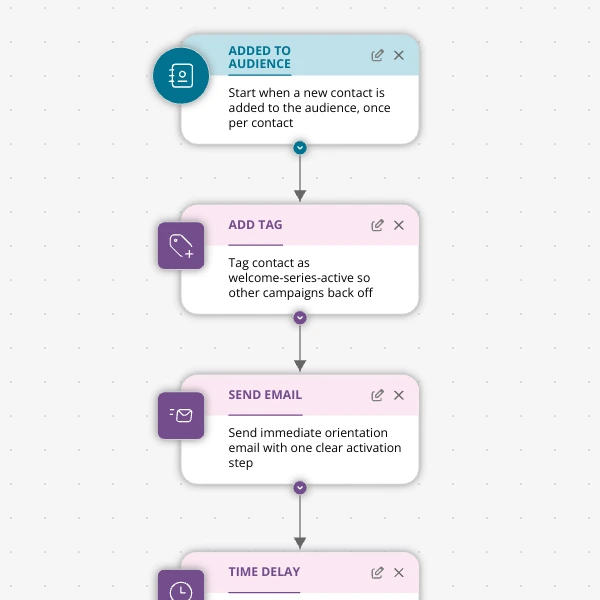
The Shopify app welcome series that turns installs into income
A step-by-step Shopify app welcome email journey for tools like CartSpark, showing how to turn new installs into activated, retained merchants using Spreeflo journeys, tags, and behavioral triggers so fewer trials quietly churn and more trials convert.
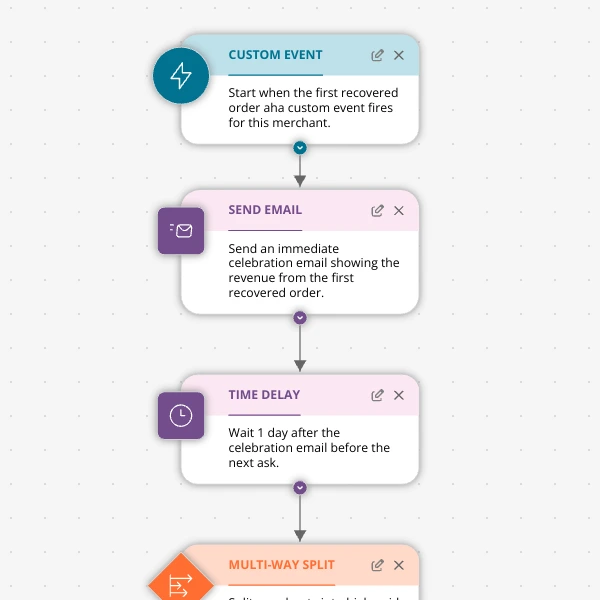
The Aha-Moment Playbook For Shopify Apps: Turn One Magic Action Into Months Of Revenue
A node-by-node playbook for Shopify and e‑commerce apps to center their lifecycle on one aha-moment custom event in Spreeflo, celebrate it, segment merchants by profile and engagement, and turn first recovered value into lasting revenue and retention.
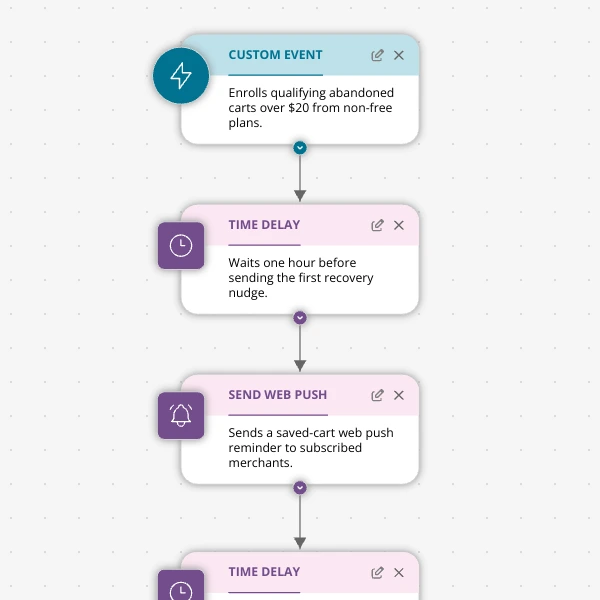
Stop Letting High‑Intent Carts Die: A 3‑Email Recovery Journey for Shopify Apps
A detailed, node-by-node walkthrough of a three-email (plus optional web push) cart-abandonment recovery journey for Shopify apps in Spreeflo, showing how to trigger events, branch on behavior, tag outcomes, and measure recovered carts and revenue.
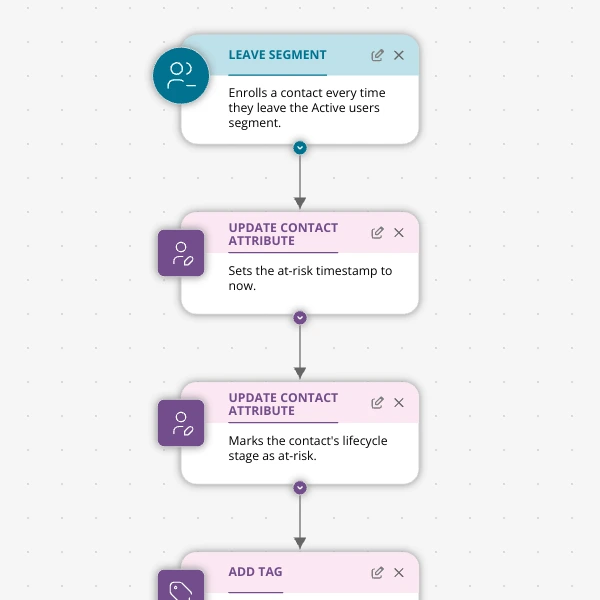
When Active Users Go Dark: A 4‑Touch Win‑Back Journey For Your Shopify App
A detailed, node-by-node Spreeflo journey for winning back previously active Shopify app users who stop engaging, using segment-based triggers, conditional logic, and a four-touch email plus internal alert sequence to recover usage and MRR.