Stop Letting Power Users Churn Before They Touch Your Best Features
FreeThis playbook shows how to build a behavior-triggered Spreeflo journey that nudges power users into your stickiest features, like content briefs, using precise events, tags, and emails to drive deeper adoption and reduce churn.
Industry
Niche
Pattern
Loading sequence...
A depressing SaaS graph: daily active users trending up, MRR inching forward, and yet your most powerful feature graph is almost flat.
At BrieflySEO, our fictional content-brief SaaS doing ~$60k MRR, that flat line was the “Content Brief Builder” chart. Agencies were adding hundreds of keywords, running technical audits, even inviting teammates… but never touching the feature that actually made the product sticky. Then a decent share of them quietly churned three months later.
This article is about the “you haven’t tried X yet” journey that fixes that.
The sequence at the top of this page is the whole journey, end to end. Let’s walk through how to wire it in Spreeflo so it nudges exactly the right accounts toward the right feature at the right time.
Why this pattern matters so much for SEO SaaS
In SEO SaaS, retention usually isn’t about logins. It’s about whether customers plug your tool into their process deeply enough that ripping it out later feels painful.
For most products, that “lock-in” comes from a handful of advanced behaviors:
Connecting Google Search Console or Analytics
Setting up rank-tracking alerts for key clients
Generating content briefs from live SERP data
Shipping an audit and then scheduling recurring crawls
When heavy users never cross into those behaviors, you’re leaking lifetime value. They get enough value to tolerate you for a project or two, but not enough to stay through budget reviews.
The feature-adoption nudge journey fixes this by doing three things:
Spotting power users who should care about Feature X.
Confirming they’ve never touched it.
Sending a contextual, deep-linked email that shows why Feature X fits the way they already work.
You’re not blasting “have you tried our integrations?” to everyone. You’re sending “you’re already tracking 132 keywords; here’s how to turn that into briefs your writers can ship in an hour.”
That’s the difference between noisy marketing and high-signal retention.
The data you need before you build anything
Before you open the campaigns and journeys screen, check that Spreeflo is actually seeing the behaviors this journey relies on.
For a “nudge into content briefs” example, you need at least:
A custom event for your core feature: for BrieflySEO, think
keyword_addedorrank_check_run.A custom event for the target feature: here,
content_brief_created.Plan or account type on the contact: e.g.
plan_tier=ProorAgency.Email subscription status, so you don’t email people who are unsubscribed.
Optional but useful: a custom attribute like
uses_content_briefs(boolean) or tags likebriefs-adopted,briefs-nudged.
Your web app should send the product events with the Spreeflo JavaScript SDK whenever users act in the browser:
When someone adds keywords, your frontend calls
Spreeflo.track('keyword_added', {...}).When they generate a brief, it calls
Spreeflo.track('content_brief_created', {...}).
If some signals live only on your backend (for example, upgrading to a plan where the feature is available), POST those to the events endpoint using the Spreeflo API.
Once those events and attributes are flowing, you’re ready to wire the journey.
Step 1: Criteria Match trigger — find the “should care but haven’t used it” cohort
This is a continuously-running journey, so start with a Criteria Match trigger.
Conceptually, the Criteria Match is just the segment builder embedded inside a trigger: “whenever a contact starts matching these rules, enroll them here.”
For our BrieflySEO example, configure the Criteria Match like this (all combined with AND):
Email Subscription Status is “Subscribed”.
Contact Attribute
plan_tierisProorAgency(whatever tiers include content briefs).Custom Events rule:
- Event name:keyword_added.
- Operator: at least 5 times.
- Time window: in the last 14 days.Custom Events rule:
- Event name:content_brief_created.
- Operator: has not triggered over all time.Tags rule:
- Contact is not tagged withbriefs-nudged.
That last rule is important. It ensures an account only enters this journey once, even if you allow re-enrollment.
On the trigger itself, set:
Re-enrollment: on or off, depending on how conservative you want to be.
If this is your first time, err on the safe side and leave re-enrollment off. With the “not tagged with briefs-nudged” condition, you’re protected either way, but turning re-enrollment off guarantees a given contact only ever goes through this once.
Result: the moment a Pro/Agency user becomes an active keyword user but still hasn’t touched content briefs, they enter the journey.
Step 2: Add Tag — mark that they’ve been nudged
The first action after the trigger is an Add Tag node.
Configuration:
Tags:
briefs-nudged.Force tag trigger: off (you only care that it’s now present, not about firing other journeys).
Why this matters:
It gates the trigger, as mentioned above.
It gives you a simple way to segment later: “who did we try to nudge into briefs?”
It prevents overlapping experiments if you build a different nudge later.
This is the first place you see Brand Message 1 in action: capturing detail on each customer so you can speak uniquely. You’re not just emailing everyone. You’re recording, explicitly, “we tried to teach this person about briefs.”
Step 3: Send Email — a highly specific “have you tried X?” email
Next comes the heart of the pattern: a Send Email node.
Use the email builder to create something that feels like a human-looking over their shoulder, not a campaign blast.
A strong structure for SEO SaaS:
Subject line:
“You’re tracking {N} keywords. Here’s how to turn them into briefs.”
Body:
Mirror their behavior
“I can see you’re already using BrieflySEO to track rankings for clients like {company_name} and to add new keywords regularly.”Name the gap
“What most teams miss is turning that keyword list into ready-to-assign briefs, so writers aren’t guessing what to include.”Introduce the feature in one sentence
“Our Content Brief Builder takes any keyword set and auto-builds an on-page brief from live SERP data.”Deep link into the exact place they should land
“Open your ‘Client A’ project, pick a keyword, and click ‘Generate Brief’ — or jump straight in here: [button linking to/projects/{id}/content-briefs].”Reduce perceived risk
“Nothing changes in your current setup; you just get a brief you can share with your writers.”
If you’re on the Professional plan, you can use AI-powered personalization and AI variables to tailor parts of this copy to each account’s behavior or niche. But even without AI, the key is that this email is triggered by real usage, not by a calendar.
In the node options:
Pick the right sender identity (often your founder or head of success for this kind of email).
Leave “Send only once” on. This is not a message you want accidentally repeating.
Step 4: Time Delay — give them a few days to act
You’ve put a new idea in their head. Now give them breathing room.
Add a Time Delay node:
Delay value: 3
Unit: days
Why three days?
Same-day usage is possible but unlikely if they’re mid-sprint.
A week feels slow for an in-app feature they can try in seconds.
Three days is long enough to cross a couple of work sessions without feeling forgotten.
This delay also keeps you within healthy pacing: there’s at least three days between this email and any follow-up email later in the flow.
Step 5: Wait Condition — move as soon as they try the feature
After the delay, insert a Wait Condition node.
Here you tell Spreeflo: “Pause here until they either use content briefs or seven more days pass, whichever comes first.”
Configure the Wait Condition like this:
Condition:
- Custom Events rule:
- Event name:content_brief_created.
- Operator: at least 1 time.
- Time window: in the last 7 days.Timeout:
- Duration: 7
- Unit: days
Behaviorally, that means:
If they generate a brief tomorrow, they don’t sit in limbo for the full seven days; they move on immediately.
If they ignore the feature entirely, the timeout expires and they advance after a week.
Notice the pattern: you’re not guessing timing based on a funnel diagram. You’re responding to reality — a foundation of Spreeflo’s campaign & journey automation model.
Step 6: If/Else — branch on adoption vs no adoption
Now you decide what to do with each outcome.
Drop in an If/Else process node right after the Wait Condition. Use the same condition as you did in the Wait Condition:
Condition:
- Custom Events rule:
- Event name:content_brief_created.
- Operator: at least 1 time.
- Time window: in the last 7 days (or “over all time” if you prefer).
If the condition is true, they hit the “Yes” branch. If not, they go down the “Else” branch.
This split powers two different experiences:
Path A: “Nice, you tried it — here’s how to get even more value.”
Path B: “You still haven’t; here’s one more, more concrete nudge.”
Let’s handle them in turn.
Step 7A: When they adopt — reinforce and go deeper
On the “Yes” branch, start with another Add Tag node:
Tags:
briefs-adopted.
Optionally, follow it with an Update Contact Attribute node if you created a boolean attribute like uses_content_briefs:
Attribute:
uses_content_briefs.Update type: set boolean to
true.
You’ve now captured two important facts:
This contact crossed the threshold into advanced usage.
You can target them in future “power user” campaigns.
Then consider a second Send Email node that feels more like a quick coaching note than a promotional broadcast.
Because there’s been at least three days plus up to seven days since the last email, you don’t need an extra delay here for pacing.
Content idea:
Celebrate the behavior: “Saw your first brief go out — nice work.”
Share one pro tip: “Teams that get the most from briefs usually add internal checklist items: tone of voice, internal links to include, URLs to avoid.”
Nudge toward the next feature: “Once you’ve done a couple, try adding our ‘Outline export to Google Docs’ to speed up collaboration.”
Even if you don’t send this second email, the tag and attribute updates alone are valuable. They let you build segments like “Pro users using briefs” for future lifecycle plays.
Step 7B: When they still ignore it — one more, more concrete nudge
On the “Else” branch, you’re talking to accounts that:
Use your tool actively.
Have seen a contextual email about the feature.
Still haven’t touched it after roughly 10 days.
This is not the moment for pressure. It’s the moment for clarity.
You can go straight into a second Send Email node here. There’s already been a 3-day delay and up to 7 days of waiting, so pacing is healthy.
A good pattern for this follow-up:
Acknowledge they might be busy
“You’ve got a lot going on; I know trying a new workflow mid-project can feel risky.”Dismantle the main objection
“You can generate a brief from an existing keyword set in under a minute, and it doesn’t affect your current rankings or projects.”Use a tiny, specific CTA
“Pick just one keyword you’re already tracking and click ‘Generate Brief’ to see the outline. If it’s not helpful, reply to this email and I’ll ask the team to take another shot at the feature.”
Notice you’re still not blasting everyone here. This is a second email only to accounts that match a very specific behavioral profile.
If you want to experiment, you can insert a Random Split earlier in this branch to A/B test different positioning, but keep the first version simple.
Measuring whether this journey is actually working
Once the journey has been live for a few weeks, you care about three numbers:
Feature adoption rate among eligible accounts
- How many contacts who entered this journey end up withbriefs-adoptedor at least onecontent_brief_createdevent?Deep-link click-through rate
- Within the first email, look at the click rate on the main “Generate a brief” link. That’s your “were they at least curious?” metric.Retention by feature use
- Build two segments in the audiences area:
- Pro/Agency accounts using briefs.
- Pro/Agency accounts who qualified for the nudge but still haven’t used briefs.
- Compare churn rates or downgrades between them over a couple of months.
If you see that “briefs users” churn significantly less, you’ve just proven the LTV case for this journey. You can now justify spending real time on refining it.
Scaling the pattern to other sticky features
The exact same structure works for other high-retention behaviors in SEO SaaS:
Connecting Google Search Console.
Enabling weekly rank alerts.
Turning on Slack notifications for drops.
Scheduling recurring technical audits.
In each case:
Swap the target event from
content_brief_createdto the new feature’s custom event.Adjust the “relevance” criteria in the Criteria Match trigger (for example, only accounts with >3 projects should get the “set up alerts” nudge).
Update the copy and deep link in the emails.
You can either clone the entire journey per feature or build a slightly more complex one that uses a Multi-way Split after the trigger to send different emails based on the account’s primary use case. Just be careful with complexity; for most small teams, a “one journey per big feature” approach is easier to reason about and maintain.
The real win: talking to each account like you know them
This pattern works because it treats your users as individuals with a history, not as rows in a newsletter list.
You’re:
Tracking meaningful behavior in detail.
Making that behavior the trigger, not just a date on the calendar.
Responding with specific, contextual guidance instead of generic feature tours.
That’s Brand Message 1 in action: capture detail on every customer so you can speak to each uniquely. And it hits Brand Message 3 too: reducing churn by nurturing engagement, not by pushing discounts at the last minute.
Once you’ve seen even a handful of accounts move from “power user who never touched Feature X” to “power user who did — and stuck around,” it becomes obvious why this journey earns a permanent place in your automation stack.
Build it once in Spreeflo, wire it to the right events, and it keeps quietly saving accounts every week while you focus on the next experiment.
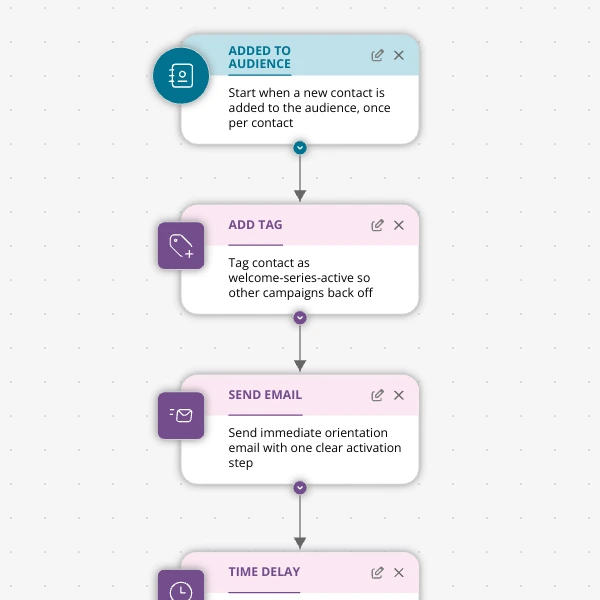
The Shopify app welcome series that turns installs into income
A step-by-step Shopify app welcome email journey for tools like CartSpark, showing how to turn new installs into activated, retained merchants using Spreeflo journeys, tags, and behavioral triggers so fewer trials quietly churn and more trials convert.
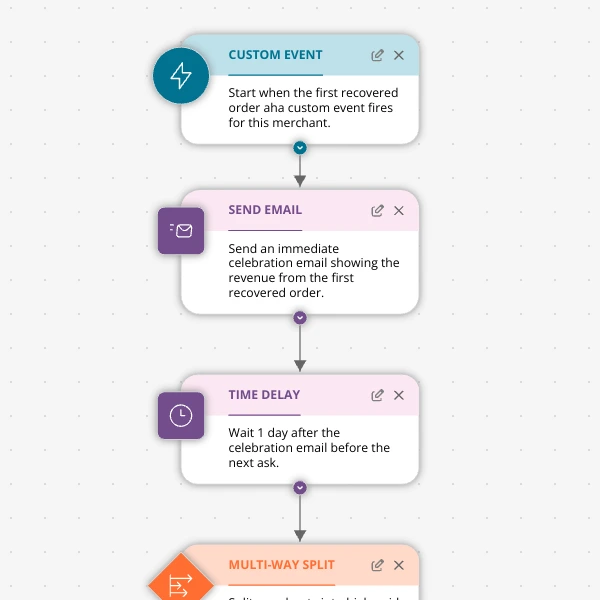
The Aha-Moment Playbook For Shopify Apps: Turn One Magic Action Into Months Of Revenue
A node-by-node playbook for Shopify and e‑commerce apps to center their lifecycle on one aha-moment custom event in Spreeflo, celebrate it, segment merchants by profile and engagement, and turn first recovered value into lasting revenue and retention.
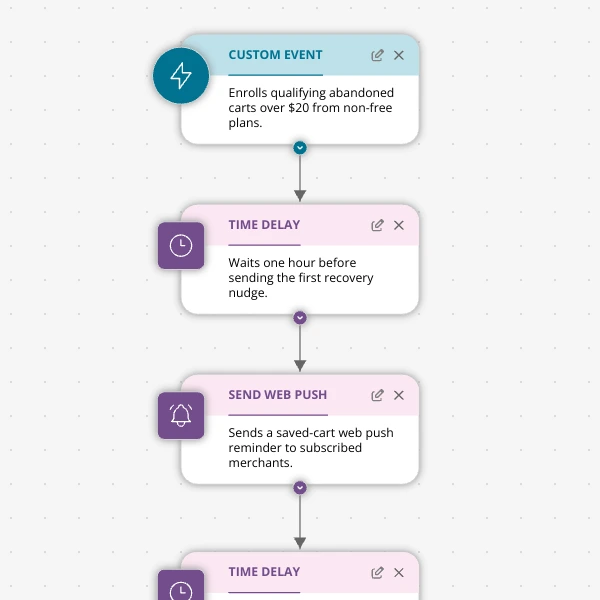
Stop Letting High‑Intent Carts Die: A 3‑Email Recovery Journey for Shopify Apps
A detailed, node-by-node walkthrough of a three-email (plus optional web push) cart-abandonment recovery journey for Shopify apps in Spreeflo, showing how to trigger events, branch on behavior, tag outcomes, and measure recovered carts and revenue.
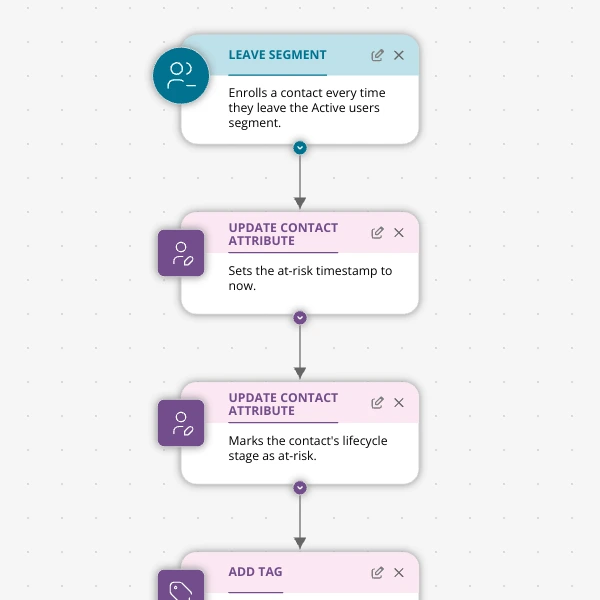
When Active Users Go Dark: A 4‑Touch Win‑Back Journey For Your Shopify App
A detailed, node-by-node Spreeflo journey for winning back previously active Shopify app users who stop engaging, using segment-based triggers, conditional logic, and a four-touch email plus internal alert sequence to recover usage and MRR.