Stop Letting Web Push Die in the Notification Tray: Build a Smart Email Fallback
A journey pattern for SEO SaaS teams to combine web push and email in Spreeflo: trigger on meaningful product events, send real-time push, wait for engagement, and automatically fall back to a richer email when push is ignored.
Industry
Niche
Pattern
Loading sequence...
Your rank-alert notification fired right on time. The keyword your user cares about just slipped three spots, you sent a push… and nothing happened.
No click. No login. No plan upgrade. Just another ignored browser notification buried behind a dozen others.
For an SEO SaaS like RankPulse or BrieflySEO, those alerts are the heartbeat of your value. When they go unseen, you’re leaking both engagement and lifetime value.
The pattern on this page fixes that: send the push, wait briefly for a click, and if the user doesn’t respond, follow up with an email version that lands in a more durable channel. The sequence at the top of this page is the whole journey, end to end.
This article walks through that journey node by node, tailored for SEO SaaS products, and shows you how to set it up inside Spreeflo so every important alert gets a second chance to perform.
Why web push alone leaks revenue for SEO tools
Web push is perfect for “right now” SEO moments:
A tracked keyword drops out of the top 10
A content brief finishes generating
A big technical issue shows up in a crawl
You can notify users even when they’re not in the app. But push has real constraints:
Browsers throttle or batch notifications
Users ignore or clear them reflexively
Some users never accepted permission in the first place
Different time zones mean your “perfect” timing might be their commute or bedtime
If you only ship those moments via push, you’re betting the whole value of that event on a single, fragile delivery path.
For a small team, the answer is not “build and maintain two separate systems.” It’s one journey that tries push first, then automatically falls back to email when push is ignored.
The pattern in one line
Here’s the behavior you’re building in Spreeflo:
A meaningful event happens (for example, a rank drop).
Spreeflo sends a targeted web push notification.
It waits for up to one hour for the user to click that notification.
If they click, you stop there and mark them as engaged.
If they don’t click, Spreeflo sends the email version of the alert.
You get the immediacy of push plus the reliability of email, with logic that adapts contact by contact.
Let’s walk through how that maps onto the journey in the sequence above.
Step 1: Pick the behavioral trigger that actually matters
This is a behavior-driven pattern. The trigger should be an event that genuinely warrants an interruption.
In an SEO SaaS context, good candidates include:
rank_drop_detectedwhen a keyword falls below a thresholdweekly_visibility_report_readyfor scheduled reportingcontent_brief_generatedfor content teamscrawl_critical_issue_foundfrom your technical SEO crawler
In Spreeflo, those show up as a Custom Event trigger in a journey.
You’ll usually send those events from your backend through the Spreeflo API whenever your own system detects them. For example, when your rank-checker job sees a tracked keyword drop by more than 3 positions, your worker posts a rank_drop_detected event to Spreeflo for that contact.
In the journey:
Node: Custom Event trigger
Event:
rank_drop_detected(or your equivalent)Property filter (optional but recommended): amount of drop, tag indicating “high-priority keyword”, or plan type
Re-enrollment: set to true
Re-enrollment matters here. The same customer can and should receive this flow multiple times over their lifetime, whenever new issues appear. With re-enrollment on, each qualifying event enrolls them again as long as they’re not currently moving through the journey. That mid-journey lock prevents duplicate flows overlapping.
If your use case is different (for example, “first time they connect Google Search Console”), you’d still use a behavioral trigger, but might choose Criteria Match or Join Segment instead. The push-email logic downstream is identical.
Step 2: Send the web push alert in real time
Once the trigger fires, the first action is your Send Web Push node.
Conceptually:
Node: Send Web Push
Template: "Rank drop alert" (or similar)
“Send only once”: turn this off
You turn off “send only once” because rank-drop events can happen repeatedly and you want each event to be eligible for a notification. The journey protects you from duplicates on the same event; “send only once” would wrongly cap it at a single notification for that contact across their entire history with this journey.
Crafting the push itself is where your SEO context shines:
Title: “Your keyword ‘best crm for agencies’ just dropped 4 spots”
Body: “You’re now #9 in Google. Here’s what changed and how to fix it.”
Click URL: Deep link to that keyword’s report or a “what changed” screen
Spreeflo’s web push setup docs walk through service worker and opt-in patterns. For this journey, assume you’ve already collected permission and your users are identified via the Spreeflo SDK so the subscription is tied to their contact record.
Now the push is out. The next question is: did they act on it?
Step 3: Wait up to an hour for the click
Instead of blindly waiting a fixed time, you want the journey to move as soon as the user clicks the notification, and only wait the full window if they ignore it.
That’s what the Wait Condition node does.
Configure it like this:
Node: Wait Condition
Condition: “Web Push Activity → clicked → this specific template → at least 1 time → in the last 1 hour”
Timeout: 1 hour
Under the hood, this uses the same segment builder Spreeflo uses everywhere else. You’re saying:
“Pause this contact until either they have a click recorded on this notification in the last hour, or one hour elapses. Then continue.”
Why Wait Condition and not a simple 1-hour Time Delay?
If they click in two minutes, you don’t need to keep them waiting. They can flow into whatever “clicked” path you define almost immediately.
If they never click, the fallback email goes out right after the hour mark, not later.
For SEO alerts in particular, that responsiveness matters. A big rankings drop or a major technical issue is time-sensitive; letting this sit untouched for days because of a coarse delay wastes the whole point of real-time monitoring.
Step 4: Branch on whether the push actually worked
After the Wait Condition, you still need to tell Spreeflo what “worked” means.
That’s where the Check Web Push Activity node comes in.
Configure:
Node: Check Web Push Activity
Template: the same notification you used in Send Web Push
Activities:
Branch A: Clicked
Branch B: Not Clicked
Else branch: safe default (you can point this at the “Not Clicked” path)
This node inspects the contact’s history with that specific notification template and routes them:
If they clicked at any point (whether during the hour wait or after), they go down the Clicked branch.
If they didn’t click, they go down the Not Clicked branch.
You could technically rely on the Wait Condition alone and assume anyone still in the journey at the end of the hour is a non-clicker. Explicitly checking click activity is safer and more transparent, especially once you start iterating.
What to do on the Clicked branch?
At minimum:
Node: Add Tag
Tag:
push-alert-engagedorrank-alert-push-clicker
Optionally, you can also:
Increment a number attribute like
rank_alerts_engagedwith Update Contact AttributeFeed that back into future segment logic (for example, show different onboarding to chronic non-clickers)
The key idea: you’re capturing detail on who responds to push versus who needs email. That becomes targeting fuel for better journeys later, not just reporting.
Step 5: Send the email version when push is ignored
The Not Clicked branch is where the fallback email lives.
Here you add a single Send Email node:
Node: Send Email
Template: “Rank drop alert (email)”
“Send only once”: usually on (each contact should not get this specific email multiple times for the same event)
Because your Wait Condition has already paused the journey for up to an hour, you don’t need an extra Time Delay before the email. You’re not bombarding the user; you’re escalating from a lightweight nudge to a richer explanation in a more persistent channel.
In the email itself, you can do what push can’t:
Include a chart of ranking over time
Call out competing URLs that just overtook them
Link to your own playbook content or feature that helps fix it
Add secondary CTAs, like “Add this keyword to a watchlist” or “Invite your content lead”
Spreeflo’s email builder makes it easy to reuse components from your product marketing and personalize by plan, segment or behavior.
For example, your email body might change based on:
Plan type: agency plans get “share this alert with your client” copy
Usage: if they’ve never used your content brief feature, suggest “Generate a brief to reclaim this ranking”
Geography: timestamps and screenshots localized to their region
That’s where Spreeflo’s core philosophy shows up: you’re not sending one flat alert. You’re speaking to each customer based on what you know about them and their behavior.
You can capture the fallback explicitly too:
Node after Send Email: Add Tag with
rank-alert-email-sentOptional: Update Contact Attribute
last_rank_alert_channel=email
Now you can segment later on “users who consistently need email backup” and treat them differently.
Optional: Add a final check on the email’s impact
If you want to push this pattern further, add a short follow-up to see whether the fallback email did its job.
After the Send Email node:
Add a Time Delay of 1 day.
Add a Check Email Activity node configured on that specific alert email, branching on Clicked vs Not Clicked.
From there:
Clicked: tag them as
rank-alert-email-clickeror increment aemail_alerts_engagedattribute.Not clicked: consider starting a light re-engagement or education sequence once they’ve ignored several alerts, or quietly reduce the frequency of certain notifications for them.
This is optional, but for SEO SaaS tools with high-alert volume it can stop you from nagging genuinely disengaged users, while still giving engaged customers all the context they need.
How this plays with journeys, segments, and reporting
By now, your journey has:
A behavioral trigger tied to a real SEO event
A web push as the first, fastest channel
A Wait Condition that gives the user up to an hour to respond
A branch that separates clickers and non-clickers
A fallback email for those who ignored the push
Tags or attributes that mark how they engaged
That unlocks simple but powerful reporting:
Cross-channel reach: contacts who either clicked the push or clicked the email divided by all contacts who triggered the journey.
Fallback conversion rate: contacts who only engaged after email divided by all contacts who received the email.
Because these are all on the same contact record, you can build segments like:
“Received a rank-drop alert in the last 30 days AND did not click either push or email at least 3 times” → candidates for a softer cadence.
“Clicked at least 5 rank alerts (push or email) AND is on a lower plan” → strong upsell segment for higher tiers or more seats.
You create those inside Audiences → Segments with the same segment builder used in the Wait Condition and Check Web Push Activity nodes. Over time, this becomes part of how you build a journey for the whole customer lifecycle, not just alerts.
Adapting the pattern to other SEO SaaS moments
Rank drops are an obvious fit, but the same push → wait → email pattern works across your product:
Weekly visibility reports: push the “report ready” alert, then email the PDF-style breakdown if they don’t click.
New feature launches: push a succinct “Compare CTR vs competitors in one click” nudge, fall back to a richer walkthrough email for non-clickers.
Trial nudges: push when a trial user hits an activation moment (for example, “first 10 keywords added”), and, if they don’t come back, email a short guide on “3 things to do in the next 24 hours to get value.”
In each case, the structure is the same; only the trigger event and content change.
If your event originates entirely outside the browser (for example, from a cloud crawler or external backlink monitor), your backend posts it into Spreeflo via the events API and the journey reacts. If it originates from within the app UI (for example, “user just created a content brief”), your frontend can call Spreeflo.track and achieve the same effect without inventing a different pattern.
Either way, the marketing automation stays in Spreeflo, not scattered across one-off scripts.
Why this pattern is a good use of a founder’s time
You could ship a basic “send email on every alert” sequence in an hour and call it done. The extra hour to wire in push, the Wait Condition, and the branching might feel like overkill.
For an SEO SaaS founder, it’s exactly the kind of system work that compounds:
You respect attention by giving engaged users a lightweight push they can act on in seconds.
You protect revenue by rescuing ignored alerts with a channel that sticks around.
You learn, at the contact level, who responds to what, and feed that back into every future campaign.
That is brand message one in action: capture detail on every customer so you can speak to each uniquely. The same alert journey behaves differently for a push-first power user and an inbox-first agency owner, without you writing two separate flows.
Once you’ve set up this pattern once, cloning it for other behaviors is trivial. Change the trigger event, the templates, and maybe the wait window, and the rest stays the same.
For a small team trying to grow an SEO SaaS from $10k to $150k MRR, this is what good automation looks like: a single, thoughtful journey that makes every signal from your product work harder, without adding more manual work to your week.
If you’re already using Spreeflo forms, events, and web tracking, you have everything you need to implement this. If you’re not, the web tracking and analytics and campaign and journey automation docs are a straightforward place to start.
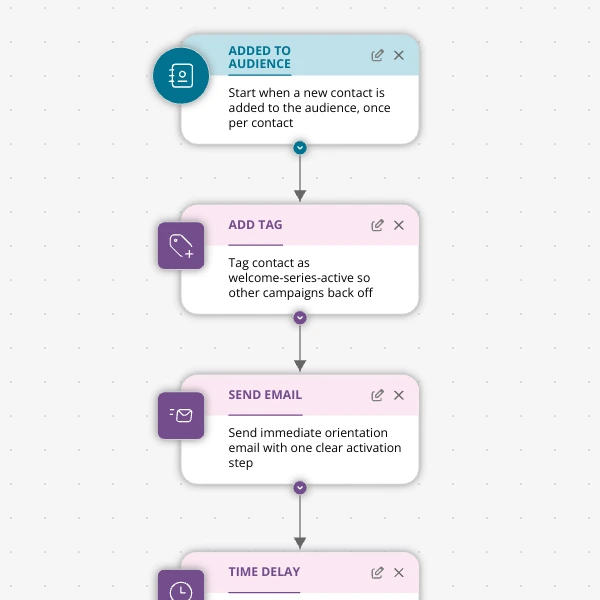
The Shopify app welcome series that turns installs into income
A step-by-step Shopify app welcome email journey for tools like CartSpark, showing how to turn new installs into activated, retained merchants using Spreeflo journeys, tags, and behavioral triggers so fewer trials quietly churn and more trials convert.
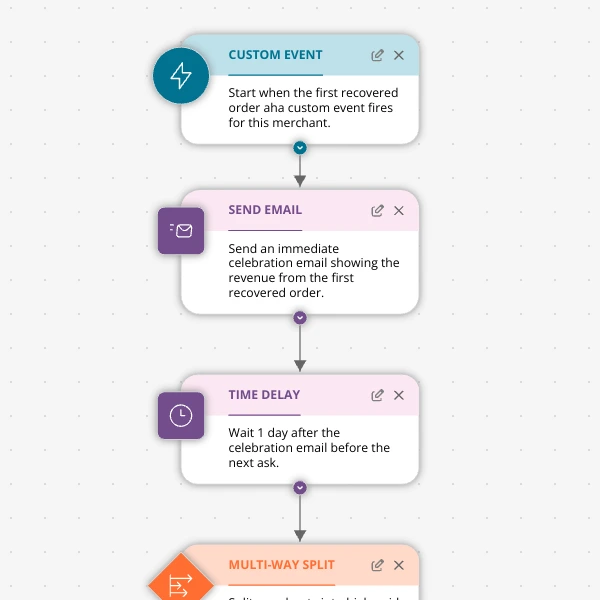
The Aha-Moment Playbook For Shopify Apps: Turn One Magic Action Into Months Of Revenue
A node-by-node playbook for Shopify and e‑commerce apps to center their lifecycle on one aha-moment custom event in Spreeflo, celebrate it, segment merchants by profile and engagement, and turn first recovered value into lasting revenue and retention.
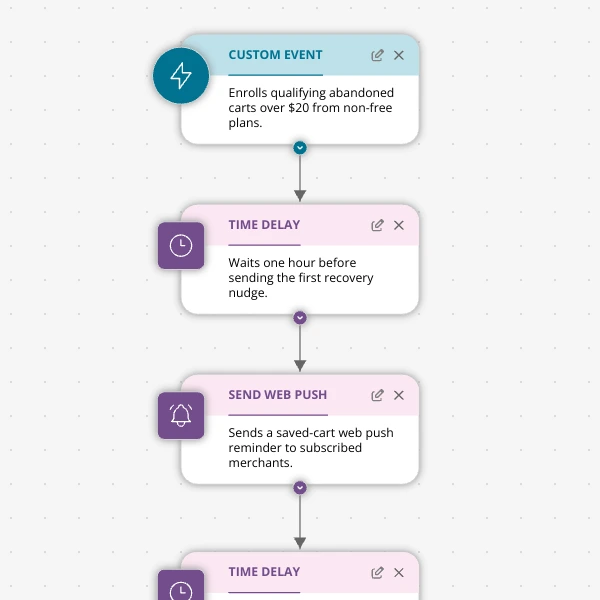
Stop Letting High‑Intent Carts Die: A 3‑Email Recovery Journey for Shopify Apps
A detailed, node-by-node walkthrough of a three-email (plus optional web push) cart-abandonment recovery journey for Shopify apps in Spreeflo, showing how to trigger events, branch on behavior, tag outcomes, and measure recovered carts and revenue.
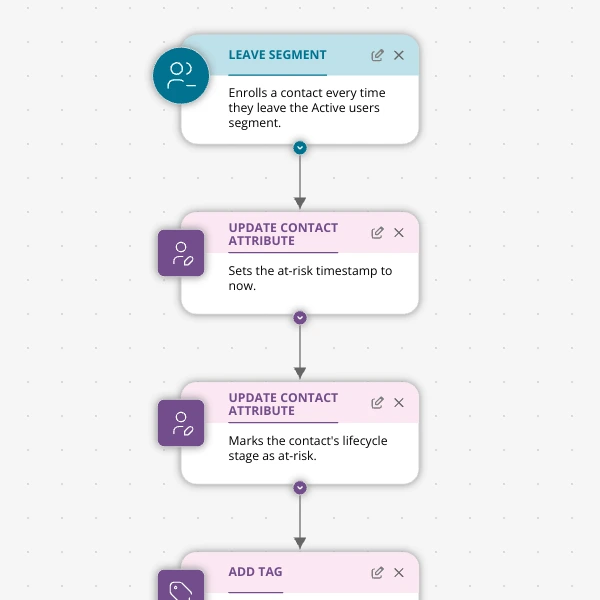
When Active Users Go Dark: A 4‑Touch Win‑Back Journey For Your Shopify App
A detailed, node-by-node Spreeflo journey for winning back previously active Shopify app users who stop engaging, using segment-based triggers, conditional logic, and a four-touch email plus internal alert sequence to recover usage and MRR.