Stop Quiet Churn: An Engaged‑Then‑Cold Rescue Journey for SEO SaaS
Build an engaged-then-cold rescue journey in Spreeflo for an SEO SaaS like RankPulse, defining engagement, triggering on segment exits, and automating alerts and personal check-ins so you catch quiet churn early and measurably improve LTV.
Industry
Niche
Pattern
Loading sequence...
A funny thing happens right before your MRR graph dips: your best users just… go quiet.
No angry emails. No bug reports. They simply stop opening your messages, stop logging in, and a few weeks later Stripe fires the “cancelled” webhook. By the time you notice, the account is gone and the agency has already migrated their clients somewhere else.
The sequence at the top of this page is the whole journey, end to end, for catching that moment earlier and doing something about it.
In this playbook, we’ll build an “engaged‑then‑cold” intervention for a fictional SEO SaaS called RankPulse: a rank tracking and content brief tool doing ~$40k MRR. They already have decent onboarding and trial flows, but they’re leaking lifetime value when power users drift away unnoticed.
This journey watches for highly engaged users who suddenly fall out of an “Engaged” segment, alerts the RankPulse team internally, and schedules a smart, personal‑feeling check‑in email that only sends if the user doesn’t self‑recover.
Why quiet churn from power users is your most expensive leak
For SEO SaaS, not all churn is equal.
Losing a free trial that never added a keyword hurts your ego. Losing a mid‑size agency that:
added dozens of projects
checks rankings every week
relies on your content briefs for client retainers
…hurts your MRR.
Those users already proved:
They can get value from your tool.
They’re willing to pay.
They have internal buy‑in.
When they go quiet, it’s rarely because your product “stopped being useful.” More often it’s:
A key user left the company.
A billing issue or failed card.
One annoying bug or missing feature that broke their trust.
They got busy and your tool slipped out of their weekly workflow.
In each case, a well‑timed, specific nudge saves the account more often than not. But you only get that chance if you:
Know who your “engaged” users actually are.
Detect when those specific users stop behaving like themselves.
Triage the right response without adding manual monitoring to your week.
That’s exactly what this journey in the Spreeflo platform is designed to do.
Step 1: Define “Engaged” like a data person, not a feeling
The journey’s trigger is “Leave Segment (Engaged).” That means your first job is to define an Engaged Users segment in Spreeflo’s segment builder.
For an SEO SaaS like RankPulse, “engaged” should be based on both email and in‑app behavior:
Example Engaged segment (conceptually):
Email Activity
- Opened at least 2 marketing emails in the last 21 daysAND Custom Events (from your app)
-checked_rankingstriggered at least 3 times in the last 14 days
- ORgenerated_content_brieftriggered at least 1 time in the last 14 daysAND Subscription state
- Email subscription status is Subscribed
- Marketing status is Marketing (optional if you use it)
You’d track those in‑app events using:
The Spreeflo SDK in your web app frontend (e.g. fire
checked_rankingswhenever a user loads a rankings report), as described in the web tracking and analytics guide.The Spreeflo API from your backend for billing‑side events like
subscription_renewedorcancelled_subscription.
This definition matters because it encodes your best understanding of “healthy usage”:
Rank trackers should behave like rank trackers (regular checks).
Content brief tools should see recurring brief generation.
Technical SEO tools should see recurring audits.
By capturing this detail on every customer, you earn the right to speak to each one uniquely. An account that was never engaged belongs in your onboarding flows. This journey is only for people who hit that engaged bar then fall off a cliff.
Step 2: Trigger on “Leave Segment (Engaged)” with re‑enrollment on
Now to the journey itself.
In Spreeflo’s campaign and journey automation, create a new journey and set the trigger to:
Trigger type: Leave Segment
Segment: Engaged Users (the one you just defined)
Re‑enrollment: On
Why Leave Segment, not Criteria Match?
The Engaged definition is reusable across your account: dashboards, other journeys, reports.
“Leave Segment” fires the moment a contact no longer matches that definition.
Why re‑enrollment on?
Because you want this safety net every time someone goes from Engaged → Not Engaged, not just once in their lifetime. Maybe an agency pauses usage in December, wakes up again in January, then goes quiet in April. Each drop matters.
Spreeflo will still prevent duplicate enrollments while they’re mid‑journey, so you won’t have two copies of this flow fighting each other.
Step 3: Tag and timestamp the “at‑risk engaged” state
Immediately after the trigger in the sequence at the top of this page, add two actions:
Add Tag
- Tag:engaged-then-coldUpdate Contact Attribute
- Attribute:at_risk_since(Timestamp custom attribute you create)
- Update type: Set now
The tag does two things:
It lets you build quick segments and dashboards later (“show me current engaged‑then‑cold accounts”).
It documents this state change for any teammate looking at the contact record.
The timestamp adds more analytical power:
How long do saved accounts typically stay at risk before they come back?
Are there plan tiers where users linger in this state longer?
Because Update Contact Attribute writes a fixed literal or “now” at the moment the node runs, you get a clean, comparable field on every at‑risk contact.
This is where most tools stop thinking. You’re already ahead: engaged churn isn’t just a feeling; it’s a documented state change.
Step 4: Fire an internal alert with context
Next node: Send Internal Email.
Configure it roughly like this:
Recipient: your “customer success” inbox, founder email, or a shared team list.
Subject: “High‑value user just went cold: {{contact.email}}”
Body: include dynamic fields like plan, company, last active event, number of tracked projects, etc.
You build this email with the same editor you use for customer emails in Spreeflo’s email builder, but the recipient is your team.
Why bother with internal alerts when the journey will also email the user?
Because some accounts warrant manual eyes:
Agency on your highest plan.
User with unusually high project count.
A beta customer or early adopter you care about personally.
The alert gives your team a chance to:
Skim recent support tickets.
Check product analytics for anomalies (e.g. a spike in crawl errors).
Decide if a truly personal outreach (e.g. Loom video) is worth it.
This is how founder‑led businesses win: your automation doesn’t replace your judgment; it routes your attention to the few cases that actually deserve it.
Step 5: Give them a short window to self‑recover
You don’t want to send a “we miss you” email one hour after someone falls out of Engaged. They might have simply skipped a week of ranking checks.
Drop a Wait Condition next:
Condition: “Is member of segment Engaged Users”
Timeout: 1 day (or 2–3 days if your usage pattern is more weekly)
This tells Spreeflo:
“Hold this contact here until either they become Engaged again, or the timer runs out — whichever comes first.”
Immediately after that, add an If/Else process node with the same condition:
If: Is member of segment Engaged Users
Else: Everyone else
This pattern matters because Wait Condition doesn’t tell you how it was satisfied. The If/Else after it double‑checks:
If they re‑engaged inside the window: they go down the “recovered” branch.
If they didn’t: they go down the “still cold” branch.
On the recovered branch:
Remove Tag:
engaged-then-coldOptionally Add Tag:
engaged-recoveredfor analyticsOptional Send Internal Email: “Good news: {{email}} is active again”
No customer email yet. They self‑fixed; your automation just tidied up the data.
Step 6: Send a personal‑feeling check‑in if they’re still cold
On the “still cold” branch out of the If/Else, you finally talk to the customer.
Add a Send Email node:
From: a real person (founder or head of product), not “no‑reply@”
Send only once: On
The copy should not be generic and should not pretend you didn’t notice their past engagement. You did notice — that’s the whole point of the journey.
Structurally, it might look like:
Subject: “Still using RankPulse for [their use case]?”
Opening: Acknowledge their previous heavy usage (“You were one of our most active users in March…”)
Middle: One or two specific possibilities: “We often see three reasons this happens: client mix changed, priorities shifted, or we missed on a feature you needed.”
CTA: A simple reply or 15‑minute call link.
Because Spreeflo has all the behavioral detail, you can even hint at specific features:
“I saw you were generating a lot of content briefs for ‘best X tools’ queries — curious if that workflow changed?”
“You were checking rankings weekly for 12 projects; did those move to a different stack?”
That’s brand message #1 in action: you’re speaking to them as a specific customer, not a row in a CSV.
Important pacing note: This is the only customer‑facing email in this journey. There’s no second marketing email immediately after it. That keeps you clear of spammy back‑to‑back sends and leaves room for a measured follow‑up pattern elsewhere if you want it.
Step 7: Wait again, then classify the outcome
After the check‑in email, add:
Time Delay
- 3 days (or 5–7 if your users work episodically)Wait Condition
- Condition: “Is member of segment Engaged Users”
- Timeout: 0 days (you can set this to 0 days and rely solely on the check, or keep it at 1 day to let late events land)If/Else
- Same condition as before.
On the “re‑engaged after email” branch:
Remove Tag:
engaged-then-cold(if you haven’t already)Add Tag:
saved-from-engaged-churnUpdate Contact Attribute:
at_risk_outcome= "saved" (TEXT attribute with static value)
Optionally, you can trigger another Send Internal Email here to celebrate the save, especially for bigger plans.
On the “still cold after email” branch:
Update Contact Attribute:
at_risk_outcome= "not_saved"Optionally Add Tag:
likely-churnOptionally Send Internal Email: “Likely churn: {{email}} still inactive after outreach”
You’re not spamming the user; you’re preparing your data:
Future reporting can slice by
at_risk_outcome.Sales or success can search for
likely-churntags to prioritize higher‑touch rescue attempts.Most importantly, the journey ends cleanly here. The contact leaves the flow so they’re eligible for re‑enrollment if they later become Engaged and then drop again.
Step 8: Measure early‑churn save rate and timing
Now the fun part: using all that structure to see if the journey is actually working.
With the tags and attributes you added, you can build segments like:
“Was tagged
engaged-then-coldin the last 60 days ANDat_risk_outcomeissaved”“Was tagged
engaged-then-coldin the last 60 days ANDat_risk_outcomeisnot_saved”
From there you can:
Compare renewal or expansion rates between these two groups.
Look at average
at_risk_since→ “rejoined Engaged” lag for saved accounts.Experiment with different timings (e.g. trigger on Engaged drop after 14 days of no opens vs 21 days) and see which produces more saves with fewer false alarms.
This is where the campaign and journey automation help doc and the audiences view work together: journeys change tags and attributes; segments and audiences expose the patterns.
A simple metric to start with:
Early‑churn save rate =
Count of contacts withengaged-then-coldandat_risk_outcome = saved
÷
Count of contacts withengaged-then-cold(any outcome)
Even a 10–20% save rate among previously engaged users can have an outsized impact on your MRR, because those accounts carry higher LTV.
Adapting the pattern for your specific SEO SaaS
The skeleton journey stays the same across products. You’ll adapt:
What “Engaged” means.
- Rank tracker: frequentchecked_rankings.
- Brief tool: steadygenerated_content_brief.
- Technical SEO: recurringran_site_audit.Who gets alerted internally.
- Founder for all accounts under $20k MRR.
- Dedicated success person for high‑tier agencies.
- A shared support inbox for everyone else.How personal the check‑in email is.
- At small scale, you might actually write each one as a true 1:1 reply.
- At larger scale, you’ll rely on personalization via attributes and events and draft one flexible template.
If your user base is diverse, you can layer on a Multi‑way Split right after the trigger:
Branch by plan (Free, Pro, Agency).
Or by primary use case (content teams vs technical SEOs, inferred from feature usage).
Each branch can send a slightly different internal alert and check‑in email while still sharing the rest of the logic.
Because all of this runs inside the same contact record and automation canvas, you’re not duct‑taping five tools together. And thanks to Spreeflo’s contact‑based billing (with unlimited non‑marketing contacts, outlined in about Spreeflo pricing plans), you can track rich event data even for accounts you’re not actively marketing to yet.
The bigger lesson: don’t let your best users disappear quietly
Most SEO SaaS founders watch the top of the funnel obsessively: new trials, new signups, new keywords tracked. The quieter leak is in the middle:
Users who already hit their “aha” moment.
Accounts that were clearly getting value.
Agencies whose logos you proudly show in your deck.
When those users go cold, that’s not random churn. It’s a high‑signal event that deserves a structured response.
This engaged‑then‑cold journey does three important things for you:
It formalizes what “engaged” means in your world, using actual data.
It catches the moment when that state breaks, without you staring at dashboards all day.
It turns that signal into targeted, human outreach rather than yet another generic sequence.
You build it once in Spreeflo, and it runs quietly in the background, nudging you whenever a valuable user needs attention. That’s how a small team plugs lifetime‑value leaks without adding more meetings or headcount.
If you already track events in your app and send basic campaigns, this is usually the next automation that earns a permanent spot in your stack.
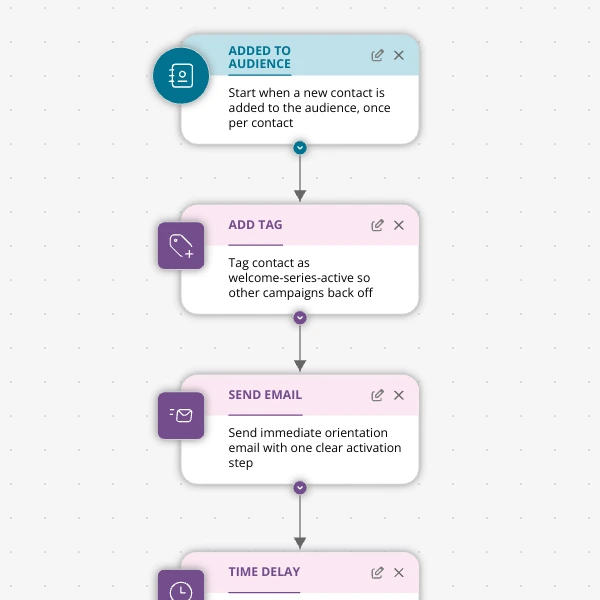
The Shopify app welcome series that turns installs into income
A step-by-step Shopify app welcome email journey for tools like CartSpark, showing how to turn new installs into activated, retained merchants using Spreeflo journeys, tags, and behavioral triggers so fewer trials quietly churn and more trials convert.
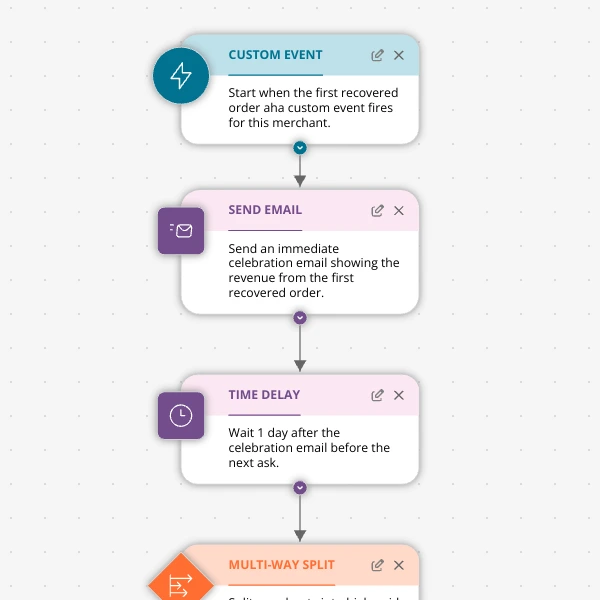
The Aha-Moment Playbook For Shopify Apps: Turn One Magic Action Into Months Of Revenue
A node-by-node playbook for Shopify and e‑commerce apps to center their lifecycle on one aha-moment custom event in Spreeflo, celebrate it, segment merchants by profile and engagement, and turn first recovered value into lasting revenue and retention.
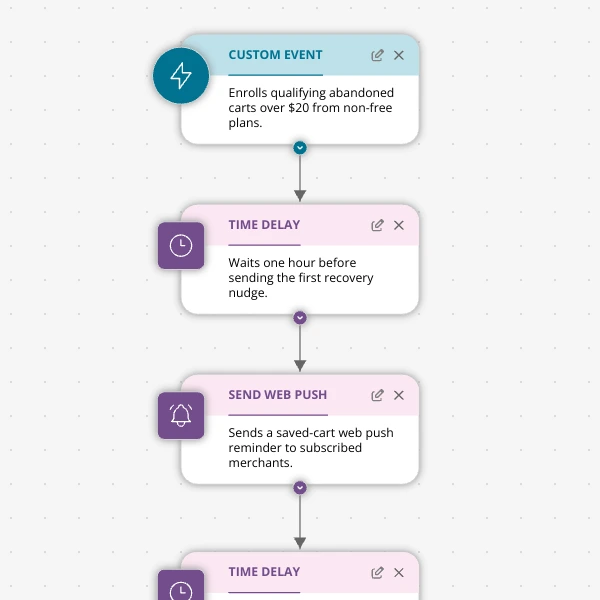
Stop Letting High‑Intent Carts Die: A 3‑Email Recovery Journey for Shopify Apps
A detailed, node-by-node walkthrough of a three-email (plus optional web push) cart-abandonment recovery journey for Shopify apps in Spreeflo, showing how to trigger events, branch on behavior, tag outcomes, and measure recovered carts and revenue.
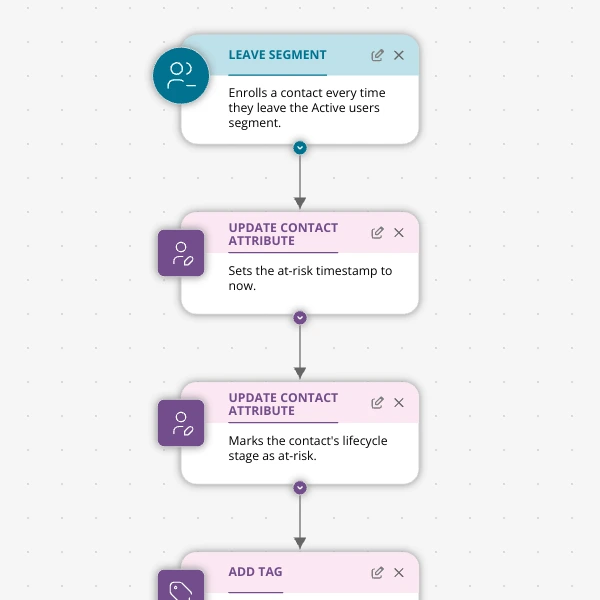
When Active Users Go Dark: A 4‑Touch Win‑Back Journey For Your Shopify App
A detailed, node-by-node Spreeflo journey for winning back previously active Shopify app users who stop engaging, using segment-based triggers, conditional logic, and a four-touch email plus internal alert sequence to recover usage and MRR.