The 14‑Day Trial Nurture Flow That Stops Your SEO SaaS Bleeding Signups
Step-by-step 14-day trial nurture journey for SEO SaaS tools, showing exactly how to wire behavior-based emails, events, and tags in Spreeflo so more trials activate, experience real value, and convert to long-term paying customers.
Industry
Niche
Pattern
Loading sequence...
A lot of SEO tools don’t lose customers on price or features. They lose them because trials quietly expire before the user ever sees real value.
Think about a team like “RankPulse,” a three‑person rank tracker doing $35k MRR. They get 600 trials a month. Fewer than 100 ever add a keyword. By day 14, most “users” have barely logged in, and the founder is staring at a churn graph instead of a growth curve.
The sequence at the top of this page is the whole journey, end to end. It’s a behavior‑aware, time‑based nurture you can drop into Spreeflo to stop your own trials from drifting away.
This playbook walks through that journey node by node, why it’s wired that way, and exactly how you’d adapt it for your own SEO SaaS.
Why most SEO SaaS trials quietly die
SEO tools are a special kind of “slow burn” product:
The aha moment is rarely instant. You need keywords configured, a crawl to finish, or enough days of data before charts look interesting.
Your ideal users are busy. Agency owners, in‑house marketers, founders. They sign up between calls, then forget.
The trial clock keeps ticking whether they’re active or not.
If you just send a generic “Welcome to [Product]” and maybe a “Your trial is ending” blast, you’re leaking lifetime value on every trial. Trial users never:
Add enough keywords
Connect Google Search Console
Generate their first content brief
Share a report with a client
The fix isn’t “more emails.” It’s the right email, at the right time, tied to what they have or haven’t done yet.
That’s what this journey does.
The spine of the journey: trigger and timing
This is a Journey in Spreeflo, not a one‑off campaign. Journeys run continuously and react to behavior over time, which is exactly what you need across a 14‑day trial. If you’re new to this distinction, a quick skim of the campaign and journey overview in Spreeflo is worth the time.
Entry: the `trial_started` Custom Event
The primary trigger is a Custom Event:
Event name:
trial_startedSent from: your backend via the Spreeflo API whenever a new trial is created
isReEnrollment: set totrueso someone who comes back months later for a second trial can go through the journey again after they’ve exited the first run
Why Custom Event and not Add to Audience?
Because you want to be precise. Not every new contact is on a product trial. A visitor who only downloads a whitepaper shouldn’t get this sequence.
Once trial_started fires, the contact enters the journey immediately.
Email pacing across 14 days
Inside the journey, every Send Email node is separated by a Time Delay of at least one day. This matters for two reasons:
It avoids spammy back‑to‑back sends.
It aligns roughly with the natural rhythm of trial usage. Daily check‑ins make sense for a 14‑day trial.
Most flows in the sequence space emails 1–3 days apart. You’ll tune this per your audience, but the pattern holds: never two emails in a row; always a pause or condition in between.
Day 0–1: Welcome and the first meaningful action
Right after the trigger, the journey sends a welcome email:
Node: Send Email (Welcome)
Content: short, focused on getting to one concrete action:
Rank tracker: “Add your first 5 keywords”
Brief tool: “Generate your first content brief from a URL”
Technical SEO tool: “Run your first crawl on your main domain”
This is where Spreeflo’s email builder comes in. Build a simple, mobile‑friendly template with:
A single primary CTA that deep‑links to the setup screen
A short checklist of what the trial will cover, framed as outcomes
Then:
Node: Time Delay (1 day, unit: Day)
You give them 24 hours to act before branching on behavior.
Branching early: did they actually do anything?
After the one‑day delay, the journey hits its first If/Else node. The condition is defined with the segment builder:
Condition group (OR):
Custom Events:
added_first_keywordtriggered at least 1 time over all timeOR
connected_search_consoletriggered at least 1 time over all timeOR
ran_first_crawltriggered at least 1 time over all time
These events are:
Tracked in your frontend with the Spreeflo SDK (for button clicks or wizard completions), or
Posted from your backend to the events API when work completes (e.g., crawl finished)
Contacts who match this condition go down the “Activated basics” branch. Everyone else goes down the “Still unactivated” branch.
Why this split?
Users who’ve seen at least some value
Users who have an empty dashboard
Sending both groups the same email wastes the data you worked to collect.
Fast activators: deepen value, don’t repeat basics
On the “Activated basics” path, the next few nodes are about usage depth.
Node: Send Email – “Nice work, here’s what power users do next”
This email acknowledges what they’ve already done and points to the next level:
“Since you’ve added your first keywords, here’s how agencies use RankPulse to monitor clients automatically.”
Two or three deeper behaviors:
Create a segment for “money pages”
Set up competitor tracking
Schedule a weekly report to your client’s email
Because Spreeflo captures detailed event data, you can personalize this email:
Show different copy if they connected GSC vs only added keywords
Mention the exact site they first added
That level of specificity is where Message #1 (“capture detail so you can speak uniquely”) quietly shows up, even though the core brand message for this pattern is about plugging lifecycle leaks.
Then:
Node: Time Delay (2 days)
Give them space to explore.
Node: If/Else – “Have they explored advanced features?”
Condition:
Custom Events (OR):
generated_content_brieftriggered at least 1 timeOR
shared_reporttriggered at least 1 timeOR
set_up_alerttriggered at least 1 time
If Yes (they’ve tried advanced features):
Node: Add Tag – apply
trial_power_userNode: Send Email – case‑study style email:
Node: Time Delay (3 days)
“How [Agency X] uses [Your Tool] across 12 clients”
Heavier on upgrade benefits, because they’re clearly engaged
If No (they’re still dabbling):
Node: Add Tag – apply
trial_activatedNode: Send Email – “One more thing before your trial ends”
Node: Time Delay (3 days)
Single advanced feature you absolutely want them to see
Short loom link or GIF walkthrough
Both paths then hit a Merge node to rejoin the main flow before the end‑of‑trial messaging begins. The tags you added (trial_power_user, trial_activated) are gold later for segmentation and pricing decisions.
Stalled trials: unblock, don’t nag
Now back to the “Still unactivated” branch from Day 1.
These are the folks who opened your welcome email (maybe) and then… nothing.
Node: Send Email – “Let’s get your first results together”
This is not another generic welcome. Make it almost unskippable:
Call out the empty state explicitly: “Right now your dashboard has no keywords. That means no rankings, no insights.”
Embed a 2–3 step mini‑guide:
Offer help: “Reply with your site and we’ll send back a recommended keyword set.”
“Add your domain”
“Paste in 5 keywords you already care about”
Then:
Node: Time Delay (2 days)
Node: Wait Condition – “Wait up to 3 days for activation”
Now you use Wait Condition:
Condition: Custom Event
added_first_keywordtriggered at least 1 time over all timeTimeout: 3 days
Spreeflo will hold each contact here until either:
They add a keyword, or
Three days pass
You still don’t know which happened, so you follow immediately with another If/Else:
Condition: same as above (
added_first_keywordat least 1 time)
If Yes (they finally activated):
Node: Add Tag – apply
trial_rescuedNode: Merge – join into the same mid‑trial flow as the “Activated basics” branch
Node: Send Email – “Is this still something you need?”
If No (completely cold by Day 6):
Node: Add Tag – apply
trial_at_riskNode: Send Email – “Is this still something you need?”
Very plain‑spoken
Reminds them what pain they said they had on signup (rank volatility, content backlog, technical issues)
Asks a one‑line question they can reply to
Then:
Node: Time Delay (3 days)
Node: Merge – flow back into the shared “trial ending soon” branch
This is how you nurture without being annoying:
You give stalled users extra support
You stop pretending they’re engaged
You still bring them into the same expiry messaging so they’re aware of options
Final stretch: from value to paid plan
By this point in the journey (around Day 10–11), every trialist has:
Either reached an activation milestone
Or been tagged as
trial_at_risk
Now you want to:
Reinforce the value they’ve already seen
Make the upgrade decision feel straightforward
Node: Send Email – “Here’s what you’ve achieved in your trial so far”
This email goes to everyone after a Merge node.
Content ideas:
“You’ve tracked 74 keywords across 3 projects.”
“You’ve generated 4 content briefs; two of those articles are already live.”
“You’ve fixed 23 technical issues flagged in your last crawl.”
You can pull these numbers from:
Custom events aggregated in your own backend and synced via
Spreeflo.identifyon the web SDK, orAttributes you maintain on the contact via your own systems
Even if you don’t personalize counts on day one, you can still speak concretely: “Most teams who reach [X] in their trial see [Y] within 60 days.”
Then:
Node: Time Delay (2 days)
Node: If/Else – “Have they shown pricing intent?”
If you’re on the Professional plan and have the SDK installed, you can use Spreeflo’s web tracking and analytics data in the segment builder:
Condition:
Page Visited URL contains
/pricingat least 1 time in the last 7 days
If Yes (they’ve hit pricing):
Node: Send Email – “Which plan makes sense for you?”
Short comparison table tailored to agency vs in‑house if you know their persona
A direct link to the correct billing screen
Node: Time Delay (1–2 days)
Node: Send Email – “Trial ending tomorrow” with a light urgency nudge
If No (no pricing visits):
Node: Send Email – “Don’t lose the rankings you’re tracking”
Reframes the trial end as losing continuity of the data they just started to collect
Strong CTA to view plans
Node: Time Delay (1–2 days)
Node: Send Email – “Last day on your trial” with a straightforward ask
Every one of these last emails is still separated by Time Delay, so nobody gets hit twice in a row.
Once they exit this path, you can either:
Let a separate billing‑status journey take over, triggered by
upgraded_plan, orUse a Leave Segment trigger in another journey for people who leave the “Active Trial” segment without upgrading (they become a reactivation audience)
Wiring this in Spreeflo without losing a week to setup
Because this is a journey, not a one‑off, you build it once and it quietly does the work while you ship product.
The core pieces in Spreeflo:
Custom Events for:
trial_started,added_first_keyword,connected_search_console,ran_first_crawl,generated_content_brief,shared_report,upgraded_plan, etc.Frontend events via the SDK
Backend events via the Spreeflo API
A Journey built in the visual editor (see the campaign & journey automation doc for mechanics)
Conditions built with the segment builder inside If/Else and Wait Condition nodes
Email content drafted with the email builder so you’re not hand‑coding HTML for each step
A couple of Add Tag actions to flag
trial_power_user,trial_activated,trial_rescued,trial_at_risk
Once you switch the journey on, every new trial that fires trial_started is automatically enrolled. You don’t have to remember to “add them to a sequence” in your CRM.
What to measure and how to tune it
This pattern exists to plug a very specific lifecycle leak: trials that never come alive.
Metrics to watch:
Trial activation rate
Feature adoption and usage depth
Trial‑to‑paid conversion
Tag distribution
Percentage of trials that trigger any of your activation events:
added_first_keywordconnected_search_consoleran_first_crawl
Counts of advanced events per trial:
generated_content_briefshared_reportset_up_alert
Trials that trigger upgraded_plan within X days of trial_started.
How many contacts end this journey tagged as trial_power_user vs trial_at_risk.
Small tuning loops:
If activation is low even after the first two emails, make the Day‑2 “Let’s set up together” email more opinionated and simplify the steps.
If trials activate but don’t convert, focus your late‑stage emails less on “see more features” and more on “here’s why paying is cheaper than not fixing this SEO problem”.
If many users reach advanced usage but still churn later, those tags become the seed for a different retention journey.
The point: this journey doesn’t just send emails. It labels contacts in meaningful ways that your future automations can use.
The real win: compounding retention for a tiny team
For an SEO SaaS founder, the constraint is almost never ideas. It’s time.
You don’t have a 10‑person lifecycle team to hand‑hold every trial. What you do have is:
A clear sense of the 3–5 behaviors that predict a long‑term customer
The ability to instrument those behaviors as events
A tool that can react automatically when they happen — or when they don’t
Most businesses in your position leak lifetime value simply because they don’t nurture engagement across the trial. They let people sign up, poke around, and drift away.
This free trial nurture journey is how you stop that.
You wire it once in Spreeflo, let it run for a few weeks, then tune based on real behavior. Every saved trial, every rescued account, every extra month of retention is compounding revenue — bought not with headcount, but with a system that keeps working while you focus on building the best SEO tool you can.
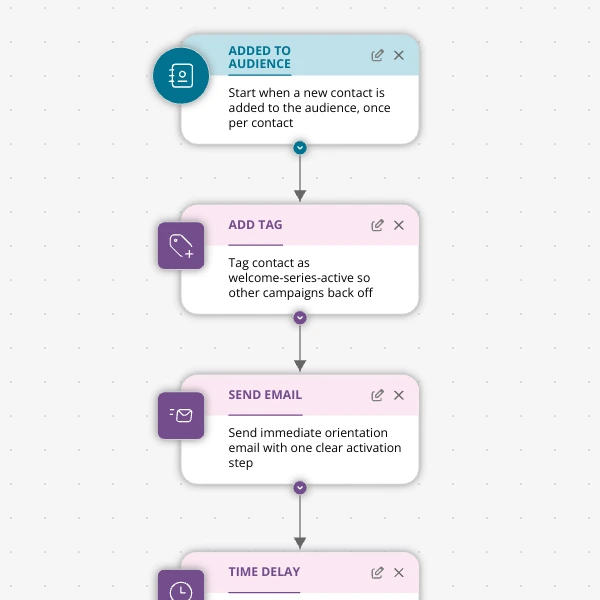
The Shopify app welcome series that turns installs into income
A step-by-step Shopify app welcome email journey for tools like CartSpark, showing how to turn new installs into activated, retained merchants using Spreeflo journeys, tags, and behavioral triggers so fewer trials quietly churn and more trials convert.
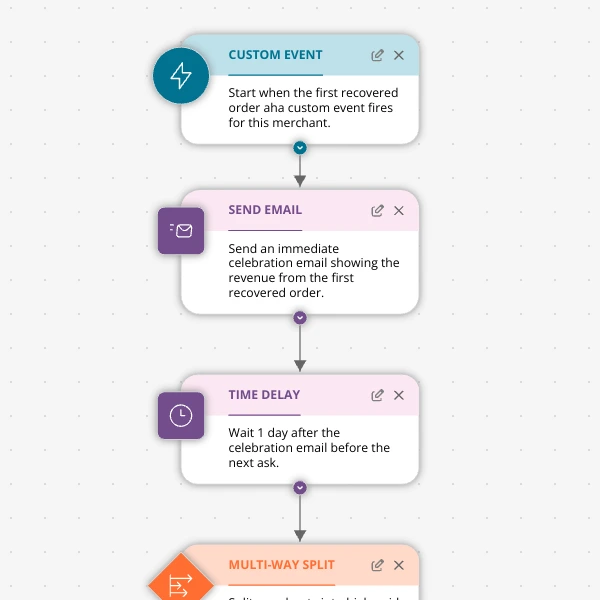
The Aha-Moment Playbook For Shopify Apps: Turn One Magic Action Into Months Of Revenue
A node-by-node playbook for Shopify and e‑commerce apps to center their lifecycle on one aha-moment custom event in Spreeflo, celebrate it, segment merchants by profile and engagement, and turn first recovered value into lasting revenue and retention.
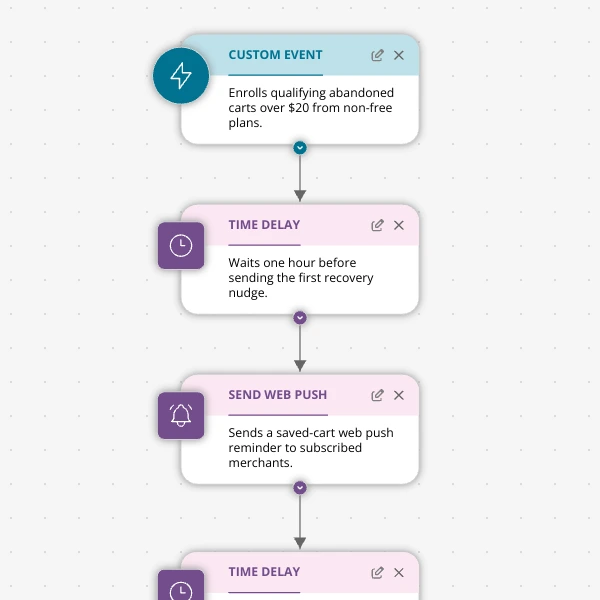
Stop Letting High‑Intent Carts Die: A 3‑Email Recovery Journey for Shopify Apps
A detailed, node-by-node walkthrough of a three-email (plus optional web push) cart-abandonment recovery journey for Shopify apps in Spreeflo, showing how to trigger events, branch on behavior, tag outcomes, and measure recovered carts and revenue.
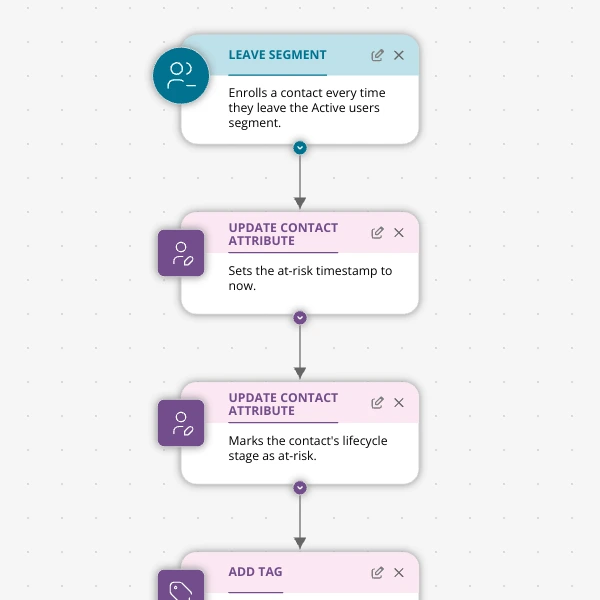
When Active Users Go Dark: A 4‑Touch Win‑Back Journey For Your Shopify App
A detailed, node-by-node Spreeflo journey for winning back previously active Shopify app users who stop engaging, using segment-based triggers, conditional logic, and a four-touch email plus internal alert sequence to recover usage and MRR.