The Profile-Completion Nudge That Makes Every SEO SaaS Email Smarter
Playbook for SEO SaaS teams to detect incomplete trial and customer profiles and run a lightweight, two-step email and in-app nudge journey so they capture key attributes like role, team size, and use case and improve all downstream segmentation.
Industry
Niche
Pattern
Loading sequence...
A lot of SEO SaaS onboarding breaks in the same quiet way: you get the email, the password, maybe a domain… and then nothing. No role, no team size, no use case. So six weeks later you’re still talking to a solo blogger and a 50‑seat agency like they’re the same person.
The sequence at the top of this page is the whole journey, end to end. It’s built for that exact problem: detect which trial and new customers are missing key profile fields, then nudge them with a short, targeted reminder so the rest of your lifecycle flows have sharper edges.
We’ll walk through how a fictional SEO SaaS, BrieflySEO (content brief generator, ~$60k MRR), uses this pattern to boost activation and make every downstream email feel tailored instead of generic.
Why incomplete profiles quietly trash your segmentation
Think about your own product for a second:
An in‑house SEO at a B2B SaaS wants weekly “keyword gap” briefs for a set of core pages.
A content agency wants multi‑domain reporting and client‑ready PDFs.
A niche affiliate blogger wants rank‑tracking alerts and “easy win” content ideas.
If you don’t know which one just signed up, every automation you send is a compromise. That shows up as:
Lower trial‑to‑paid conversion because onboarding talks past their actual job.
Poor expansion because you never pitch the team features to teams.
Higher churn because the value narrative doesn’t match how they’re trying to use you.
All because “role”, “industry”, and “team size” were optional on sign‑up, and most people skipped them.
This journey fixes that in a lightweight way: it finds contacts where those attributes are missing, then runs a tight two‑step reminder that points them back to your profile/setup page (and optionally an in‑app micro‑survey). Once that data is in Spreeflo, every other journey you build gets smarter.
What “profile completeness” should mean in an SEO SaaS
Before touching the flow, decide which attributes are non‑negotiable for good segmentation. For most SEO tools, you want at least:
Role: freelancer, in‑house, agency, founder, marketing generalist.
Team size: 1, 2–5, 6–20, 21+.
Primary use case: rank tracking, content briefs, technical audits, reporting.
Industry or site type: SaaS, ecommerce, local services, media/publishing, other.
With just those four, you can:
Send different “first win” checklists to solo SEOs vs. agencies.
Trigger “add teammates” nudges for accounts where team size ≥ 3.
Highlight API/reporting features only to agencies and in‑house teams.
Swap examples in your onboarding emails to match their industry.
The goal of this pattern is not to collect everything at once. It’s to reliably capture the 2–4 datapoints that make every later decision – what content to send, what feature to promote, when to push for the upgrade – much more precise.
How the journey works at a glance
Here’s what the sequence at the top of this page is doing, conceptually:
A Criteria Match trigger continuously looks for contacts who are:
- Newly added,
- Subscribed to marketing email,
- Missing at least one of your key profile attributes.Those contacts are tagged as “needs profile data” and get a short, value‑framed email asking for two quick answers to personalize their experience.
After a few days, an If/Else check asks: “Did they complete their profile?”
If yes, they drop into a “completed” path: you tag them as complete and optionally send a confirmation that reinforces next steps tailored to their segment.
If not, they get one concise final reminder, and you can optionally follow up with an in‑app popup form for active users who keep ignoring email.
Tags and attributes from this journey power downstream segments: complete vs. incomplete profiles, plus the new fields themselves.
Let’s break it down node by node and talk about the why behind each choice.
Step 1: Get your attributes into Spreeflo cleanly
First, you need Spreeflo to actually know about “role”, “team size”, and friends.
In your workspace’s audience and custom attributes (see the audiences overview), define:
role(TEXT or a set of expected values),team_size(NUMBER or TEXT with ranges),primary_use_case(TEXT),industryorsite_type(TEXT).
Then make sure these get populated whenever you have them:
On sign‑up: if your registration form already asks for any of these, send them into Spreeflo as contact attributes (e.g., via
Spreeflo.identifyin your frontend, or a backend POST to the Spreeflo API when an account is created).From imports: when you import existing customers, map those columns to the same attributes so you don’t have two competing versions of “industry”.
You don’t have to migrate every bit of product data, just enough context for segmentation. The profile‑completion journey will help fill the rest.
Step 2: Criteria Match trigger – define “missing profile”
Create a new journey (not a one‑off campaign – journeys run continuously). If you want a refresher on how triggers behave, the campaign and journey automation guide walks through the editor basics.
Use a Criteria Match trigger as the single entry point. In the embedded segment builder, set up a condition like:
Group A (AND):
Email subscription status is “Subscribed”.
Contact added date is within the last 30 days.
Group B (OR):
roleis blank.team_sizeis blank.primary_use_caseis blank.industryis blank.
That reads as: “any new-ish, subscribed contact who is missing at least one of our key fields.”
A few design choices here:
Limit to new contacts (e.g., 30 days) so you don’t suddenly hit old customers with “complete your profile” out of nowhere. You can always spin up a separate, more carefully worded win‑back for legacy accounts.
Check for “blank” on each attribute individually instead of a single “profile_complete” flag. That keeps the journey resilient if you later decide to make role mandatory at sign‑up but keep industry optional.
Set Re-enrollment to off. Someone should only move through this journey once; if they churn and come back months later, their new account is a fresh contact anyway.
Immediately after the trigger, add:
An Add Tag action: e.g.,
profile-nudge-started. This gives you a quick way to segment people who have been through this journey at least once.
Step 3: Email 1 – a short, specific value promise
Next node: Send Email.
This is where many teams overthink. The goal of this email is not to explain your whole product again. It’s to answer one question for the reader: “Why should I bother giving you this info?”
A straightforward structure, built in the email builder:
Subject: “Two quick questions so we can send better SEO wins”
Opening line: Acknowledge they’re busy and make the benefit concrete.
“You just started your BrieflySEO trial – nice. To send you useful playbooks instead of noise, we’re missing two details.”Body:
- 1–2 bullets that tie profile fields to value. For example:
- “Your role tells us whether to send client‑ready templates or in‑house workflow tips.”
- “Your primary use case changes which success stories we highlight first.”A single CTA button: “Complete your profile” linking to your in‑app settings/onboarding page where they can update role, team size, and use case.
Close: Reassure this is optional but helpful. No threats, no faux urgency.
In the node settings, keep “Send only once” on. Even if you later rework the journey, you don’t want anyone to ever receive this same profile‑nudge email twice.
The journey then flows into a Time Delay node.
Step 4: Time Delay – give them room to act
Insert a Time Delay of 3 days (unit: days, value: 3).
Why a fixed delay instead of a Wait Condition?
You want to respect message pacing. Some people will complete their profile minutes after the first email. A Wait Condition that can resolve instantly might push them straight into a second email, which feels spammy.
A simple delay guarantees at least 72 hours between your first and any possible second email, regardless of when they act.
During those three days, your app’s normal UI and flows are doing the work. When a user updates their role or team size in your product, your backend can update the contact attributes in Spreeflo via the API. By day three, they either have a complete profile or they don’t.
Step 5: If/Else – did they complete their profile?
After the delay, add an If/Else process node.
Condition (built with the segment builder inside the node):
Group (AND):
roleis not blank.team_sizeis not blank.primary_use_caseis not blank.industryis not blank.
That’s your definition of “profile complete” for this journey.
If the condition is true, the contact goes down the “yes” branch.
Everyone else drops into the “else” branch.
A subtle benefit of checking each attribute directly instead of looking for a “profile_complete” tag: this always reflects reality. If a user later removes or changes something in your app, the state in Spreeflo still matches.
Step 6A: The “completed” branch – tag and reinforce
On the “yes” side, add:
An Add Tag action: e.g.,
profile-complete. This becomes your canonical signal for downstream journeys that want only well‑annotated contacts.Optionally, a second Send Email node that:
- Thanks them for completing their profile.
- Uses their fresh attributes to make the product feel tailored.
Example content:
For an agency with team size 6–20 and use case “reporting”, you might highlight:
- How to set up multi‑client workspaces.
- Templates for monthly client SEO reports.For a solo niche blogger focused on “content briefs”, you might send a “First 3 briefs to create this week” guide.
With the attributes now available, you can use Spreeflo’s personalization and AI features to vary examples, CTAs, and even subject lines so each segment feels like you wrote the email for them.
Because this second email sits after a 3‑day delay from the first, you’re still pacing messages conservatively.
You can end the branch here. The point is simply to acknowledge their effort and start using the new data immediately.
Step 6B: The “still incomplete” branch – one last nudge (plus optional in‑app form)
On the “else” side (attributes still missing after 3 days), add:
A Send Email node for a final reminder. Keep it even shorter than the first:
- Subject: “Can we tailor BrieflySEO to your role?”
- One sentence on why it matters.
- One CTA back to the same in‑app profile page.
This email is for people who saw the first message and ignored it, or missed it entirely. Don’t guilt‑trip them. They’re doing you a favor if they respond; respect that.A Time Delay of 7 days. Give them another week before trying anything else.
(Optional, Pro plan) A Popup Form action for in‑app visitors.
This is powerful for users who keep logging into your app but never click your emails. With a Popup Form action:
- Build a tiny Spreeflo form with 1–2 key questions (for example, role and use case). Make sure the form’s Map to contacts is on and each question is mapped to the right contact attribute. The forms help guide walks through that setup.
- Use the Popup style that fits your UI (Popover or Sidetab often feel less intrusive than a full modal).
- In the action node, target the popup to show only on specific app URLs (like/onboardingor/dashboard), and cap frequency so it appears at most once every few days.
The journey designs when the popup becomes eligible; the SDK on your app handles actually showing it when the contact is online. Because the user is already identified, their answers map straight onto the same contact record without asking for an email again.
Once the second email and optional popup run, you can end the branch with an Add Tag action like profile-incomplete. That gives you visibility into how many people opted out of sharing more detail, and lets you treat them differently later (for example, defaulting them into more generic, conservative messaging).
Step 7: Use completeness in every later journey
The immediate win of this pattern is higher profile‑completion rates. The compounding win is what you do with that data afterwards.
A few ideas grounded in SEO SaaS realities:
Onboarding paths by role
Use a Join Segment trigger for “Segment: Role is Agency” to send agency‑specific onboarding lessons (client reporting, multi‑domain tracking) that you’d never send to solo site owners.Expansion based on team size
Whenteam_sizecrosses thresholds, trigger nudges about shared workspaces, permissions, or “add a new seat” offers. Agencies with 8 people in the product are ripe for expansion; a single founder is not.Use‑case‑aligned education
Ifprimary_use_caseis “technical audits”, focus your ongoing content on crawl reports, Core Web Vitals, and fixing critical issues. If it’s “content briefs”, send templates and SERP analysis tips instead.
All of that depends on having the attributes in the first place. This profile‑completion reminder journey is how you get there without manual chasing.
What to watch in the numbers
For this pattern, focus on three sets of metrics:
Journey‑level:
- Percentage of triggered contacts who become “profile-complete” within, say, 10 days of entry.
- Open and click rates on the first and second reminder emails.Cohort comparison:
- Among new signups, activation rate (whichever “aha” event you use – e.g.,added_first_keywordorgenerated_content_brief) for:
- Contacts with completed profiles vs.
- Contacts who stayed incomplete.
If you see a meaningful gap, that’s evidence the extra context helps you guide users to value.Downstream performance:
- Over a longer window, compare trial‑to‑paid conversion and early churn for complete vs. incomplete profiles. This tells you how much lifetime value you’re currently leaving on the table by were treating them the same.
You can build segments like “Profile complete” and “Profile incomplete” with the segment builder and then use them both in analytics and as entry criteria for other journeys.
Turning richer profiles into a durable advantage
For a small SEO SaaS team, the temptation is always to ship another feature or write another blog post. Fixing “boring” gaps like missing profile fields doesn’t feel exciting on the roadmap.
But this is exactly the kind of automation where founder‑led businesses win: you design it once, and it quietly upgrades every other message you send. Each contact stops being just an email address and becomes “agency owner, 9‑person team, uses us for content briefs in ecommerce.” That’s the level of detail you need if you want to speak to each customer uniquely, at scale.
Spreeflo’s journeys and Criteria Match triggers make that system feel routine rather than heroic. Set up the attributes, wire the flow you saw at the top of the page, and let it run. Then, when you sit down to design your next onboarding or upsell sequence, you’re not guessing who’s on the other side of the screen – you already know.
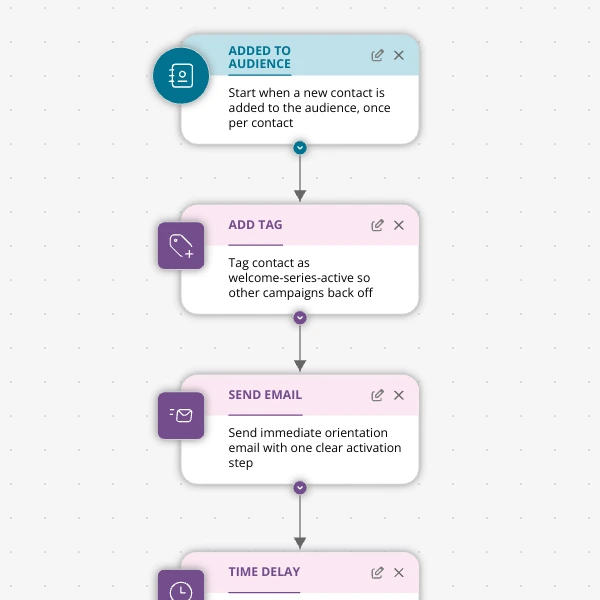
The Shopify app welcome series that turns installs into income
A step-by-step Shopify app welcome email journey for tools like CartSpark, showing how to turn new installs into activated, retained merchants using Spreeflo journeys, tags, and behavioral triggers so fewer trials quietly churn and more trials convert.
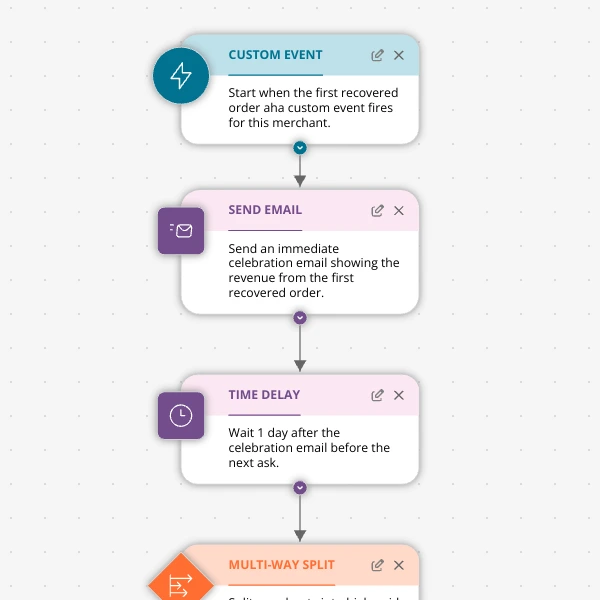
The Aha-Moment Playbook For Shopify Apps: Turn One Magic Action Into Months Of Revenue
A node-by-node playbook for Shopify and e‑commerce apps to center their lifecycle on one aha-moment custom event in Spreeflo, celebrate it, segment merchants by profile and engagement, and turn first recovered value into lasting revenue and retention.
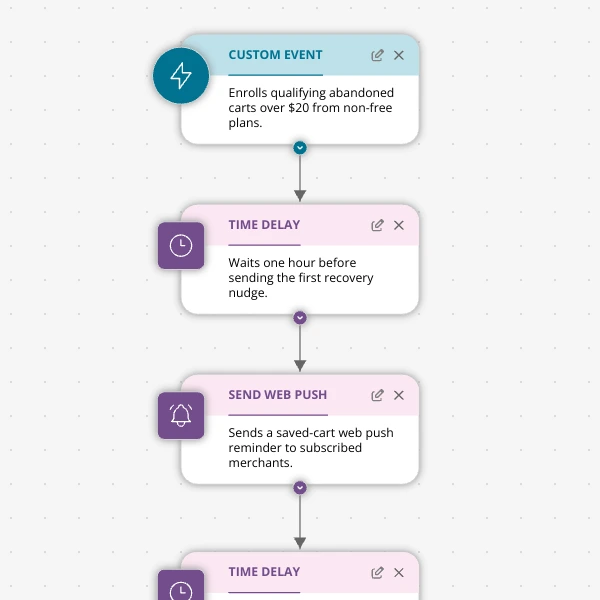
Stop Letting High‑Intent Carts Die: A 3‑Email Recovery Journey for Shopify Apps
A detailed, node-by-node walkthrough of a three-email (plus optional web push) cart-abandonment recovery journey for Shopify apps in Spreeflo, showing how to trigger events, branch on behavior, tag outcomes, and measure recovered carts and revenue.
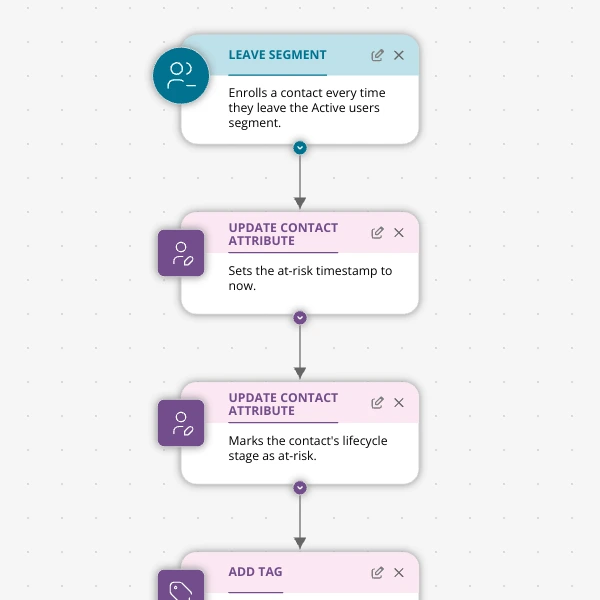
When Active Users Go Dark: A 4‑Touch Win‑Back Journey For Your Shopify App
A detailed, node-by-node Spreeflo journey for winning back previously active Shopify app users who stop engaging, using segment-based triggers, conditional logic, and a four-touch email plus internal alert sequence to recover usage and MRR.