The “Ready to Review” Journey Your Shopify App Actually Deserves
This playbook shows how to build an event-driven “ready to review” journey in Spreeflo for Shopify apps, so you only ask for public reviews after real product value and route at-risk users into helpful, feedback-first paths that protect LTV.
Industry
Niche
Pattern
Loading sequence...
A lot of Shopify apps beg for reviews at the worst possible moment: five minutes after install, before the merchant has even seen a result.
For CartWizard, a fictional cart-recovery app doing $90k MRR, that looked like a 1–2% review rate, the occasional grumpy 2‑star, and a support inbox full of “I can’t rate you yet, nothing’s happened.” Once they switched to a “ready to review” journey tied to real usage, their review rate tripled and the average rating climbed above 4.7.
The sequence at the top of this page is that journey, end to end. Below, we’ll walk through why it’s built this way and how to adapt it for your own app.
Why timing beats volume for reviews
For e‑commerce apps, “installed” is not the same as “experienced value.”
If you send a fixed “please review us” email X days after install, you get three problems:
Some stores never complete setup: you’re asking for a review of a product they haven’t used.
Some stores hit their first “aha” moment much faster: by the time your fixed delay fires, the moment of delight is already cold.
Some stores are actively struggling: they’re more likely to vent publicly than privately.
You don’t need more review emails; you need them sent only when the merchant can answer honestly, “Yes, this app is helping.”
That’s the core of this pattern: use a behavioral ready_to_review event as the journey trigger, not a calendar delay.
Step 1: Define “ready to review” for your app
Before you touch the journey builder, you need a clear internal definition of “ready.”
For CartWizard, the team settled on:
At least 3 recovered carts, and
At least $200 in recovered revenue, and
App installed ≥ 10 days.
For a hypothetical analytics app like ShopMetrics, “ready” might be:
Logged in on ≥ 5 different days, and
Viewed at least 3 different core reports, and
No “data missing” errors in the last 7 days.
The point: “ready” is tied to outcomes and engagement, not just time elapsed.
On your backend, you track these events as usual. When a store meets your chosen threshold, your server posts a ready_to_review event into Spreeflo via the Spreeflo events API. The Spreeflo API accepts this as a normal custom event with the contact’s email and any useful properties (plan tier, source, etc.).
That single event is what kicks off the journey.
Step 2: Build this as a Journey, not a Campaign
This pattern is always-on, not one-and-done. You want every store that hits “ready” next week, next month, and next year to get the same optimized experience.
In Spreeflo, that means creating a Journey, not a Campaign. Journeys run continuously and start from triggers; campaigns work off a fixed snapshot.
If you’re new to this distinction, the overview of how to build a journey in Spreeflo’s docs is a good primer. Here, we’ll assume you’re comfortable inside the canvas and focus on the node choices.
Node 1: Custom Event trigger — “ready_to_review”
The journey starts with a Custom Event trigger:
Event name:
ready_to_review(or whatever you send from your backend).Property conditions: optional; you can scope to
plan = "pro"orsource = "shopify_app_store"if you want separate flows later.Re-enrollment: usually off for this pattern.
Why re-enrollment off? Because, for a typical Shopify app, you want one strong public review per store, not a new review request every quarter. If you do want to ask again a year later (e.g., for a new marketplace), send a different event (ready_to_review_g2) and use a separate journey.
Brand message at work: the trigger is how you “capture detail on every customer so you can speak to each uniquely.” You are literally encoding the moment they first got value into your data model.
From this trigger, every contact flows into an If/Else check.
Node 2: If/Else — “Is this a good review candidate?”
Not everyone who hits your usage threshold should be pushed to review. Some might be actively frustrated. Others might be unsubscribed from marketing email.
The If/Else node uses the segment builder to filter for “safe to ask” contacts.
Example condition group for the “Yes” branch:
Email subscription status is “Subscribed”, AND
Marketing status is “Marketing”, AND
Custom event
app_uninstalledhas not triggered over all time, ANDCustom number attribute
support_ticket_count_openis less than 3.
You’ll have your own markers of happiness: high feature usage, low ticket volume, maybe a custom health_score. The important part is to gate the ask.
Configuration notes:
The “Yes” branch = good candidates → go to the review-request path.
The “Else” branch = marginal candidates → go to a feedback‑first path instead of the public review ask.
This is where you start plugging the lifecycle leak. Instead of pushing unhappy users to leave a bad review, you split them into a path where they get help.
Happy path, Part 1: Give the moment some breathing room
When a store crosses your ready threshold, they probably just saw something great: a recovered cart, a clear dashboard, a successful automation.
You do not want an email to land in their inbox at the exact same second. It feels robotic.
So the first step on the happy path is a Time Delay:
Delay: 2 hours
Unit: Hours
Two hours is enough to separate the in-app “win” from the email, but still close enough that the memory is fresh.
After that delay comes Send Email #1: the core review request.
Happy path, Part 2: The first review-request email
The Send Email node is where this journey earns its keep.
You build this email in Spreeflo’s email builder. A few ingredients matter:
Context: remind them what the app has already done. “In the last 14 days, CartWizard has recovered 5 abandoned checkouts worth $372 for your store.”
Simple CTA: one primary button to your review page on the Shopify App Store or other marketplace.
Optional secondary path: a subtle “Something not quite right? Reply to this email” line that invites private feedback.
Because this is a behaviorally triggered flow, you can confidently personalize the copy. You already know what they’ve done.
To scale that personalization, use AI-backed content with contact and event variables. The help doc on AI variables for personalization walks through how to feed usage stats and plan details into subject lines and body text inside Spreeflo.
Configuration specifics:
Set “Send only once” to on for this node. Even if you eventually allow re-enrollment at the trigger level, no one should see the same review email twice.
From here, everyone hits another Time Delay:
Delay: 3 days
Unit: Days
Three days is enough time for people who intend to review to actually do it before you start nudging.
Happy path, Part 3: Branch on engagement with Check Email Activity
After the three-day delay, add a Check Email Activity process node tied to that first review email.
Configure it with:
Marketing email: the review-request template you just sent.
Activities to branch on:
- Branch A: “Link Clicked”
- Else branch: everyone else (opened but didn’t click or didn’t open).
Why this split?
“Link Clicked” is a strong signal of intent. They went to the review page; they might just have been interrupted.
Everyone else is lower intent. You may still want to follow up, but with more restraint.
From “Link Clicked”, we’ll monitor for an actual review. From “Else”, we’ll send one gentle reminder, but only if they’re still a good-fit customer.
Happy path, Part 4: Wait for the actual review
On the “Link Clicked” branch, add a Wait Condition:
Condition: custom event
review_submittedtriggered at least 1 time in the last 7 days.Timeout: 7 days, unit Days.
On your side, whenever a public review lands (via Shopify, G2, Capterra, etc.), your backend should:
Capture the review and star rating.
Post a
review_submittedevent into Spreeflo via the Spreeflo API, keyed to the same contact.
The Wait Condition holds each contact until either:
You’ve seen
review_submittedfor them, or7 days have passed.
Either way, they move to the next node once the wait is over.
To decide what to do next, add a second If/Else:
Yes branch condition: custom event
review_submittedtriggered at least 1 time over all time.Else branch: no review event on record.
Now you have two distinct outcomes:
Clicked and actually reviewed.
Clicked but never got around to posting.
For group 1 (Yes branch), you can:
Use an Add Tag action to apply tags like
public_reviewerorreviewed_on_shopify.Fire a Send Internal Email to your success channel: “Store X just left a public review. Rating: 5 stars. Link: …”
You might choose to send a “thank you” email to the customer as well. If you do, drop a Time Delay of at least 1 hour before that new Send Email node so you never send back-to-back marketing emails on the same path.
For group 2 (Else branch), a single gentle reminder works well:
Add a Time Delay of 4 more days.
Then a second Send Email with alternate copy: maybe a shorter ask, different subject, or a social-proof-heavy version.
Again, set “Send only once” on this email. And cap the sequence here; more than two review requests in one run is overkill.
Happy path, Part 5: Low-engagement contacts
Back at the Check Email Activity node, the Else branch catches everyone who didn’t click the first email.
You have options, but a simple pattern that respects inboxes is:
Time Delay of 7 days.
If/Else check that they are still a good-fit active user:
- Has not triggeredapp_uninstalledover all time.
- Total visits at least 3 in the last 30 days (using the “Total Visits” criteria in the segment builder).Only for those who pass this check, send a second, final review email.
Everyone else (uninstalled, dormant) simply exits here with no second ask.
This is how you avoid the “nagging ghost” pattern where churned stores keep getting “please review” emails, which erodes both brand and ratings.
Else path: Feedback-first for at-risk users
Let’s go back to that first If/Else after the trigger.
The Else branch holds contacts who:
Hit your “ready” threshold, but
Fail the “good review candidate” conditions (too many tickets, marginal health, etc.).
For them, the right play is not a public review request. It’s private feedback and rescue.
A simple and effective path:
Time Delay of 2 hours (same logic: don’t email in the exact moment of frustration).
Send Email from your founder or success lead:
- Subject: “Can we make [App Name] work better for you?”
- Body: short, plain-text style, explicitly inviting a reply.Send Internal Email to your support channel whenever someone replies, driven by a separate Email Action trigger + journey.
If you want structured feedback, build a short in-app survey with Spreeflo forms and surface it as a popup inside your app for this segment, using the Popup Form action in a separate journey. The forms help doc on how to create and embed forms covers the in-app delivery patterns; just keep it out of email.
The key: at-risk users get human help, not a public rating prompt. That’s where you recover negative feedback before it hits your listing.
Make this measurable: tags, attributes, and segments
To iterate on this journey, you need to see:
Review submission rate: of those who got a request, how many triggered
review_submitted?Star rating mix: what proportion of those reviews are 4–5 stars vs 1–3?
Negative-feedback recovery: how many “at risk” users stay installed after going through the feedback path?
Spreeflo’s data model helps you capture this without extra tools:
Use Add Tag nodes to track states like
asked_for_review,public_reviewer,review_denied_path.When your backend receives a review webhook, have it update rating attributes on the contact via the Spreeflo API (e.g.,
last_public_rating,last_review_site).Build saved segments like “Asked for review but no
review_submittedevent” or “Public reviewers with rating ≤ 3” using the segment builder.
From there, you can build follow-on journeys: special loyalty perks for 5‑star reviewers, or targeted win-back for low ratings.
Why this pattern compounds your LTV
Most SaaS teams treat reviews as a one-time acquisition tactic. Fire off some generic requests, hope for the best, move on.
For e‑commerce apps and Shopify extensions, that mindset leaks value in two directions:
You leave high-intent, high-satisfaction users unasked at precisely the moment they’d happily advocate for you.
You push unhappy or unready users into public review flows, where their (valid) frustrations damage your listing and scare off future installs.
An event-driven, behaviorally gated review journey fixes both.
It asks only when the customer has clearly seen value. It treats unhappy signals as a reason to help, not to push. And it ties every step back to actual usage and outcomes, not guesses.
Under the hood, it’s just intelligent automation: a Custom Event trigger, a few If/Else and Check Email Activity nodes, some Time Delays, and well-crafted Send Email steps. The mechanics are simple; the thinking about “ready” and “happy” is where the advantage lies.
That’s exactly where founder-led teams win: you know your product’s true “aha” moment better than any generic tool does. Spreeflo’s campaign and journey automation simply lets you encode that knowledge into a system that runs for every future customer.
Build this once, wire it to your own definition of “ready,” and let it quietly turn real product value into a steady stream of five-star proof — without shouting at people who aren’t there yet.
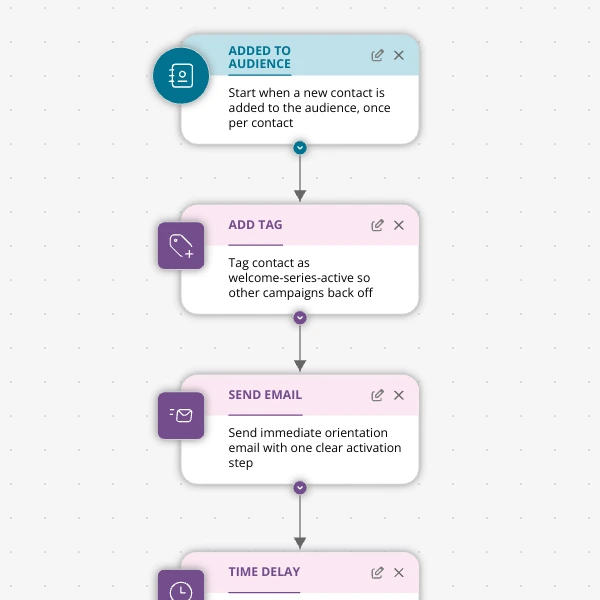
The Shopify app welcome series that turns installs into income
A step-by-step Shopify app welcome email journey for tools like CartSpark, showing how to turn new installs into activated, retained merchants using Spreeflo journeys, tags, and behavioral triggers so fewer trials quietly churn and more trials convert.
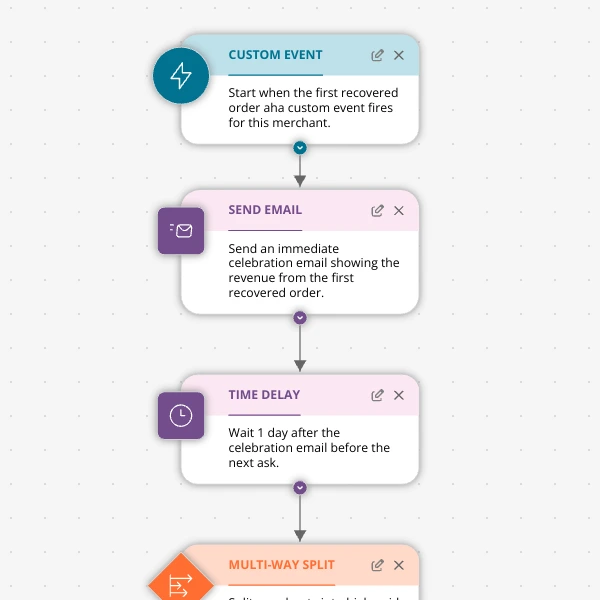
The Aha-Moment Playbook For Shopify Apps: Turn One Magic Action Into Months Of Revenue
A node-by-node playbook for Shopify and e‑commerce apps to center their lifecycle on one aha-moment custom event in Spreeflo, celebrate it, segment merchants by profile and engagement, and turn first recovered value into lasting revenue and retention.
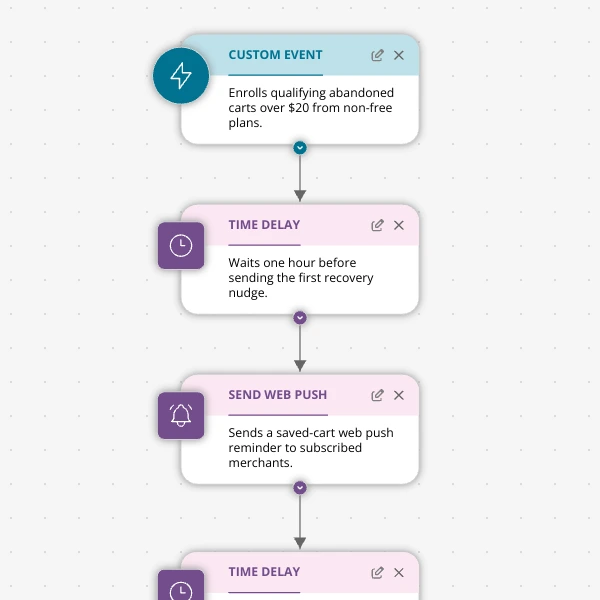
Stop Letting High‑Intent Carts Die: A 3‑Email Recovery Journey for Shopify Apps
A detailed, node-by-node walkthrough of a three-email (plus optional web push) cart-abandonment recovery journey for Shopify apps in Spreeflo, showing how to trigger events, branch on behavior, tag outcomes, and measure recovered carts and revenue.
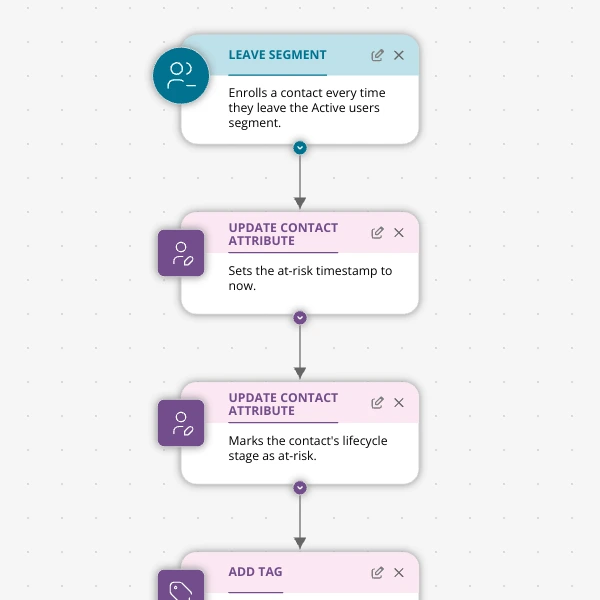
When Active Users Go Dark: A 4‑Touch Win‑Back Journey For Your Shopify App
A detailed, node-by-node Spreeflo journey for winning back previously active Shopify app users who stop engaging, using segment-based triggers, conditional logic, and a four-touch email plus internal alert sequence to recover usage and MRR.