The Renewal Reminder Series That Quietly Saves Your SEO SaaS MRR
Design a Spreeflo renewal reminder journey for SEO SaaS with 30-, 7-, and 1-day touches that separate auto-renew from manual customers, add internal alerts for high-risk accounts, and quietly plug revenue leaks from failed or missed renewals.
Industry
Niche
Pattern
Loading sequence...
A surprising amount of your MRR dies not with a bang, but with an expired credit card and a missed email.
For SEO SaaS, that hurts twice: you lose recurring revenue, and your own product adoption numbers (projects tracked, briefs generated, audits run) take a hit, which makes every growth chart look worse than it should. The sequence at the top of this page is designed to stop that.
In this playbook, we’ll build a renewal reminder journey in Spreeflo for an SEO SaaS like “RankPulse” or “BrieflySEO”: 30‑day, 7‑day, and 1‑day reminders, with different flows for auto‑renew vs manual renewal and internal alerts for accounts that look shaky.
The goal is simple: stop leaking lifetime value because you didn’t nurture the last mile before renewal.
Why renewals quietly leak so much SEO SaaS revenue
Look at your churn spreadsheet and you’ll probably see a pattern:
Agencies who cancel after a project ends.
In‑house teams who let trials and early‑stage plans expire because they never quite got to “aha”.
Perfectly happy customers who churn because their card expired and no one noticed.
The first two are product and onboarding problems. The third is a communication problem.
For SEO tools, the user’s behaviour (how often they check rankings, generate briefs, or run audits) is a strong signal of fit. But when it comes to renewals, most teams still rely on a single “your subscription is renewing” email from Stripe or Paddle. No segmentation. No education. No human catching high‑value accounts before they slip.
That’s the leak this journey plugs.
Instead of treating every renewal the same, you’ll:
Time reminders relative to each customer’s renewal date.
Branch messaging for auto‑renew vs manual renewal.
Trigger internal alerts when critical accounts are at risk.
All of it runs as a Spreeflo journey, so once you design it, it keeps working for every future cycle. If you’re new to journeys vs campaigns, the overview in the campaign and journey automation guide is worth a quick skim.
Step 0: Get your billing data into Spreeflo
Before you touch the journey canvas, you need clean billing data on each contact. The automation is only as smart as what you store.
At minimum, mirror these fields into Spreeflo contact attributes:
plan_name(e.g. “Pro”, “Agency”)plan_interval(“monthly”, “annual”)renewal_date(timestamp)is_auto_renew(boolean)mrrormonthly_value(number, for prioritising internal alerts)subscription_status(“active”, “trialing”, “cancelled”)
Your billing system (Stripe, Chargebee, Paddle, etc.) remains the source of truth. Every time a subscription is created, updated, or cancelled, your backend should call the Spreeflo API to upsert these attributes on the contact.
If you’re migrating existing customers, you can also start with a CSV and map columns to attributes during import using the contact import flow. Then keep them up to date via the API.
Two more helpful helpers:
renewal_window(TEXT): one of"30d","7d","1d", or blank. Your billing job can set this each night based onrenewal_date.billing_portal_url(TEXT): per‑customer link to your billing portal, so emails can deep‑link straight to “update card” or “renew now”.
Those two keep the segmentation in Spreeflo simple and explicit, instead of trying to do date math inside the builder.
The journey shape: three date windows, two renewal types, one brain
The sequence at the top of this page is the whole journey, end to end.
You’ll see:
Three separate Cyclic triggers:
Each trigger feeds into an If/Else that branches on
is_auto_renew.Each branch sends an appropriately framed Send Email.
The 7‑day and 1‑day flows add Send Internal Email, Time Delay, and Check Email Activity nodes so your team can catch risky accounts.
“Renews in 30 days”
“Renews in 7 days”
“Renews in 1 day”
All three triggers share the same canvas, but they behave independently. A contact will:
Enter the 30‑day arm when they hit that window.
Later, separately, enter the 7‑day arm.
Finally, enter the 1‑day arm.
Because we’ll configure re‑enrollment correctly, this pattern works every renewal cycle.
Let’s walk it node by node.
Node 1–3: Cyclic triggers for 30, 7, and 1 days before renewal
You’ll add three Cyclic triggers in a single journey, one per window. Each runs daily.
Configuration pattern for each:
Repeat interval: every 1 day
Time of day: pick a consistent send time (e.g. 09:00 in your main timezone)
Re-enrollment: on (you want this journey to run again for the same contact on their next renewal cycle)
Criteria (built with the segment builder) might look like:
Email Subscription Status is “Subscribed”
subscription_statusattribute is “active”renewal_windowattribute is"30d"(for the 30‑day trigger)Or
"7d"/"1d"for the other two triggers
The point of renewal_window: your billing job sets that flag once per cycle per contact (e.g. for everyone whose renewal_date is exactly 30 days out), then clears or changes it as days pass. The Cyclic trigger simply asks, “Who has renewal_window = '30d' right now?” each morning.
Why Cyclic instead of a Custom Event trigger?
Renewal is fundamentally date‑driven. A daily sweep is easier to reason about than dozens of event names.
You keep the API side simple: update attributes, don’t fire behavioural events.
If you’d rather centralise logic, you can of course create segments like “Renews in 30 days” and have the Cyclic triggers key off segment membership instead of renewal_window, but the underlying idea is the same.
Node 4: If/Else – split auto‑renew vs manual
Immediately after each Cyclic trigger, add an If/Else:
Condition:
Contact attribute
is_auto_renewis true
Then branch:
“Auto‑renew on” (Yes branch)
“Manual renewal” (Else branch)
This is the core of the pattern: customers who will renew automatically need reassurance and a chance to update payment details. Customers who must manually renew need urgency and a clear call to action.
Because this If/Else sits right after each date‑window trigger, each arm will have:
A 30‑day auto email vs 30‑day manual email
A 7‑day auto email vs 7‑day manual email
A 1‑day auto email vs 1‑day manual email
Copy and offers differ, but structurally the branches are the same.
30‑day window: education and expectation‑setting
Auto‑renew at 30 days
Path: 30‑day Cyclic → If/Else (auto branch) → Send Email
In this Send Email node:
Uncheck “Send only once”. You want this email to send every renewal cycle, not just the first year.
Use the email builder to do three things:
Confirm the renewal date and plan: “On March 14, your RankPulse Pro plan will renew at $89/month.”
Remind them what they’re getting: “You’re currently tracking 172 keywords, 12 domains, and 4 projects.”
Invite proactive card updates: “If your card has changed, update it now so your rank history isn’t interrupted.”
Link the primary button to billing_portal_url.
Why send this even though the payment will run automatically?
Because failed payments are silent killers. Many customers don’t realise their card expired until after access is cut off. Getting a light‑touch reminder 30 days out cuts those “surprise” churns dramatically.
Manual renewal at 30 days
Path: 30‑day Cyclic → If/Else (manual branch) → Send Email
This email is more explicit about action:
Highlight that renewal is manual: “Your BrieflySEO subscription ends in 30 days. To keep your content briefs, you’ll need to renew.”
Show loss aversion: “If you don’t renew, we’ll hold your briefs and history for 14 days before deleting them.”
Explain the decision in ROI terms: “In the past 90 days you’ve published 18 briefs through BrieflySEO; average organic traffic per brief is X” (if you have that data, otherwise keep it more general).
Again, turn off “Send only once” so it repeats each cycle.
At this stage we don’t escalate internally yet. The 30‑day email is about planting the seed, not ringing alarm bells.
Optionally, you can add an Add Tag node after each email (e.g. tag:renewal_30d_sent) to make later reporting easier.
7‑day window: closing loops and catching card issues
Seven days out is where intent and risk become clearer. Someone who hasn’t opened any renewal messaging by now is more likely to lapse.
We’ll use the 7‑day arm to:
Nudge behaviour again.
Route non‑engagers to your team via internal email.
Catch high‑MRR accounts before they quietly churn.
Auto‑renew at 7 days
Path: 7‑day Cyclic → If/Else (auto branch) → Send Email → Wait Condition → Send Internal Email (for high‑value non‑actioners)
1. Send Email
Content focus:
Clear subject like “Quick check: your [Plan] renews in 7 days”.
Emphasise that renewal is automatic, but card issues can interrupt reports.
One primary CTA: “Check or update billing details”.
2. Wait Condition
Next, insert a Wait Condition:
Condition: Page Visited URL contains “/billing” at least 1 time in the last 7 days, OR Custom Event
billing_details_updatedtriggered at least 1 time in the last 7 days (if your backend posts that event via the Spreeflo API).Timeout: 4 days.
Effect:
If they visit the billing page or update card within 4 days, they quietly progress past this node with no escalation.
If the timeout expires without the condition being met, they move on anyway.
3. Send Internal Email (optional, for higher‑value accounts)
On the timeout path, add a Send Internal Email node. Use the contact’s mrr or monthly_value attribute to decide which accounts are worth alerting in a second, upstream If/Else:
If
mrr>= $200 → send an internal email tofounder@orsuccess@.Else → skip internal outreach.
Internal email content:
Subject: “High‑MRR auto‑renew at risk: [Company Name]”
Body: Include renewal date, MRR, last seen date, and a deep link to their profile in your app so someone can personally reach out.
This is where founder‑led businesses win on leverage: a tiny number of well‑timed, human check‑ins on high‑value accounts, informed by automation.
Manual renewal at 7 days
Path: 7‑day Cyclic → If/Else (manual branch) → Send Email → Time Delay → Check Email Activity → Send Internal Email (if no engagement)
1. Send Email
This is your “last week” pitch:
Re‑state what they’ll lose if they don’t renew (projects, history, team access).
Highlight any new features since they last paid.
Put a short FAQ inline to reduce friction: invoicing, PO support, seat changes.
2. Time Delay
Insert a Time Delay of 2 days. This respects pacing rules and gives them space to open.
3. Check Email Activity
Add a Check Email Activity node tied to this 7‑day manual email, with at least two branches:
“Clicked” (Link Clicked)
Else (includes unopened and unclicked)
4. Send Internal Email (only on the “Else” branch)
On the “Clicked” branch you might just add a tag like tag:renewal_intent_7d.
On the Else branch, add Send Internal Email so someone can reach out, especially if mrr is above a threshold. This could go to a shared inbox or Slack via a webhook, but keeping it as an internal email node keeps everything inside Spreeflo.
Again, no second customer‑facing Send Email here; we’re avoiding feeling spammy while still catching risks.
1‑day window: clear expectations and true last chance
The 1‑day touch is short, clear, and to the point.
Auto‑renew at 1 day
Path: 1‑day Cyclic → If/Else (auto branch) → Send Email
This email is mainly about transparency and receipts:
Subject: “Tomorrow: your [Plan] renews at $X”.
Body: confirm amount, interval, and card brand/last4 if you include that in your own email (Spreeflo just sends the message; card details live in your billing data).
Reiterate how to cancel if they truly don’t want to continue.
For happy customers, this builds trust and reduces chargebacks. For unhappy ones, it gives them a respectful exit before renewal.
Again, turn off “Send only once” so this fires every cycle.
Manual renewal at 1 day
Path: 1‑day Cyclic → If/Else (manual branch) → Send Email → Send Internal Email
1. Send Email
This is the true deadline:
Very clear subject: “Your RankPulse account expires tomorrow”.
One big CTA: “Renew now to keep your keyword history and alerts”.
Brief reminder of impact: “If you don’t renew, we’ll pause all rank‑drop alerts and remove your projects in 14 days.”
2. Send Internal Email
Immediately after, send an internal email for accounts above a value threshold. At this point, a quick personal loom or email from the founder can save a multi‑hundred‑dollar MRR account.
Because Send Internal Email is a different node type from Send Email, you can place it directly after without violating any pacing rules.
Measuring whether this series is actually working
Once the journey is live, you want to know whether it’s worth the effort.
Some practical metrics to track using Spreeflo segments and tags:
1. Renewal rate lift
Segment A: Active subscribers who received at least one renewal email in the last 60 days.
Segment B: Active subscribers who didn’t (e.g. before you launched this).
Compare the share who are still active after their renewal date.
2. Billing‑update completion
Among auto‑renew customers who got the 7‑day email, how many triggered the
billing_details_updatedevent or visited/billingbefore renewal?This measures whether your “check your card” copy is doing its job.
3. Manual‑renewal opt‑in
Track how many manual customers clicked renewal CTAs from the 7‑day and 1‑day emails vs how many simply lapsed.
A simple tag like
tag:renewed_after_7dapplied by your backend on successful payment makes this easy to slice.
4. Internal touch effectiveness
For contacts who triggered an internal email, did MRR renew more often than for similar‑value contacts where no alert fired (because they engaged normally)?
If yes, you’ve justified the extra human time.
All of these can be built as saved segments and viewed under Audiences; the audiences overview page walks through how tags, attributes, and segments fit together.
Why this pattern matters for your LTV
Most SEO SaaS teams obsess over acquisition: rankings, content, funnels. But the cheapest revenue you’ll ever earn is the renewal you almost lost and then saved.
This renewal series doesn’t add more meetings or a new hire. You design it once, wire in the data you already have, and let it run. The system:
Spots who is approaching renewal.
Talks to them differently based on how they pay.
Pulls your attention only when it truly matters.
That’s the kind of automation founder‑led businesses win with: plug a specific lifecycle leak, then move on to the next one.
You can build this journey in an afternoon. Start by defining the attributes and segments, then replicate the sequence at the top of this page step by step in the Spreeflo editor, following the campaign and journey automation guide as you go.
Every saved renewal buys you more time to focus on product and distribution, instead of waking up to another “why did this customer churn?” thread in Slack.
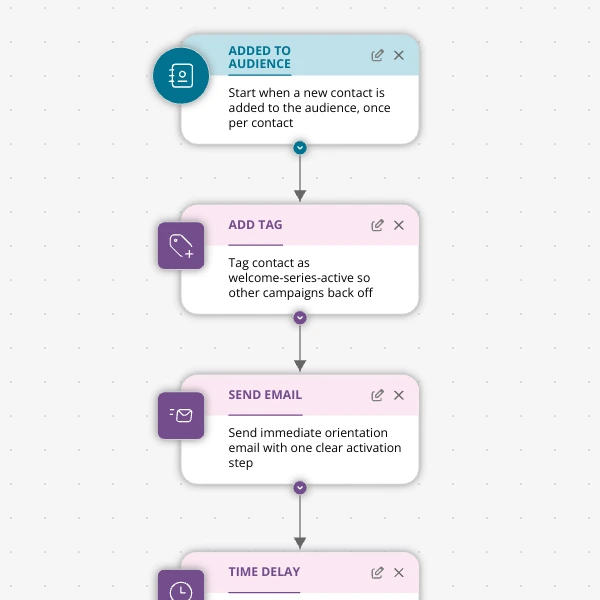
The Shopify app welcome series that turns installs into income
A step-by-step Shopify app welcome email journey for tools like CartSpark, showing how to turn new installs into activated, retained merchants using Spreeflo journeys, tags, and behavioral triggers so fewer trials quietly churn and more trials convert.
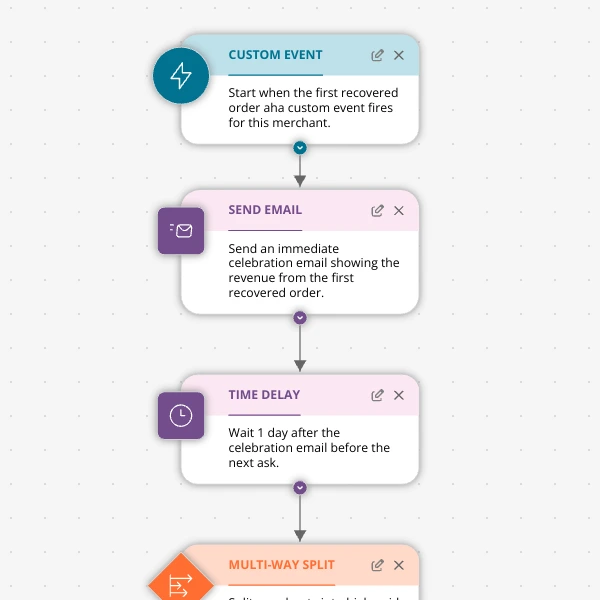
The Aha-Moment Playbook For Shopify Apps: Turn One Magic Action Into Months Of Revenue
A node-by-node playbook for Shopify and e‑commerce apps to center their lifecycle on one aha-moment custom event in Spreeflo, celebrate it, segment merchants by profile and engagement, and turn first recovered value into lasting revenue and retention.
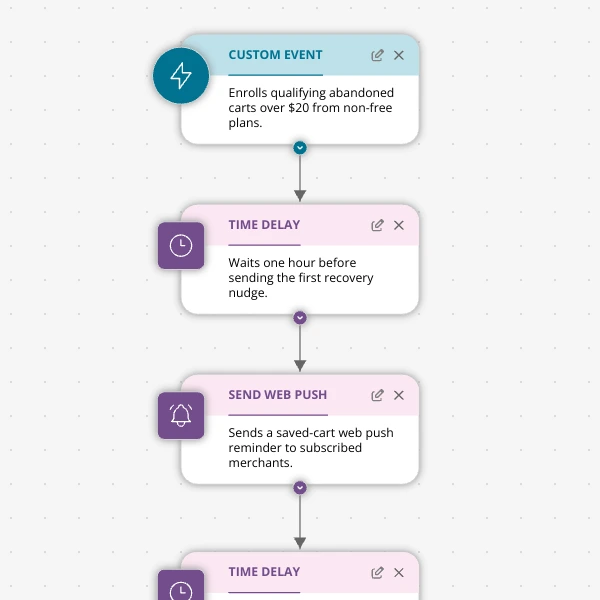
Stop Letting High‑Intent Carts Die: A 3‑Email Recovery Journey for Shopify Apps
A detailed, node-by-node walkthrough of a three-email (plus optional web push) cart-abandonment recovery journey for Shopify apps in Spreeflo, showing how to trigger events, branch on behavior, tag outcomes, and measure recovered carts and revenue.
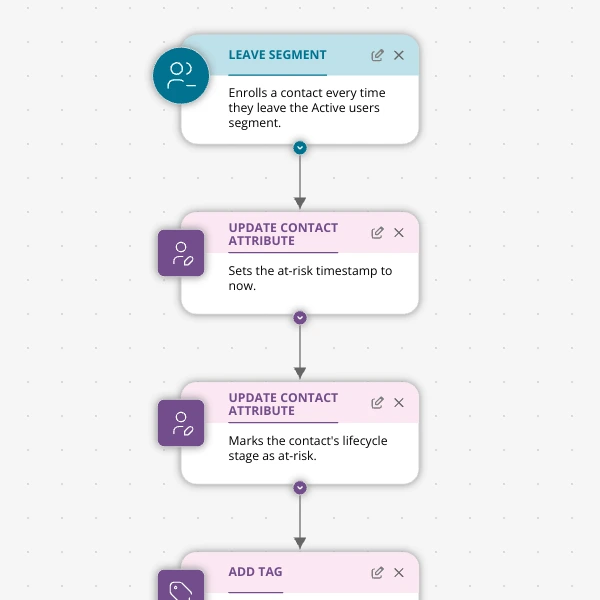
When Active Users Go Dark: A 4‑Touch Win‑Back Journey For Your Shopify App
A detailed, node-by-node Spreeflo journey for winning back previously active Shopify app users who stop engaging, using segment-based triggers, conditional logic, and a four-touch email plus internal alert sequence to recover usage and MRR.