Turn GDPR Consent Renewal into a Churn-Saving Routine for Your SEO SaaS
This playbook shows how an SEO SaaS can automate GDPR-style consent renewal in Spreeflo with a cyclic journey, turning compliance into a recurring lifecycle funnel that protects deliverability, cleans EU lists, and quietly re-engages or unsubscribes contacts.
Industry
Niche
Pattern
Loading sequence...
You probably didn’t build a rank tracker or content-brief generator to spend evenings worrying about EU consent timestamps. Yet if 20–40% of your MRR is in the EU/UK, ignoring consent age is both a legal risk and a quiet source of list decay.
The journey in the sequence at the top of this page is designed to fix that: a rolling GDPR-style consent renewal that runs itself, keeps your list clean, and turns “admin” into a re-engagement opportunity instead of a mass list purge.
We’ll walk through it node by node, using a fictional SEO SaaS called BrieflySEO (content briefs for SEO teams, ~$60k MRR) as the example. The pattern is built in Spreeflo, but the underlying logic is what matters: treat consent renewal like a lifecycle funnel, not a one-off panic campaign.
Quick disclaimer: this is a marketing automation pattern, not legal advice. Always sanity-check consent rules with your own counsel.
Why consent renewal is a lifecycle problem, not a checkbox
For an SEO SaaS, GDPR consent is easy to frame as “compliance overhead.” That’s the wrong mental model.
If you send regular product education, feature tips, and SERP-win stories but never refresh consent, you face two bad options:
Keep emailing old EU contacts and accept the risk.
Wipe or “sunset” large chunks of your list when someone finally gets nervous.
Both routes kill lifetime value. The real opportunity is to do three things at once:
Systematically re-confirm who actually wants to hear from you.
Proactively unsubscribe people who don’t care anymore (before they hit the spam button).
Use the touchpoint to remind engaged users why they chose your tool in the first place.
That’s what this journey does, using a scheduled Cyclic trigger, a small cluster of Send Email, Wait Condition, and If/Else nodes, plus subscription updates.
The data you need in place before you build
Before you drag the first node into a canvas, make sure three basics are covered.
A “consent granted” timestamp
Create a TIMESTAMP contact attribute such asgdpr_consent_at. Whenever someone gives you marketing consent (trial signup, pricing demo request, lead magnet, etc.), your frontend should callSpreeflo.identify(...)with that attribute, or your backend should include it in the payload to the Spreeflo API. This is the date we’ll age off.A consent status text attribute
Add a TEXT attribute likegdpr_consent_statuswith values such asactive,pending_renewal,expired. We’ll flip this with Update Contact Attribute to keep a simple audit trail on each contact.A segment (or criteria) for “contacts we actually email”
In Spreeflo, you can either define this inline in the journey, or create a reusable segment via the segment builder. Typical rules:
Email Subscription Status is
SubscribedCountry (or custom region attribute) is in EU/UK
gdpr_consent_statusisactivegdpr_consent_atis older than, say, 21 months
Once those are in place, the rest of the journey becomes simple plumbing.
Step 1: A Cyclic trigger that checks consent age daily
At the very top of the visual sequence is a Cyclic trigger. This is the “date-based heartbeat” of the whole pattern.
Configuration:
Frequency: Every 1 day
Time of day: Whatever time you like (e.g., 09:00 in your operating timezone)
Criteria: use the embedded segment builder to express your consent-age rules, for example:
Email Subscription Status is
SubscribedRegion is EU/UK
gdpr_consent_statusisactivegdpr_consent_atis before “21 months ago”
Set Re-enrollment = true on this trigger. That sounds scary, but remember:
Contacts only enter if they match the criteria at that daily check.
Once they renew consent, we’ll update
gdpr_consent_atto “now,” so they won’t match again until 21+ months in the future.While a contact is mid-journey, Spreeflo’s mid-journey lock prevents duplicate enrollments anyway.
The goal is: “Any subscribed EU contact whose consent is approaching our refresh window gets picked up, every time, automatically.”
Step 2: Mark that a renewal is in progress
The next node is an Add Tag action that applies something like gdpr_renewal_pending.
Why bother?
It gives your team a quick filter for “who is in the renewal funnel right now.”
It can double as a condition elsewhere (e.g., don’t add them to heavy promo campaigns while they’re mid-renewal).
Optionally, follow that with an Update Contact Attribute node:
Attribute:
gdpr_consent_statusUpdate type: Update
Value: literal string
pending_renewal
Because Update Contact Attribute writes static literals you define at design time, you’re using it for clear, predictable states (active → pending_renewal → expired), not dynamic values.
Now each contact’s record tells a clean story: consent is old, renewal is in progress.
Step 3: First renewal email – clear, simple, respectful
Next up: your first Send Email node.
This is the central touchpoint, and it should feel like a value reminder, not a legal threat. Use Spreeflo’s email builder for something clean and mobile-safe.
Content pointers for an SEO SaaS:
Subject: remind them of the value (“Still want ranking alerts and content brief ideas from BrieflySEO?”)
Body:
In one sentence, what they get from staying subscribed (SERP wins, content ideas, technical health checks).
A short line about staying aligned with EU privacy rules.
One primary button: “Yes, keep me subscribed.”
That button should send them to a page you control (e.g., /preferences/confirm) where:
- Your frontend identifies them (e.g., via a signed token from the email URL and Spreeflo.identify(email, …)), and
- Calls Spreeflo.track('gdpr_consent_renewed', {...}) in the browser.
If, for some reason, you handle this server-side (say, capturing approvals from a separate portal), your backend should POST a gdpr_consent_renewed event into the Spreeflo API. Either way, that custom event is what the journey will watch for.
Important pacing rule: don’t put another Send Email right after this one. The next node must be a wait.
Step 4: Wait up to 14 days for consent, then check
After the first email, add a Wait Condition:
Condition: Custom event
gdpr_consent_renewedtriggered at least 1 time in the last 14 days (using the Custom Events filter in the embedded Segment Builder)Timeout: 14 days
Mechanics:
If they click and your site fires
gdpr_consent_renewed, the contact will typically satisfy the condition quickly and move on.If they ignore or delete the email, they simply sit in this node until the 14-day timeout hits.
The Wait Condition itself doesn’t branch; it just pauses. To decide what happened, you follow it with an If/Else.
Configure the If/Else with the same condition:
If branch (Yes): “Has custom event
gdpr_consent_renewedat least 1 time in the last 30 days”Else branch (No): everyone else
Why 30 days here when the wait used 14? That gives you some buffer if your timezone filters or tracking are slightly off. The principle is just “did they renew recently?”
Anyone who renewed moves into the “success” arm; everyone else heads towards reminder territory.
Step 5: Re-consent path – update timestamps and clean up
On the “Yes, they renewed” branch, you typically want three things:
Update the consent timestamp
Use Update Contact Attribute ongdpr_consent_atwith the update type “Set to now.” This is the one case where the node writes a dynamic value: it records the current timestamp at execution.Reset status and tags
Optional internal notification
If you’re tracking key accounts manually (say, big agencies using your tool for dozens of clients), you can fire a Send Internal Email to a shared inbox when those contacts renew. That’s overkill for most, but useful when a handful of accounts dominate your MRR.
Update Contact Attribute on
gdpr_consent_statusback to literalactive.Remove Tag to clear
gdpr_renewal_pending.Optionally Add Tag like
gdpr_consent_renewed_2026for reporting.
After that, you can end the path. The Cyclic trigger will not touch them again until gdpr_consent_at ages past your renewal window.
Step 6: Non-responders – a second, final reminder
Back on the “No” branch from the first If/Else, it’s time for a gentle final nudge.
Second Send Email
This is the “last call” message. Keep it short, and don’t guilt-trip.A shorter Wait Condition
After this email, add another Wait Condition:Another If/Else on the same condition
Subject: “Final reminder: keep getting SEO insights from BrieflySEO”
Body:
Brief reminder of what they get (e.g., rank change alerts, content opportunities, technical crawl warnings).
Clear statement: “If we don’t hear from you, we’ll stop emailing you after [date].”
Same “Yes, keep me subscribed” button pointing to the same re-consent flow (and
gdpr_consent_renewedevent).
Condition: Custom event
gdpr_consent_renewedat least 1 time in the last 7 daysTimeout: 7 days
If branch: treat exactly like the earlier “re-consent” path (update timestamp, status, tags).
Else branch: this is where you enforce the “hard fall-through.”
Again, spacing is built-in: they never receive the second email until at least 14 days after the first, and they never get two emails back-to-back without any delay node between them.
Step 7: Hard fall-through – unsubscribing and logging expiry
On the final “No re-consent” branch, you make two explicit choices:
Stop marketing email
Add an Update Email Subscription Status node:Mark consent as expired
Use Update Contact Attribute twice:
You can also:
Status: Email unsubscribed
gdpr_consent_status→ literalexpiredOptional TIMESTAMP attribute
gdpr_consent_expired_at→ Set to nowRemove Tag
gdpr_renewal_pendingAdd Tag
gdpr_consent_expired
For many teams, this is also where a Webhook node makes sense if you need to mirror the unsubscribe in another system (e.g., Intercom or your own admin panel). The Webhook sends a JSON payload to your endpoint with the contact’s email and relevant attributes, and your backend can do whatever extra cleanup is required.
From here, the path ends. You’ve made a deliberate choice: no re-consent, no more marketing email.
Measuring GDPR renewal like a funnel, not a binary
Because this journey marks contacts so clearly, you can treat consent renewal like any other lifecycle step.
Useful metrics and how to get them:
Re-consent rate
Build a simple segment where:
Tag containsgdpr_consent_renewed_2026(or status attribute isactiveandgdpr_consent_atwithin your recent renewal window)
Divided by:
Contacts who hadgdpr_renewal_pendingand were sent the first email.
That gives you “what share of contacts we tried to renew actually said yes.”Opt-out (expiry) rate
Segment wheregdpr_consent_statusisexpired. It tells you what fraction of your EU base is silently churning at the consent layer.List churn from renewal over time
Because unsubscribed contacts remain in your audience but no longer count as marketing contacts (see the detailed pricing-plan explainer), you can plot how many fall intoexpiredeach quarter without paying extra for their storage. That’s a clear picture of how strict or relaxed your cadence is.
Over a few cycles, you’ll start to see patterns:
Agencies that are truly using your ranks/briefs renew at very high rates.
Project-based accounts or one-off experimenters quietly expire.
That clarity is exactly where Brand Message 3 lives: most businesses leak lifetime value not when people churn loudly, but when they drift away quietly. A consent renewal journey turns that drift into a visible, measurable funnel.
Why this earns its spot in your automation stack
For a founder of an SEO SaaS, the temptation is to deal with GDPR consent “later” and focus on acquisition. The problem is that “later” often appears as:
A panicked “we need to clean EU data now” Slack thread, or
A deliverability slide because too many cold EU contacts mark your product updates as spam.
This journey solves a different problem than legal checklists. It does three compounding things for you:
Protects deliverability by pruning people who truly don’t want your emails anymore.
Surfaces the subscribers who care enough to re-consent and are worth extra attention.
Turns a required compliance rhythm into one more touchpoint that reminds users why your product matters for their rankings and organic traffic.
And because it runs as a continuously ticking Cyclic journey in Spreeflo, you configure it once in the campaign and journey editor and it keeps doing the boring work for you.
Founder-led businesses win on leverage, not headcount. Consent renewal is exactly the kind of thing that should be automated: predictable, rules-based, and easy to forget until it’s a problem. With a sequence like the one at the top of this page, it becomes just another system quietly defending both your list health and your MRR.
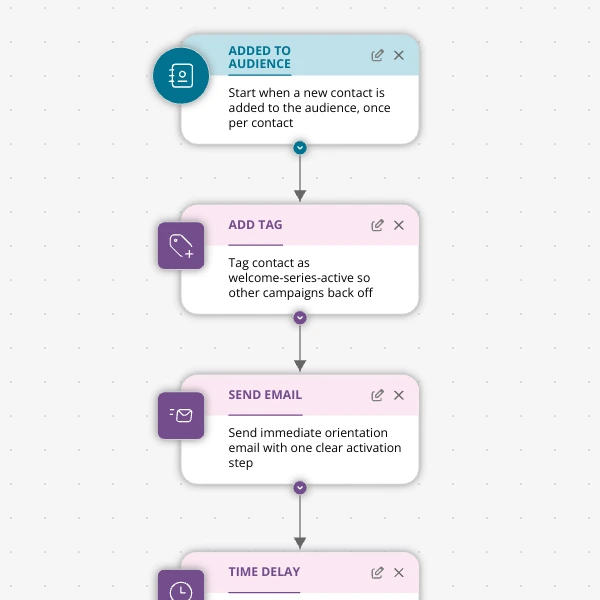
The Shopify app welcome series that turns installs into income
A step-by-step Shopify app welcome email journey for tools like CartSpark, showing how to turn new installs into activated, retained merchants using Spreeflo journeys, tags, and behavioral triggers so fewer trials quietly churn and more trials convert.
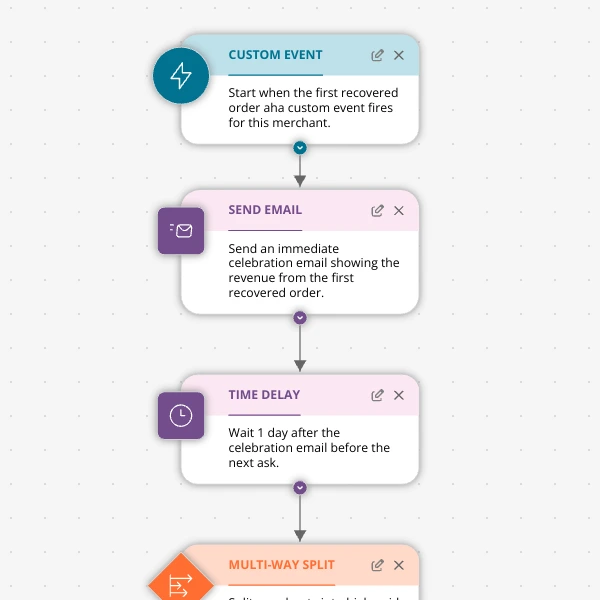
The Aha-Moment Playbook For Shopify Apps: Turn One Magic Action Into Months Of Revenue
A node-by-node playbook for Shopify and e‑commerce apps to center their lifecycle on one aha-moment custom event in Spreeflo, celebrate it, segment merchants by profile and engagement, and turn first recovered value into lasting revenue and retention.
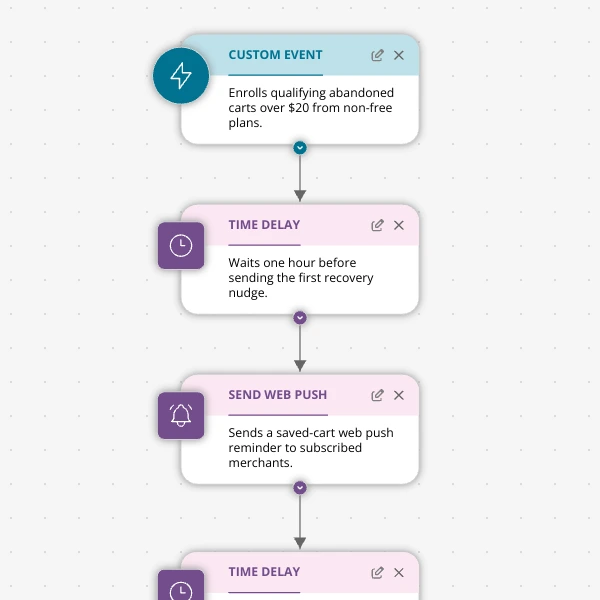
Stop Letting High‑Intent Carts Die: A 3‑Email Recovery Journey for Shopify Apps
A detailed, node-by-node walkthrough of a three-email (plus optional web push) cart-abandonment recovery journey for Shopify apps in Spreeflo, showing how to trigger events, branch on behavior, tag outcomes, and measure recovered carts and revenue.
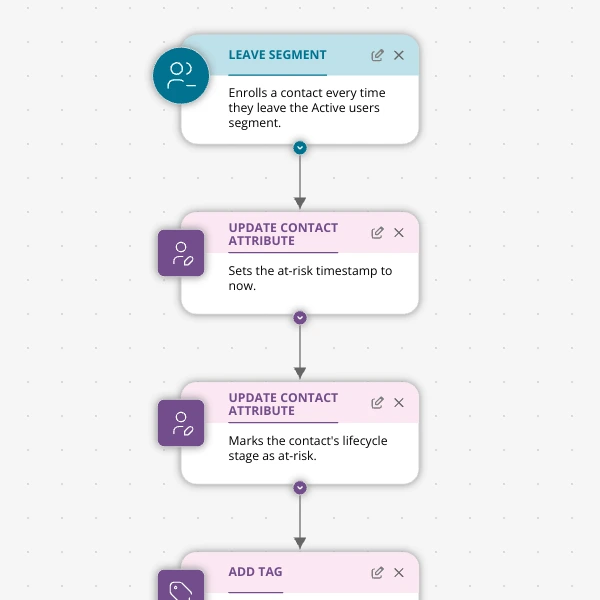
When Active Users Go Dark: A 4‑Touch Win‑Back Journey For Your Shopify App
A detailed, node-by-node Spreeflo journey for winning back previously active Shopify app users who stop engaging, using segment-based triggers, conditional logic, and a four-touch email plus internal alert sequence to recover usage and MRR.