Turn Refunds and Cancellations into a 30‑Second Support Workflow
This playbook shows SEO SaaS teams how to turn Stripe refund and cancellation events into an automated Spreeflo journey that tags contacts, alerts support, and sends clear customer confirmations, creating a repeatable 30-second workflow instead of manual triage.
Industry
Niche
Pattern
Loading sequence...
Your Stripe dashboard pings: another refund, another “please cancel my account” email sitting in support, another tab you have to keep open to make sure nothing slips.
For a 3–5 person SEO SaaS team, this is exactly the kind of operational drag that quietly eats hours every month.
The sequence at the top of this page is the whole journey, end to end: every refund or cancellation event becomes a context-rich internal email plus a clean, timely acknowledgement to the customer.
This playbook walks through how to build that once in Spreeflo so you never manually “forward Stripe to support” again.
Why refunds are noisy but predictable
Take RankPulse, a fictional rank-tracking SaaS doing ~$40k MRR.
Their pattern will feel familiar:
Refunds and cancellations arrive as Stripe or Paddle webhooks.
The founder or a support rep triages each one:\n- Check who the customer is.\n- Check which plan they’re on.\n- Check if they’re an agency, high MRR, or on a small plan.\n- Decide whether to reach out, ask why, or just let it go.
The customer might get:\n- An automated Stripe email (barely branded).\n- A manual acknowledgement later… if someone remembers.\n- Or nothing at all.
That mix creates three kinds of pain:
Time wasted on repetitive, low-brain work.
Inconsistent experience for customers at a sensitive moment.
No reliable record of who canceled and why, beyond billing.
Refunds and cancellations are emotionally charged, but operationally simple. They’re classic “design once, automate forever” territory.
What this journey does for your SEO SaaS
The journey you see in the sequence does three things every time a refund or cancellation happens:
Listens for billing-side events using a Custom Event trigger.
Sends a Send Internal Email alert with full context to your support queue (or directly to you).
Sends a Send Email acknowledgement to the customer that sets expectations and, if appropriate, opens the door for a human reply.
You wire it once using the Spreeflo API, then let it run in the background while you focus on shipping features.
Let’s go node by node.
Step 1: Wire billing events into a Custom Event trigger
Refunds and cancellations start in your backend, not in the browser. That matters.
When Stripe (or Paddle, Chargebee, etc.) hits your webhook with a customer.subscription.deleted or charge.refunded event, your server should:
Look up the customer’s email.
POST a custom event into the Spreeflo events API with that email and a clear event name.
Examples:
subscription_canceledpayment_refunded
You can store extra details (plan, refund_amount, cancellation_reason) as properties on that event, or as contact attributes via the same Spreeflo API. Attributes are ideal if you want to reference those values in email copy later.
In Spreeflo, the journey starts with a Custom Event trigger:
Event name:
subscription_canceled(for cancellations).Re-enrollment: On. A customer might cancel, come back months later, and cancel again; you want the journey to run each time.
Property conditions (optional):\n- Filter by a property like
refund_type is fullvsrefund_type is partial.\n- Or byplan_tier is Agencyto send certain events down a different automation.
You’ll create a second Custom Event trigger for refunds:
Event name:
payment_refunded.Same isReEnrollment setting: On.
Because journeys in Spreeflo can have multiple triggers, both events can enter the same journey but follow their own paths.
If you’re new to journey building in Spreeflo, the overview on how to build a journey is a useful primer before you set this up.
Step 2: Tag the contact so you can find them later
Right after each Custom Event trigger, add an Add Tag action.
For cancellations:
Tags:
subscription-canceled, maybeneeds-offboarding.
For refunds:
Tags:
refund-issued.
Keep Force tag trigger off unless you deliberately want to re-fire downstream “Added Tag” triggers when the tag already exists.
Why bother tagging?
It gives you an instant way to filter in your CRM and in Spreeflo.
You can build segments like “Canceled in the last 30 days” using the segment builder.
It lets you exclude churned users from certain marketing campaigns while still sending them product or account notices.
You can also optionally use Update Contact Attribute here to set a literal status, for example:
account_status="canceled"on the cancellation path.last_refund_at= “Set to now” on the refund path.
Those attributes are static values set at design time (except for “Set to now”), so you’d handle anything dynamic (like last_refund_amount) in your backend before sending it into Spreeflo.
Step 3: Send a context-rich internal email to support
This pattern is primarily about internal operations. The core of it is a Send Internal Email node per path.
For the cancellation path, configure:
Template name: “Cancellation – support handoff”.
From: Whatever shared inbox you want to appear in the email (“ops@…”, “no-reply@…”, etc.).
Send only once: On is usually fine; each cancellation event creates a new journey run anyway.
Email body: Use the internal template editor to include:\n\n- Who canceled:\n - Contact name and email.\n - Any key attributes you track:
plan_tier,is_agency,mrr,trial_or_paid.\n- What happened:\n - “Event: subscription_canceled”.\n - “Source: Stripe webhook”.\n- What they were doing recently:\n - Recent events you’ve tracked:added_first_keyword,generated_content_brief,ran_technical_audit.\n- What you want the support agent to do:\n - Reply to confirm.\n - Ask why they canceled for high-MRR accounts.\n - Flag anything that needs manual cleanup (e.g., delete scheduled rank checks).
Because Send Internal Email can reference contact data, you can give your team the context they’d normally have to click around three tools to assemble.
Mirror this for refunds with a different template:
“Refund – support/finance handoff”.
Include attributes like
last_refund_atorplan_tierso finance knows whether this is an important relationship to maintain.
This is the “30-second workflow” moment: the right person gets everything they need in their inbox automatically.
Step 4: Confirm with the customer and set expectations
From the customer’s point of view, two questions matter:
Did my cancellation/refund actually go through?
What happens next?
That’s where the next Send Email action comes in.
On the cancellation path:
Template name: “Your [Product] subscription has been canceled”.
From: Your normal product sender (e.g., “team@rankpulse.io”).
Send only once: On.
Content (using the email builder):\n\n- A clear subject: “We’ve canceled your RankPulse subscription”.\n- A short confirmation in the first line.\n- Key details:\n - Effective date.\n - What happens to their data (e.g., “We’ll keep your projects for 30 days if you change your mind”).\n- How to get help:\n - “If you didn’t intend to cancel, reply to this email and our team will restore your account.”
On the refund path, do the same:
Subject: “Your refund from RankPulse is being processed”.
Content:\n - Amount and timeline, if you maintain those as attributes.\n - Clarify which invoice / billing period it covers.\n - Tell them when to contact you again (e.g., “If you don’t see the refund in 5–10 business days…”).
Note that in this flow there’s only one Send Email to the contact on each path, so you don’t need a Time Delay node for pacing. The internal email goes to your team; the customer sees just a single, timely acknowledgement.
For high-volume, must-send system messages (like receipts), you might prefer dedicated transactional email. For refunds and cancellations, a journey-based acknowledgement is usually enough and has the benefit of being easy to adapt over time.
Step 5: Converge both paths and mark the account
At this point, both the refund and cancellation paths have:
Tagged the contact.
Notified your team.
Acknowledged the customer.
You probably want some shared “done” behavior after both:
Add a generic tag like
recent_billing_change.Or start a longer-term churn analysis journey.
To do that cleanly, drop a Merge node after the customer-facing Send Email in each path. Both flows connect into this Merge, which then continues into shared actions.
Immediately after the Merge you might:
Add another Add Tag for
at-risk-if-return.Or use Update Email Subscription Status to set them to “Unsubscribed” from marketing if that’s your policy.
This keeps your canvas clean and respects Spreeflo’s “one incoming edge per node (except Merge)” rule.
Step 6: Optional – treat high-value accounts differently
For a lot of SEO SaaS founders, losing a $29/mo solo plan is one thing; losing a $799/mo agency is another.
You can add an optional layer of routing with a Multi-way Split immediately after each trigger:
Branch A:
plan_tier is Agency(ormrr greater than 300).Branch B: everyone else.
Else branch: catch-all if neither condition matches.
Conditions in a Multi-way Split use the same segment builder logic as segments:
Pick “Contact Attributes”.
Choose your
plan_tierormrrattribute.Use operators like
is,greater than, etc.
For the high-value branch, you might:
Send the internal email not just to support, but with the founder or a CSM in CC.
Add a second Send Internal Email node to a “vip@…” alias.
Delay marking them as “Unsubscribed” from marketing until someone has reviewed the account.
For the standard branch, stick with the basic flow you already built.
Each branch eventually feeds into its own Merge and then the shared end-of-journey actions.
Step 7: Measure whether the journey is actually helping
Because this pattern is about internal operations, the metrics to watch are different from a classic marketing campaign.
Focus on three:
Time-to-resolution\n- How long from the refund/cancellation event to:\n - Internal email sent.\n - Ticket closed or customer reply (if any).\n- With the journey in place, the “internal email sent” part is effectively instant.
Support-ticket reduction\n- Count pre-journey vs post-journey:\n - “Did my cancellation go through?”\n - “Did you get my refund request?”\n- Fewer of those tickets = the acknowledgement email is doing its job.
Customer satisfaction at exit\n- Even if you’re not running an in-app survey yet, your support responses will feel calmer when everyone knows exactly what happened and what the customer has already been told.
On the Spreeflo side, you can easily build segments like:
“Canceled in the last 30 days but visited the site at least once” for later win-backs.
“Refunded more than once” as a risk flag.
Those are simple saved segments built in the segment builder using tags and custom attributes you’ve already set in this journey.
Adapting this to your stack and scale
Every SEO SaaS stack is slightly different, but the wiring is similar:
Billing tool (Stripe/Paddle/Chargebee) → your backend.
Backend → Spreeflo API with:\n - Custom events (
subscription_canceled,payment_refunded).\n - Attribute updates (plan_tier,mrr,last_refund_at, etc.).Spreeflo journey:\n - Custom Event triggers to enter.\n - Add Tag / Update Contact Attribute to label.\n - Send Internal Email for the support handoff.\n - Send Email for the customer acknowledgement.\n - Optional Multi-way Split, Merge, and status updates.
Pricing-wise, these flows typically touch paying users in your core MRR band. If you want to understand exactly how those contacts are counted, the guide on about Spreeflo pricing plans breaks down how marketing contacts work.
The important thing: you design this once. It runs whether you’re at your desk, on a flight, or heads‑down on a release.
Why this is a “leverage, not headcount” kind of flow
The cliché advice is to “hire support” as you grow. But a lot of founder-led SEO SaaS teams don’t need more people; they need fewer manual loops.
Refunds and cancellations are a perfect example: highly repetitive, emotionally important, easy to automate.
With this one journey in place:
Your team spends time on the conversation, not the plumbing.
Every customer gets a clear, consistent experience when they leave.
You get a clean trail of who canceled, when, and on which plan.
That’s the heart of the idea that founder-led businesses win on leverage, not headcount. You build the system once, and it quietly does the right thing every time a customer leaves — so you can spend your energy on keeping the right ones around.
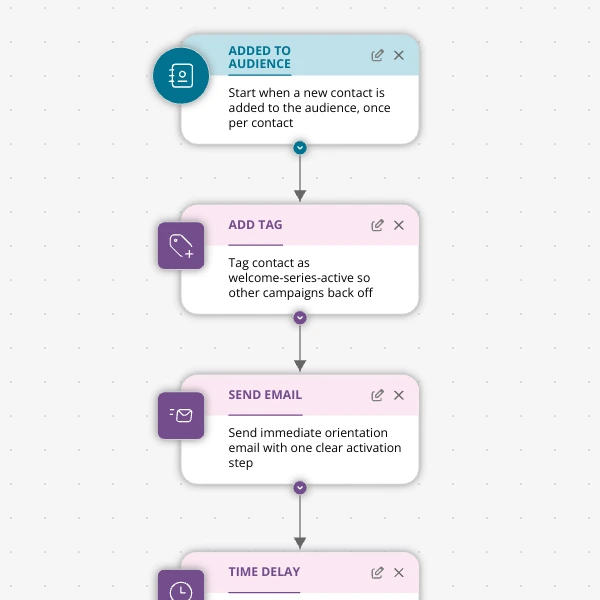
The Shopify app welcome series that turns installs into income
A step-by-step Shopify app welcome email journey for tools like CartSpark, showing how to turn new installs into activated, retained merchants using Spreeflo journeys, tags, and behavioral triggers so fewer trials quietly churn and more trials convert.
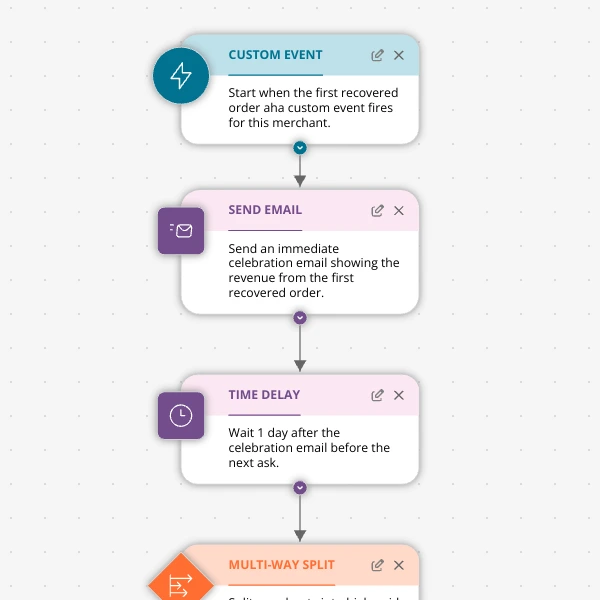
The Aha-Moment Playbook For Shopify Apps: Turn One Magic Action Into Months Of Revenue
A node-by-node playbook for Shopify and e‑commerce apps to center their lifecycle on one aha-moment custom event in Spreeflo, celebrate it, segment merchants by profile and engagement, and turn first recovered value into lasting revenue and retention.
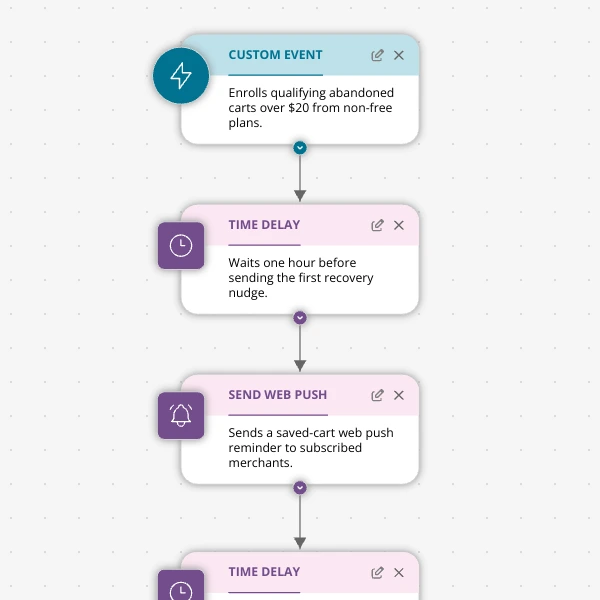
Stop Letting High‑Intent Carts Die: A 3‑Email Recovery Journey for Shopify Apps
A detailed, node-by-node walkthrough of a three-email (plus optional web push) cart-abandonment recovery journey for Shopify apps in Spreeflo, showing how to trigger events, branch on behavior, tag outcomes, and measure recovered carts and revenue.
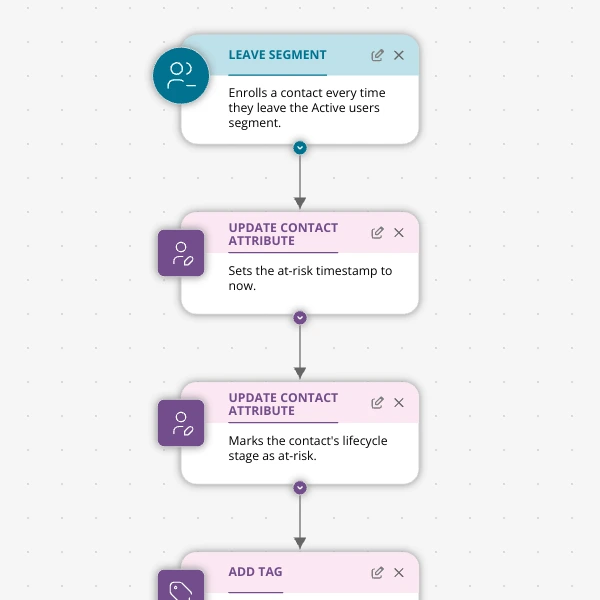
When Active Users Go Dark: A 4‑Touch Win‑Back Journey For Your Shopify App
A detailed, node-by-node Spreeflo journey for winning back previously active Shopify app users who stop engaging, using segment-based triggers, conditional logic, and a four-touch email plus internal alert sequence to recover usage and MRR.