When a User Hits “Spam”: Building a Complaint-Based Pause-and-Review Journey
This playbook walks through building a complaint-triggered pause-and-review journey in Spreeflo so every spam complaint instantly pauses marketing, tags the contact, and alerts your team, protecting deliverability and revenue for an SEO SaaS.
Industry
Niche
Pattern
Loading sequence...
The fastest way to kill your onboarding and reactivation emails isn’t a bad subject line. It’s a quiet spike in spam complaints that drags your sender reputation into the gutter.
For an SEO SaaS sending rank alerts, weekly reports, and trial nudges, you can’t afford to find out weeks later that Gmail started burying everything in Promotions or, worse, spam. The sequence at the top of this page is the whole journey, end to end, for treating every complaint as an emergency brake and a learning moment.
Let’s walk through how to build that in Spreeflo so your list stays healthy and your retention emails keep landing.
Why complaints matter more than unsubscribes
Unsubscribes are feedback. Spam complaints are a warning shot.
Mailbox providers interpret complaints as "this sender is not wanted in this inbox." Even a handful can hurt when your list isn’t huge. If RankPulse (our fictional SEO rank-tracking SaaS doing $40k MRR) sends a campaign to 5,000 users and 15 people hit "This is spam," that’s a 0.3% complaint rate. On a small domain, that’s enough to start throttling or rerouting mail.
The knock-on effect for an SEO SaaS:
Fewer trial users see their “here’s how to get value in week one” sequence.
At-risk users miss “you haven’t checked rankings in 14 days” nudges.
Win-back campaigns hit junk instead of inbox.
In other words, you leak lifetime value because the very emails that keep customers engaged stop showing up.
The fix is simple in theory: the moment someone complains, stop all marketing to them and review what happened. But doing that manually off webhook logs doesn’t scale. You need a small, always-on journey that watches for complaints and reacts in seconds.
That’s exactly what this complaint-based pause-and-review pattern does using a behavior-driven journey in Spreeflo.
What this journey actually does
Zooming out before we go node-by-node, this journey does four things whenever a complaint event hits Spreeflo:
Listens for an
email_complaintcustom event coming from your backend via the Spreeflo API.Immediately stops marketing email for that contact by changing their subscription and marketing status.
Tags the contact for analytics so you can segment and report on complaints later.
Sends an internal review email with context so a human can decide what went wrong and what to change.
No message goes back to the complainer. Everything is about protecting your list and giving your team a clean, actionable signal.
Now let’s walk through each step in the sequence at the top of this page and talk about why it’s configured that way.
Step 1: Turning complaint webhooks into a Custom Event trigger
Spam complaints almost always originate outside your app:
Your email delivery provider fires a webhook when a mailbox provider sends a feedback loop (complaint) notification.
Or your own transactional infrastructure records a “complaint” status for a send.
Either way, that logic lives on your backend. To bring it into Spreeflo, your webhook handler should POST to the events endpoint of the Spreeflo API with a custom event name like email_complaint, keyed by the contact’s email.
In the journey:
Trigger node:
Custom EventEvent name:
email_complaint(or whatever you decide to send)Property conditions (optional but recommended):
A property like
sourceequalsmarketing(so you don’t pause critical system emails if you treat them separately).Or a property like
environmentequalsproductionif you send from staging/test.
For this trigger, set Re-enrollment = true.
Why? Complaints should be rare, but if something breaks and the same contact ends up getting another marketing email and complains again months later, you want this journey to fire again. Spreeflo’s journey-scoped lock will still prevent duplicate enrollments at the same time; it just allows a new run after the previous one finished.
This one-trigger setup keeps the journey clean: any time your backend says “this contact complained,” the flow starts.
Step 2: Immediately stop all marketing email
The first responsibility of this journey is to prevent further damage. That means:
The complainer should not receive another marketing broadcast or automation.
They should also be treated as a non-marketing contact for billing and segmentation.
You do that with two back-to-back actions.
2a. Update Email Subscription Status
Insert an Update Email Subscription Status action right after the Custom Event trigger.
Configure it to:
Status:
Email unsubscribed
This aligns with best practice and keeps your marketing automations honest: even if someone accidentally re-adds the contact to a segment or CSV import later, their subscription status will block new marketing sends.
2b. Flip their marketing status
Next, add an Update Contact Attribute action to change their marketing status.
Configure it to:
Attribute: your
Marketing Statuscontact attributeUpdate type:
UpdateValue:
Non-marketing
Why bother, if they’re already unsubscribed?
Two reasons that matter for a price-sensitive, founder-led SEO SaaS:
Segmentation clarity. It’s easy to filter “Marketing” vs “Non-marketing” contacts in the segment builder. Complaint-driven contacts clearly sit on the non-marketing side.
Billing hygiene. Per Spreeflo’s pricing plans, only marketing contacts count toward your paid contact limits. Moving complainers to non-marketing status means you’re not paying to store people you’ve agreed not to market to.
These two nodes together are the “pause” in “pause and review”: they guarantee the complainer is out of all future nurture and promo flows.
Step 3: Tag the contact for analytics and guardrails
Next, you want a simple, machine-readable way to answer:
How many unique contacts have ever complained?
Which segments (trialists, agencies, enterprise) are driving most complaints?
Are complaints clustering around a specific email or campaign?
Add an Add Tag action node after you flip marketing status.
Configure it to:
Tags:
email-complaint(or your preferred naming convention)Force tag trigger: off (you’re not trying to trigger any other journeys here)
This tag unlocks a few useful patterns:
Build a “Complained” segment with the segment builder:
- Tag containsemail-complaint
- Email subscription status isUnsubscribed
That’s your denominator for complaint analytics.Exclude complainers from any manual exports you might still feed into other tools.
Spot high-risk behaviors: if someone has both
email-complaintandtrial-churnedtags, for instance, you might want to review how aggressive your trial sequences are.
Because tags are cheap and flexible, this single node gives you more visibility than just toggling subscription status alone.
Step 4: Send an internal review email with context
Now that you’ve protected your list, it’s time to learn from the complaint.
Add a Send Internal Email action as the last node in the main path.
Set it up to:
Use an internal template you create in the email builder.
Send from a shared sender (like
alerts@yourdomain.com) to a distribution list or a small group: founder, marketer, maybe support.
The body of this internal email is where you turn a raw event into a useful review:
Who complained: contact email, name, plan, MRR if you store it as a custom attribute.
What they complained about: the email template ID or campaign name, passed through as an event property into the template.
When it happened: event timestamp.
How to respond: a lightweight checklist, for example:
- Check if this contact was correctly targeted (segment, region, plan).
- Check if we sent too many emails in a short window.
- Check whether they have other negative signals (churned trial, refund, angry support ticket).
- Decide if copy, cadence, or targeting needs to change.
For this pattern, it usually makes sense to leave Send only once switched on for the node. A contact who has complained once should already have been unsubscribed; if you somehow send them marketing again, you have a deeper process issue than needing a second alert.
This is the “review” half of the journey: every complaint comes with a human-readable mini-brief in someone’s inbox, rather than disappearing into a log.
Optional: Route high-risk complaints differently
Not all complainers are equal.
If an agency on your highest plan complains about a core product update email, that’s a different class of issue than a free-trial user marking a one-off promo as spam.
You can reflect that in the journey with a simple branch before the internal email.
Insert an If/Else process node after the
Add Tagaction.In the condition, use the segment builder to define “high-value account,” for example:
- Contact attributeplanisAgencyOREnterprise
- OR amonthly_mrrnumber attribute is greater than 200On the “yes” branch:
- Add a Send Internal Email to a founder or senior owner with a subject like “High-value spam complaint – action needed.”On the “else” branch:
- Add a separate Send Internal Email to your general support/marketing alerts inbox.
Each path ends with its own internal email. There’s no need to merge them back if you don’t have any further automated action.
How to measure whether this journey is working
You can’t fix what you don’t measure. For this pattern, three metrics matter.
1. Complaint rate
At a minimum, you want a sense of:
How many unique contacts have
email-complaintin a given period.How that compares to the total number of people you’ve sent marketing email to in that same period.
You can:
Build a segment for “complainers in the last 30 days” using a
Custom Eventsrule (eventemail_complainttriggered at least 1 time in the last 30 days).Compare that count to the size of the segments you’ve targeted with campaigns or journeys in that window (from your sending tool, whether that’s Spreeflo or another platform).
Trend matters more than the absolute number. If your complaint segment doubles month over month, your copy, cadence, or targeting needs attention.
2. Review SLA
The automation fires instantly. The bottleneck is human.
Decide on a simple SLA: for example, “All spam complaints are reviewed within 24 hours on weekdays.” Then:
Make sure the internal alert goes to an inbox someone actually watches.
Occasionally spot-check: pick a few complaint emails and scroll back through support/Slack to see how quickly someone acted.
You can also add a manual step: replying to the complainer (if appropriate) or making a note in your CRM if you use one.
3. False-positive rate
Some complaints are really about content (“This isn’t relevant to me”). Others are operational (“I never signed up”), which usually points to list hygiene or permission issues.
Over time, have whoever reviews the internal emails tag each incident informally:
Mis-targeted (right person, wrong message)
Mis-timed (too many emails, too fast)
Mis-consented (they don’t remember signing up)
True outlier (someone overusing the spam button)
Patterns here tell you where your LTV is leaking:
Mis-targeted? Your segments are too broad.
Mis-timed? Your onboarding or promo cadences are over-aggressive.
Mis-consented? Your signup forms or imports need clearer consent language.
Because Spreeflo keeps all of this tied to one contact record, you can refine segments, journeys, and campaigns without re-assembling data from multiple systems.
Why this tiny journey protects big revenue
For a small SEO SaaS team, it’s tempting to focus automation energy on shiny flows: multi-step onboarding, trial nudges, feature discovery sequences. Those absolutely matter for LTV.
But all of them depend on a quiet assumption: that your emails actually land.
A complaint-based pause-and-review journey is like a circuit breaker. It doesn’t make money directly. It:
Protects your sender reputation so your onboarding and reactivation flows keep doing their job.
Stops you from repeatedly annoying the same person after they’ve clearly said “stop.”
Turns a potentially invisible, technical signal into a structured feedback loop your team can act on.
Founder-led businesses don’t have the headcount to babysit deliverability dashboards all day. You need simple systems that catch the important edges for you. This one takes a few minutes to build with Spreeflo journeys, then quietly guards your list while you ship features and content.
If your email program is even moderately important to how your SEO SaaS retains and grows customers, this pause-and-review flow isn’t optional hygiene. It’s part of treating every contact — including the unhappy ones — as a long-term asset you can’t afford to burn.
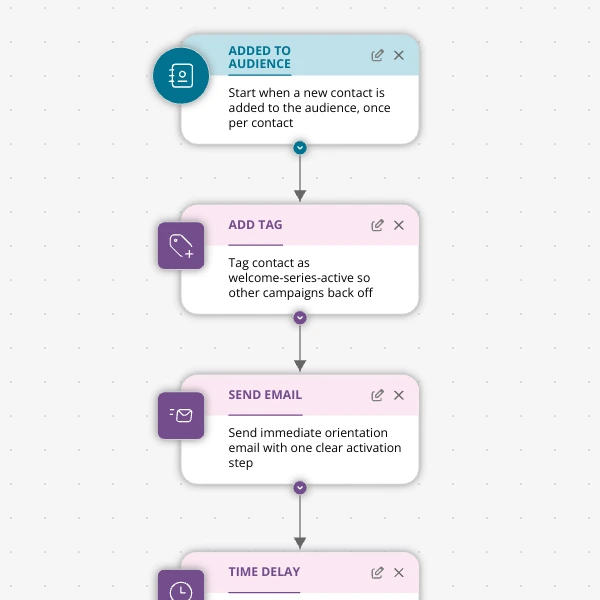
The Shopify app welcome series that turns installs into income
A step-by-step Shopify app welcome email journey for tools like CartSpark, showing how to turn new installs into activated, retained merchants using Spreeflo journeys, tags, and behavioral triggers so fewer trials quietly churn and more trials convert.
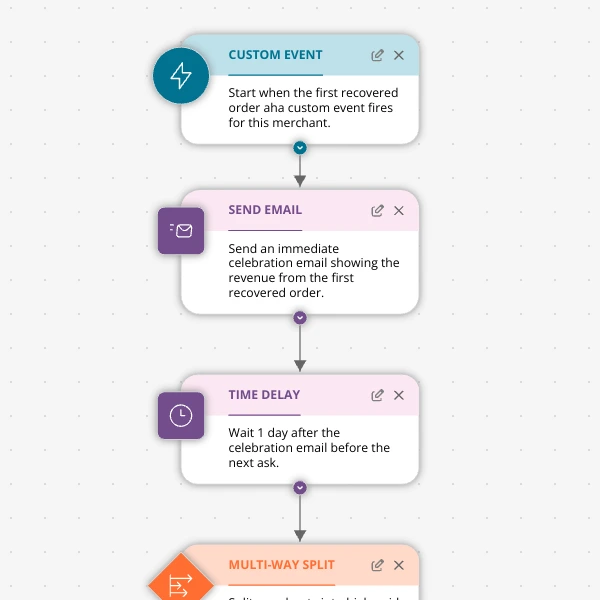
The Aha-Moment Playbook For Shopify Apps: Turn One Magic Action Into Months Of Revenue
A node-by-node playbook for Shopify and e‑commerce apps to center their lifecycle on one aha-moment custom event in Spreeflo, celebrate it, segment merchants by profile and engagement, and turn first recovered value into lasting revenue and retention.
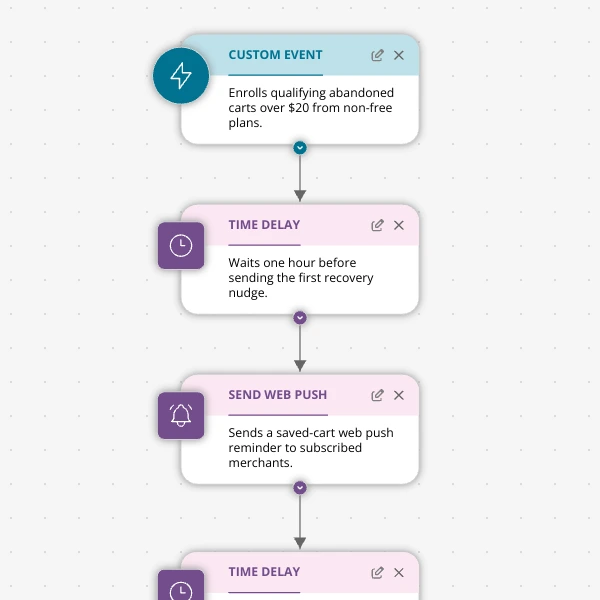
Stop Letting High‑Intent Carts Die: A 3‑Email Recovery Journey for Shopify Apps
A detailed, node-by-node walkthrough of a three-email (plus optional web push) cart-abandonment recovery journey for Shopify apps in Spreeflo, showing how to trigger events, branch on behavior, tag outcomes, and measure recovered carts and revenue.
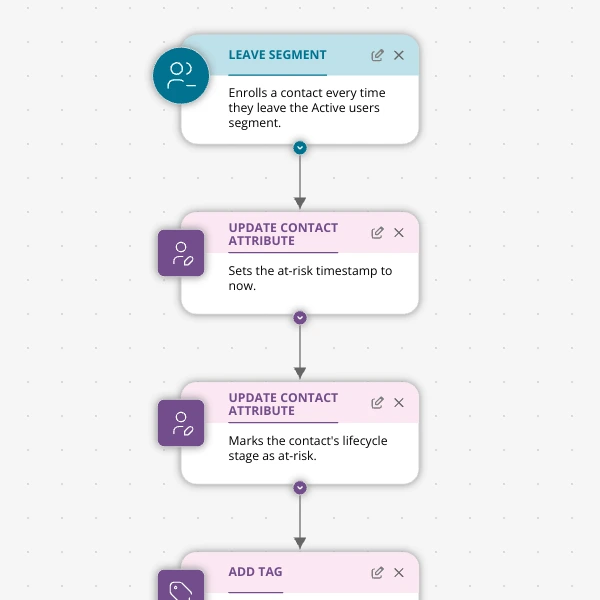
When Active Users Go Dark: A 4‑Touch Win‑Back Journey For Your Shopify App
A detailed, node-by-node Spreeflo journey for winning back previously active Shopify app users who stop engaging, using segment-based triggers, conditional logic, and a four-touch email plus internal alert sequence to recover usage and MRR.