When SEO Deals Go Silent: A Stalled-Deal Re‑Pitch Journey That Actually Brings Them Back
A practical Spreeflo journey for reviving stalled SEO SaaS deals by defining a “stalled” stage, automating context-rich marketing re-pitches, and routing reactivated prospects back to sales while tracking performance and minimizing manual follow-up.
Industry
Niche
Pattern
Loading sequence...
Your sales board is full of ghosts: agency leads who loved the demo, in-house SEOs who "just need internal approval," and trials that quietly expired after a big content push.
They’re not lost. They’re just unmanaged.
For a team running an SEO SaaS like rank tracking or content briefs, those stalled opportunities are often the difference between $40k and $70k MRR. The sequence at the top of this page is the whole journey, end to end, for how you put those deals on rails: marketing takes over when a deal goes quiet, then hands it back to sales the moment there’s a pulse.
We’ll walk through that journey node by node and show how to adapt it to your own stack and sales motion.
Why “stalled” should be a real stage in your pipeline
Take BrieflySEO, a 5‑person content-brief SaaS. Their founder handles big-agency deals personally. On paper, they have plenty of volume: ~40 new qualified opportunities a month, 20% close rate.
Look closer and you see the leak:
40% of opps go quiet for 4+ weeks after the proposal
Sales doesn’t have time to babysit them
Marketing doesn’t know which deals to nurture or when to step in
That’s exactly what this journey fixes.
You’re going to:
Define “stalled” using real behavior, not gut feel.
Let a journey pick up those deals automatically and run a smart, context-aware nurture.
Route them back to sales instantly when they show new intent.
This is the core of two of Spreeflo’s beliefs:
You win when you capture enough detail on each buyer to speak to them like a human, not a row in a CRM.
As a founder, your follow-up should be systematized once, not rebuilt deal by deal.
The data you need before you automate anything
Before you drag a single node into a journey, decide what “stalled” means in your world and how Spreeflo will know.
For most SEO SaaS teams, that’s three ingredients:
Who is “in pipeline”
What counts as a sales touch
Intent signals from the buyer
Represent this at the contact level with tags or attributes. For example:
stage_demo_scheduledstage_demo_completedstage_proposal_sentstage_negotiationcustomer
Sales (or your CRM) applies and removes these. In Spreeflo, tags are lightweight and perfect for this; if you’re not already using them, start with the tags help doc.
You need a signal that “a human from our side did something”:
Logged call
Personal follow-up email
New proposal version
Live demo
Model this as a custom event called sales_touch. Every time your CRM logs one of these, your backend posts it to Spreeflo’s events endpoint via the Spreeflo API as event: "sales_touch" with the contact’s email.
That gives you an activity trail tied to each contact.
These are signs of life you can pick up without sales touching them:
Opening or clicking your emails
Logging back into the product (
app_loginevent)Visiting pages like
/pricing,/plans, or your onboarding docs
The Spreeflo SDK on your app and marketing site handles these automatically (page views, events), and email behavior flows in from campaigns and journeys.
Now you can build precise segments in Spreeflo’s segment builder instead of fuzzy lists like “old leads.”
Step 1: Catch stalled deals with Cyclic + Criteria Match
You’re going to use two triggers in one journey:
A Cyclic trigger that sweeps for stalled deals on a schedule.
A Criteria Match trigger that fires as soon as a deal becomes stalled for the first time.
Both feed into the same nurture path.
1. Build a “Stalled deals” segment
Under Audience → Segments, create a saved segment called “Stalled deals – sales-owned”. Use these rules (expressed with the segment builder’s categories and operators):
Group 1 (who is in the sales pipeline):
Contact tags:
contact is tagged withany of
stage_demo_completedstage_proposal_sentstage_negotiation
Group 2 (no sales touch recently):
Custom events: event name
sales_touchwith operatorHAS_NOT_TRIGGEREDTime window:
in the last21days
Group 3 (still emailable):
Email subscription status
isSubscribed
Wrap them in a top-level AND group:
Group 1 (pipeline stage tags)
AND Group 2 (no
sales_touchin last 21 days)AND Group 3 (subscribed)
This is your definition of “stalled.”
2. Cyclic trigger: daily sweep for stalled deals
In a new Journey (Marketing → Journeys; the campaigns and journeys overview has the difference if you need a refresher):
Add a Cyclic trigger.
Schedule: every 1 day at 09:00 in your main timezone.
Criteria: one rule, type
segments, operatorIS, valueStalled deals – sales-owned.Re-enrollment: turn this on.
Every morning, any contact who currently matches that segment and isn’t already in the journey enters the flow.
Re-enrollment on matters here: if an opportunity stalls again six months from now, you want this same journey to take over once more.
3. Criteria Match trigger: catch new stalls instantly
Add a second trigger to the same journey:
Criteria Match trigger.
Criteria: same segment rule as above —
segments IS "Stalled deals – sales-owned".Re-enrollment: leave this off.
This trigger fires the moment a contact newly matches the stalled segment for the first time. After they exit the journey, any future stall will be picked up by the Cyclic sweep.
Because Spreeflo’s re-enrollment is journey-scoped, not trigger-scoped, you now have:
First-time stalls entering quickly via Criteria Match.
Later stalls entering via Cyclic, but never while a contact is mid-journey.
4. Merge the two paths
On the canvas, each trigger starts its own path. Drop a Merge node and connect both triggers into it. From this Merge onward, every stalled deal follows the same steps.
This keeps your nurture logic in one place while still honoring two distinct entry points.
Step 2: Marketing takes over with a context-rich re‑pitch
Right after the Merge, the journey needs to declare “marketing is now primary owner” and send a first, highly relevant touch.
1. Mark the contact as stalled
Add an Add Tag action right after the Merge:
Tags:
stalled_deal(create it if needed).Force tag trigger: off (you don’t need downstream Added Tag triggers here).
This tag is your history: you’ll use it later for reporting on reactivation rates.
Optionally, you can add another tag such as stalled_cycle_1 and use an Update Contact Attribute to increment a numeric stalled_cycle_count each time the journey starts. That lets you split messaging later for “this is the third time we’ve tried this” cases.
2. Send the first re‑pitch email
Next, add a Send Email action:
From: ideally the original AE or founder address.
Send only once: keep this on so they never see this exact email twice across multiple stalls.
Use Spreeflo’s email builder to create a template that reads like a thoughtful check‑in, not a sequence robot.
Because you’ve captured rich contact data, personalize this email instead of sending a bland “just bumping this up”:
Reference which features they actually used:
If they fired a
generated_content_briefevent, talk about their content pipeline.If they triggered
technical_audit_run, speak to site health and technical debt.Mention their role or company size if you have it as attributes.
Use AI personalization to vary the angle based on industry or previous activity.
Small example angles:
Agencies: “Here’s how other agencies your size package rank tracking into retainers.”
In-house SEO teams: “You’re already tracking X keywords; here’s how customers in similar positions use BrieflySEO to justify headcount.”
This is where “capture detail on every customer so you can speak to each uniquely” stops being a slogan and starts being line‑by‑line copy.
3. Don’t pile on: add breathing room
Right after Send Email, add a Wait Condition:
Condition: “signs of life” (we’ll define it next).
Timeout: 5 days.
This ensures you do not send another marketing email for at least several days. It also gives the prospect time to engage before you decide what to do next.
Step 3: Watch for “signs of life” and hand the deal back to sales
The core behavior of this journey is simple:
If they engage at any point, get out of the way and tee up sales with context.
If they stay cold, continue a structured, value-first nurture and then gracefully step back.
1. Define a reusable “Sign of life” segment
Instead of rewriting conditions in multiple nodes, create another saved segment: “Sales reactivation signals.”
In the segment builder, use an OR group like:
Email Activity:
openedat least 1 time in the last 7 days (any marketing email)OR
clickedat least 1 time in the last 7 daysOR Custom events:
app_logintriggered at least 1 time in the last 7 daysOR Page visited:
URL
contains/pricingat least 1 time in the last 7 daysOR URL
contains/upgradeat least 1 time in the last 7 days
Wrap that in a top-level group with Email subscription still Subscribed if you want to be strict.
You’ll now reference this segment everywhere you need to know “are they back?”
2. Wait for a signal, then branch
Go back to your Wait Condition after the first re‑pitch email and set:
Condition: segment membership
IS“Sales reactivation signals”.Timeout: 5 days.
After that Wait Condition, add an If/Else node with the same condition:
If branch: member of “Sales reactivation signals”.
Else branch: not a member (they stayed dark for 5 days).
Because the Wait Condition only releases when the condition becomes true or the timeout expires, this If/Else effectively distinguishes between “they engaged” and “they didn’t.”
3. If they engage: route straight back to sales
On the “Then” branch:
Clean up tags
Alert the owner
End this path.
Add a Remove Tag action removing stalled_deal.
Optionally Add Tag revived_deal.
Add a Send Internal Email action to your sales inbox (or a specific AE).
Subject template example: “Revived deal: {{ contact.first_name }} at {{ contact.company }} is active again”.
In the body, include:
Last product event (e.g. last
app_logindate)Last page visited (pricing? docs?)
Which email they opened or clicked
Because internal emails can reference contact data, you’re giving the rep instant context without them digging through tools.
Sales can now decide whether to call, send a 1:1 email, or update the opportunity stage. Marketing has done its job and stepped aside.
4. If they stay cold: continue a short, targeted nurture
On the “Else” branch (no sign of life after 5 days):
Add a Time Delay of 2 days.
Add a second Send Email.
After that second email, add another Wait Condition.
Add a second If/Else.
Focus this one on proof:
One strong case study relevant to their segment (agency vs in‑house, B2B vs ecommerce).
Concrete deltas: “Reduced weekly reporting from 3 hours to 20 minutes,” “lifted non‑brand traffic 18% in 90 days.”
Again, use contact attributes or tags to choose which story they see. You can build separate templates for agencies, in‑house, and solo founders, and route via a Multi-way Split earlier in the journey if your audience is mixed.
Same condition: membership in “Sales reactivation signals”.
Timeout: 7 days.
If branch (they finally engage): go through the same “route back to sales” mini‑sequence: Remove stalled_deal, Add revived_deal, Send Internal Email, then end.
Else branch (still no response after roughly two weeks of polite, value-first outreach):
Optional final Send Email after a 1–2 day Time Delay:
Tone: “Should I close the loop?” — respectful, gives them an easy out and a clear next step if timing was the issue.
Add tags like stalled_nurture_complete so you can exclude them from aggressive sales campaigns but still include them in lower‑frequency product updates or content roundups.
At this point, if they come back months later (maybe from SEO or word of mouth), they’ll likely re-enter the journey via the Cyclic trigger once they qualify as stalled again — but they won’t be spammed with the same early emails because those steps have “Send only once” enabled.
Step 4: Let deals cycle more than once without being annoying
This is where re-enrollment and attributes matter.
In this pattern:
Cyclic trigger:
isReEnrollment = trueso a contact can re-enter the journey in a future stall.Criteria Match trigger:
isReEnrollment = falsebecause its job is only the first immediate handoff.
Inside the journey:
Key Send Email steps (the first re‑pitch and the final “close the loop”) should keep “Send only once” on.
If you want variety on later stalls, create additional email steps that are only used when
stalled_cycle_count(a numeric contact attribute you update at journey start) is at least 2. Use an If/Else right after the Merge to branch “first stall” vs “second or later”.
That way:
The first time they go dark, they see your core re‑pitch and best case study.
The second time, they might get a shorter “things change; here’s a new way to think about this” touch instead of a repeat.
This is classic founder leverage: your system remembers how many chances you’ve already given and adapts, while you stay out of the weeds.
What to measure once this is live
The point of all this scaffolding is simple: move real revenue, not email vanity metrics.
A few practical numbers to track:
Stalled-deal reactivation rate
Marketing-influenced close rate
Email behavior inside the journey
Time saved for sales/founder
Numerator: contacts tagged revived_deal in a period.
Denominator: contacts who entered the journey with stalled_deal in that same period.
This tells you what percentage of stalled opps show any meaningful post‑journey engagement.
In your CRM, mark deals that had the stalled_deal tag or a “revived” internal email before closing.
Compare:
Close rate for opportunities that went through this journey.
Close rate for those that never stalled (control group).
If you’re on the Professional plan, you can add a Webhook action at the “revived” point to ping a small integration or Zap that updates your CRM automatically.
Look at open and click rates per email.
Use Spreeflo’s email analytics plus a segment of stalled_nurture_complete to see which messages actually moved the needle.
Rough but real: estimate how many stalled opps per month you used to follow up manually vs now.
Multiply by your typical “craft a thoughtful follow-up” time. That’s reclaimed founder / AE hours you can spend on live deals.
Over a few months, you’ll find the right cadence and messaging for your specific niche — technical SEO platforms, content brief tools, and rank trackers all have slightly different objections and timing.
The broader shift: from heroic follow-up to reliable systems
Most SEO SaaS founders accept stalled deals as background noise. A few lucky ones get revived months later when the lead reappears in Stripe, and they tell themselves “see, it works out.”
What this journey does is remove luck from that equation.
You capture the right behavioral detail on every buyer — sales touches, app logins, pricing-page visits — and you teach Spreeflo how to respond when that detail stops changing. You design the system once, and it runs whether you’re heads‑down on product, jumping into support, or actually on holiday.
If you’re still trying to juggle this by hand or with scattered one-off campaigns, this is a good moment to turn it into a living asset. Start with a simple version of the sequence at the top of this page, wire it up using tags, segments, and a couple of journey nodes, and let it run for a month.
Then look at how many “dead” deals turn out to be very much alive when you treat “stalled” as a stage to be managed, not a graveyard.
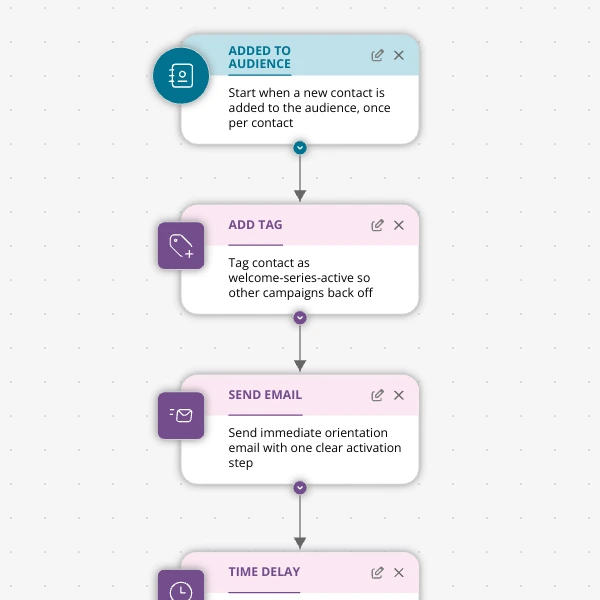
The Shopify app welcome series that turns installs into income
A step-by-step Shopify app welcome email journey for tools like CartSpark, showing how to turn new installs into activated, retained merchants using Spreeflo journeys, tags, and behavioral triggers so fewer trials quietly churn and more trials convert.
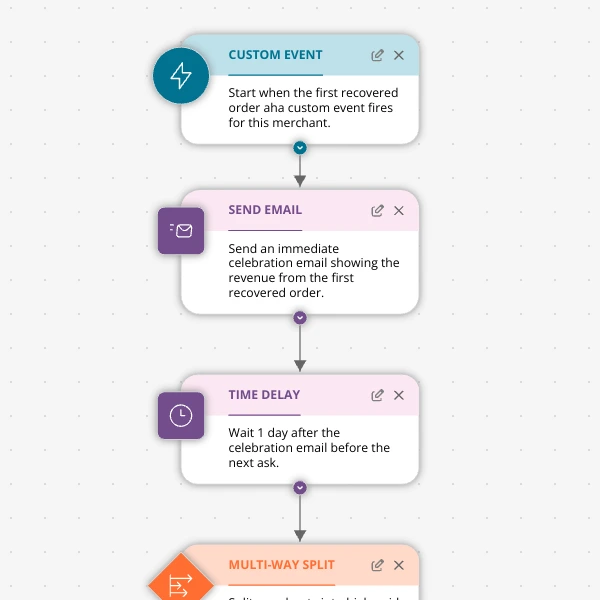
The Aha-Moment Playbook For Shopify Apps: Turn One Magic Action Into Months Of Revenue
A node-by-node playbook for Shopify and e‑commerce apps to center their lifecycle on one aha-moment custom event in Spreeflo, celebrate it, segment merchants by profile and engagement, and turn first recovered value into lasting revenue and retention.
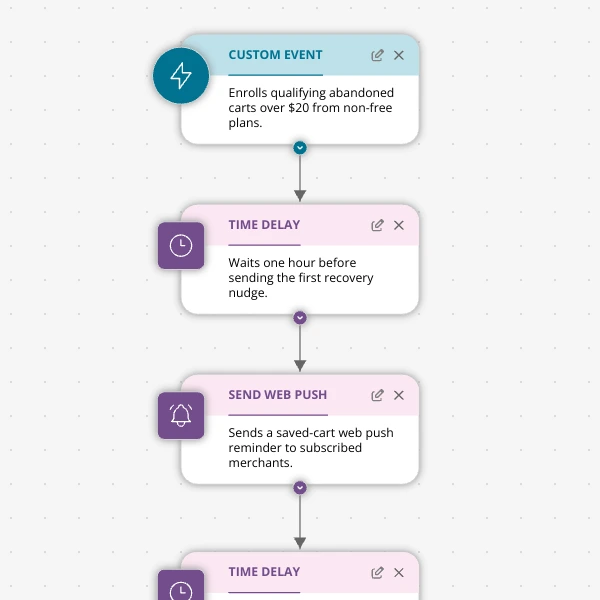
Stop Letting High‑Intent Carts Die: A 3‑Email Recovery Journey for Shopify Apps
A detailed, node-by-node walkthrough of a three-email (plus optional web push) cart-abandonment recovery journey for Shopify apps in Spreeflo, showing how to trigger events, branch on behavior, tag outcomes, and measure recovered carts and revenue.
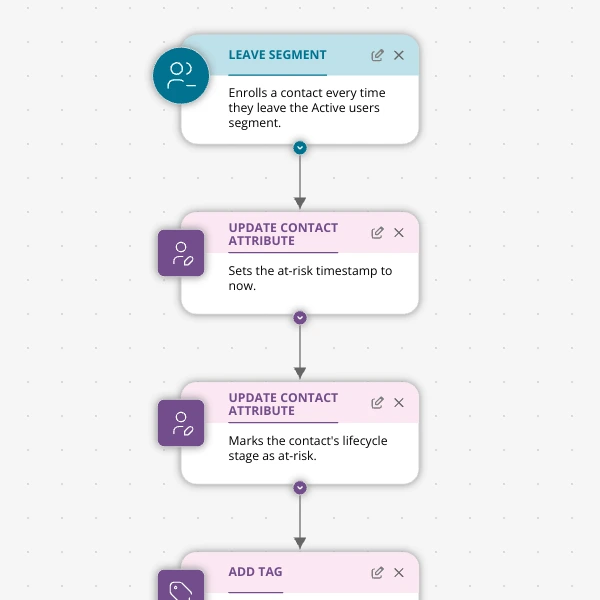
When Active Users Go Dark: A 4‑Touch Win‑Back Journey For Your Shopify App
A detailed, node-by-node Spreeflo journey for winning back previously active Shopify app users who stop engaging, using segment-based triggers, conditional logic, and a four-touch email plus internal alert sequence to recover usage and MRR.