Win Back Quiet SEO Subscribers With a Single, Honest Email
A detailed Spreeflo automation playbook for SEO SaaS teams to detect lapsed newsletter subscribers, send one honest “still useful?” email, then reactivate, watch-list, or quietly suppress them to protect deliverability and lifetime value.
Industry
Niche
Pattern
Loading sequence...
The fastest way to kill an SEO newsletter isn’t spam complaints. It’s quiet apathy from people who stopped opening months ago but are still on your list.
For a team like RankPulse, a three-person rank tracking SaaS doing ~$40k MRR, that apathy was invisible until open rates slid from 38% to 22% over a year. The same “weekly SERP briefing” going to the same list—but less and less of that list was actually listening. The sequence at the top of this page is the journey they wish they’d had in place from day one.
This playbook shows you how to build that journey in Spreeflo: a lapsed-subscriber reactivation flow that asks, honestly, “Is this still useful?” and then either re-engages the right people or quietly lets go of the rest.
Why lapsed subscribers quietly wreck SEO SaaS economics
If you run an SEO SaaS, your newsletter isn’t vanity. It’s:
Education that makes users actually use your features (and stick around).
A channel to announce new reports, integrations, and pricing.
A way to keep agencies thinking about you between client projects.
When 30–50% of that list is dead weight, three things happen:
Deliverability erodes. ESPs see “you send, they don’t open” and route more of your mail to Promotions or spam. Active readers suffer.
Upsell and expansion suffer. The subscribers who would upgrade to your new “multi-domain rank tracking” tier never even see the launch email.
Churn hides. Customers who stopped opening months ago finally cancel and it looks like a pricing problem, not the engagement problem it really is.
Most SEO SaaS teams keep plowing ahead: new issues, same list, hoping fresh content alone saves the trend. That’s the lifetime-value leak.
The fix isn’t sending more. It’s building one very intentional journey that:
Detects when a subscriber has gone cold.
Sends a single, clear “still want this?” message.
Uses their behavior on that email as the decision point: re-engage, keep an eye on, or suppress.
That’s exactly what the Spreeflo journey above does.
The journey in plain language
Before we go node by node, here’s the shape of the flow you see above:
A Criteria Match trigger watches for subscribers who haven’t opened the last N issues of your SEO newsletter.
Those subscribers get tagged as “lapsed” and sent a candid reactivation email asking if the content is still useful, with simple topic/cadence options.
After a few days, a Check Email Activity node looks at how they interacted with that email:
Each path updates their status differently—either reactivating them, keeping them on a watch list, or suppressing them so they stop dragging down your metrics.
If they clicked, they’re clearly still engaged.
If they opened but didn’t click, they’re lukewarm.
If they ignored it, they’re truly cold.
You can build this as a journey once, then let it run in the background while you focus on shipping features.
Let’s walk it step by step.
Step 1: Define “lapsed” with a Criteria Match trigger
Pattern says: “Newsletter subscribers with no opens in 5+ issues.” In Spreeflo, that becomes a Criteria Match trigger powered by the segment builder.
You drop a Criteria Match trigger onto the canvas and configure conditions roughly like:
Contact has the “newsletter” tag.
Email Subscription Status is “Subscribed”.
Email Activity: did not open at least 5 marketing emails in the last 45 days.
Why those details matter:
Tag + subscription status keeps you away from one-off transactional recipients or older contacts who already unsubscribed.
Using “did not open at least 5 emails” is the closest expression of “hasn’t opened the last 5 issues” available in the builder. If you send weekly, 45–60 days is a good window.
Set the trigger’s Re-enrollment to “on”.
You want this journey to fire again if someone re-engages, then goes cold a year later. The mid-journey lock prevents duplicate runs at the same time, but over their full lifetime a subscriber can go through this reactivation process more than once.
This is your “who.” Now you decide what happens when they qualify.
Step 2: Tag lapsed subscribers for visibility and control
Right after the trigger, the journey uses an Add Tag action to apply something like newsletter-lapsed.
Two reasons to do this immediately:
Reporting: You can see, at a glance, how many subscribers are currently in the “lapsed” bucket and track that number over time.
Safeguards: You can exclude
newsletter-lapsedcontacts from other nurture campaigns or promotional blasts, so they don’t get conflicting messages while they’re in this reactivation flow.
There’s no delay here; the tag is applied as soon as the Criteria Match trigger fires.
If you care about internal visibility, you can also add a Send Internal Email node here to ping yourself or your marketer when a large batch of subscribers becomes lapsed (for example, when a big content experiment doesn’t land). But that’s optional.
Step 3: Send the honest “still useful?” email
Next is the heart of the pattern: a Send Email node that delivers your reactivation message.
This is the single moment where you talk directly to lapsed subscribers, so spend time on the creative. Use Spreeflo’s email builder to make something that feels both direct and respectful.
Core elements that work well for SEO SaaS:
A subject line that acknowledges the behavior:
“Still want weekly SEO rank insights?”
“Should we stop sending these SERP briefs?”A short opener that shows you’re paying attention, not guilt-tripping:
“You haven’t opened the last few RankPulse Briefings. That usually means one of two things: you’re busy, or the content isn’t hitting.”Clear options, each with its own link:
Keep getting everything as-is.
Only send major feature or product updates.
Only send deep-dive technical SEO / content strategy pieces.
Stop sending the newsletter.
Those option links don’t go to a form (remember, forms stay in-app). Instead:
Each link sends them to a simple preferences or confirmation page in your app or on your site.
On that page, your frontend calls Spreeflo.identify(email, { newsletter_preference: 'technical_seo_only' }) or similar via the SDK to update their contact attribute.
From Spreeflo’s perspective, the key behavior in this journey is “did they open or click this email?” The finer-grained topic preference is something you’ll use in other nurture journeys later.
In the Send Email node, keep “Send only once” turned on. Even if they re-qualify as lapsed in the future, they’ll get a fresh reactivation email then, not the same exact template twice in one run.
Step 4: Wait a few days to gather behavior
After sending the reactivation email, insert a Time Delay node.
Typical delay: 3–7 days. For a weekly SEO newsletter, 5 days is a sweet spot:
It gives people time to see and act on the email.
You don’t let them sit for another whole month while deliverability continues to decay.
Configure the delay to “5 days” (or your chosen window). This is also where the pacing rule is satisfied: there’s now clear spacing between the first Send Email and any potential follow-up email in this journey.
Once the delay is over, you’re ready to branch based on engagement.
Step 5: Branch on how they engaged using Check Email Activity
Now drop in a Check Email Activity process node, pointing it to that specific “still useful?” template.
Configure three branches:
Branch A: “Clicked” (Link Clicked)
Branch B: “Opened” (Opened but didn’t click)
Branch C: else (everyone who didn’t open at all, including undelivered)
Spreeflo evaluates each contact against those branches after the delay. The first matching branch wins; if they didn’t match any configured activity, they follow the else path.
Why branch this way instead of a simple open/no-open split?
Clickers are your highest-intent group. They cared enough to choose a preference or read more deeply.
Openers are interested enough to glance but not yet ready to act.
Non-openers are telling you, with their inaction, that this channel is noise for them.
Each group deserves different treatment.
Step 6: Treat clickers as reactivated, not just “not dead”
Contacts who reach the “Clicked” branch are clearly alive. They saw your email, chose a link, and hit your site.
On this branch, the journey typically does three things in sequence:
Update Contact Attribute: Set a text attribute like
engagement_bucketto a static value such asreactivated. This gives you a simple way to target them later: “send case studies only to reactivated subscribers,” for example.Remove Tag: Use a Remove Tag node to strip
newsletter-lapsed.Add Tag (optional): Add a positive tag like
newsletter-reactivatedfor reporting.
No more emails go out here. They simply drop out of the journey, and your regular newsletter continues to reach them.
Down the line, other journeys can key off that engagement_bucket or newsletter-reactivated tag—say, a series highlighting new rank volatility alerts or Google Search Console integrations that active readers will care about.
Step 7: Handle “opens but no clicks” as a watch-list, not a win
The “Opened” branch is nuanced. These people noticed the email but didn’t engage with the options. Maybe they’re fine with the status quo. Maybe they’re skimming on mobile and intend to change settings later.
On this path, you might:
Update Contact Attribute: Set
engagement_buckettowarm.Remove Tag: Remove
newsletter-lapsedso they’re no longer considered in the lapsed pool.End the journey.
You’re treating them as saved, but with a different label from the more committed clickers. That gives you flexibility to:
Exclude “warm” contacts from future aggressive reactivation pushes.
Compare metrics between “reactivated” and “warm” segments (open rates, CTRs, eventual upgrades).
You’re also respecting their inbox: they got one “still useful?” email, they glanced at it, and you didn’t badger them with follow-ups.
Step 8: Quietly suppress true non-openers
The else branch—the people who never opened the reactivation email—is where you protect your list quality.
These are the subscribers who:
Haven’t opened 5+ recent issues, and
Ignored a direct, honest “do you still want this?” message.
For them, the journey can:
Update Email Subscription Status: Set status to “Non-subscribed” using the Update Email Subscription Status node.
Optionally, Add Tag like
newsletter-suppressedso you can analyze how big this group is over time.Remove Tag
newsletter-lapsedso your lapsed count reflects only currently-in-journey contacts.
You’re not punishing anyone. You’re acknowledging, silently, that this channel isn’t working for them and choosing not to keep paying the deliverability cost.
Crucially, “Non-subscribed” in Spreeflo means they won’t receive future marketing emails unless they explicitly opt back in, but you still retain them as contacts. They might reactivate via your product or another opt-in later.
If you want to be extra transparent, you can mention this policy inside the reactivation email itself:
“If we don’t hear from you, we’ll stop sending the weekly brief so we’re not cluttering your inbox. You can always rejoin from your account settings.”
That line is the consent you’re acting on in this branch.
Measuring whether this journey is earning its keep
For an SEO SaaS, the success of this pattern shows up in three metrics:
Reopen rate
Among people who enter this journey, what percentage open the “still useful?” email? If your typical campaign open rate is 30%, seeing 15–20% here is a good sign. These are people who’d been cold for 5+ sends.Reactivation rate
Of those lapsed subscribers, how many you classify as “reactivated” (clickers + maybe openers) over a 30–60 day window? This is the share of your list you would have written off that you now treat as active again.Unsubscribe / suppression rate
How many end up in the “non-subscribed” bucket via this journey? Early on, this might feel scary—a big number. But watch what happens to your overall newsletter metrics:
- Higher open and click rates on future sends.
- Better inbox placement.
- Cleaner data feeding other journeys and segments.
Inside Spreeflo, you can track these cohorts with tags and attributes, and use audiences and segments to slice performance: “reactivated vs never-lapsed vs newly-subscribed.”
Over time, this one journey becomes a kind of hygiene layer under your entire email strategy.
Why this matters more for SEO SaaS than almost anyone
If you sell SEO tooling, your buyers are overwhelmed with content. They’re subscribed to five other SEO newsletters, follow half of Twitter, and skim changelogs from Ahrefs and Google.
That makes nurturing engagement with your own messages non-negotiable:
If agencies don’t see your ongoing value during quiet client periods, they churn when that project ends.
If in-house marketers don’t hear about your new features, they never adopt the bits that would make you sticky.
If your newsletter slowly fills up with ghosts, every launch email underperforms—even if the feature is fantastic.
The lapsed-subscriber reactivation journey in the sequence above attacks that leak directly. It doesn’t try to drag everyone back. It separates:
People who still care (and tells you who they are).
People who might care later (and marks them as warm).
People who are done (and stops shouting at them).
And it does it with one email, one split, and a handful of attribute and tag updates you set up once in Spreeflo’s campaign and journey automation tools.
For a founder-led team, that’s the whole point: you don’t have time to manually prune lists or run one-off “win back” blasts every quarter. You need a system that quietly protects your deliverability and resurrects the right subscribers while you work on the product.
Most SEO SaaS businesses are leaving lifetime value on the table because they treat their newsletter as a broadcast, not a relationship that needs upkeep. This journey is how you stop that leak—one honest question to your quiet subscribers, automated forever.
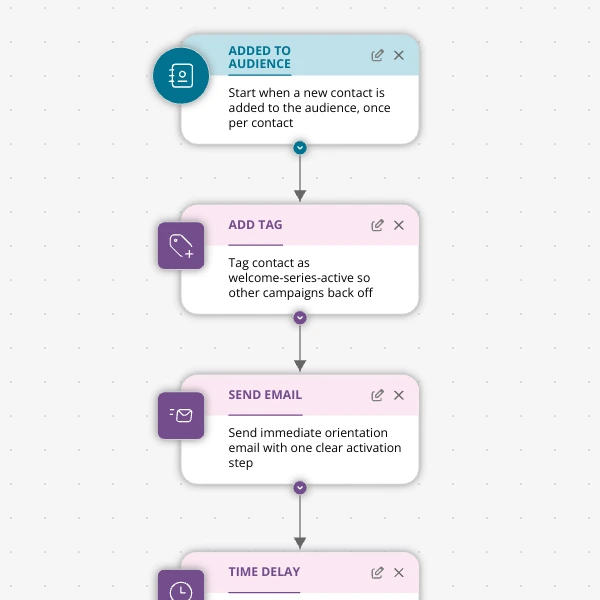
The Shopify app welcome series that turns installs into income
A step-by-step Shopify app welcome email journey for tools like CartSpark, showing how to turn new installs into activated, retained merchants using Spreeflo journeys, tags, and behavioral triggers so fewer trials quietly churn and more trials convert.
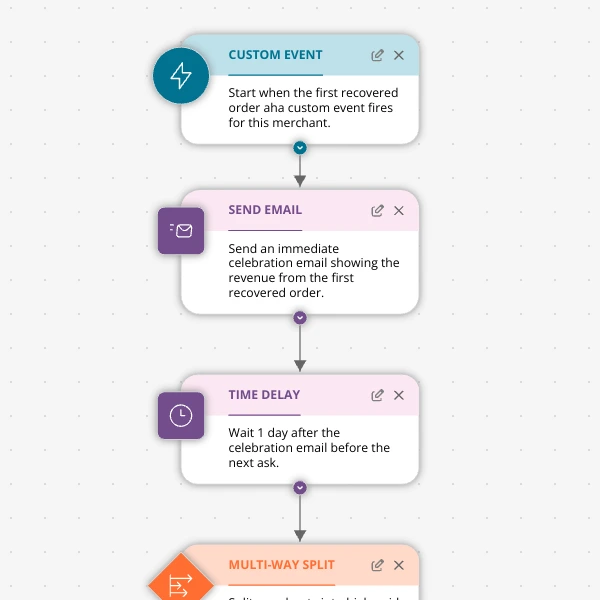
The Aha-Moment Playbook For Shopify Apps: Turn One Magic Action Into Months Of Revenue
A node-by-node playbook for Shopify and e‑commerce apps to center their lifecycle on one aha-moment custom event in Spreeflo, celebrate it, segment merchants by profile and engagement, and turn first recovered value into lasting revenue and retention.
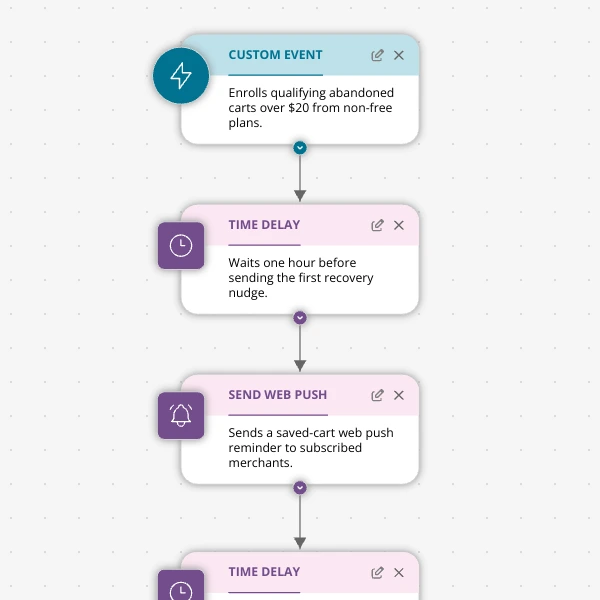
Stop Letting High‑Intent Carts Die: A 3‑Email Recovery Journey for Shopify Apps
A detailed, node-by-node walkthrough of a three-email (plus optional web push) cart-abandonment recovery journey for Shopify apps in Spreeflo, showing how to trigger events, branch on behavior, tag outcomes, and measure recovered carts and revenue.
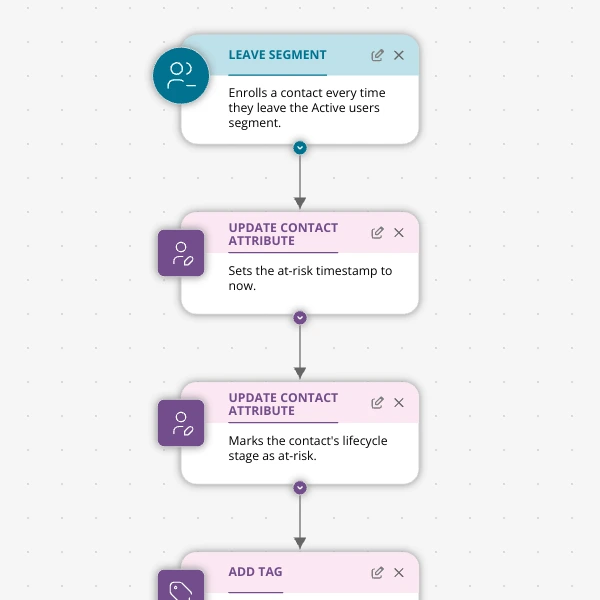
When Active Users Go Dark: A 4‑Touch Win‑Back Journey For Your Shopify App
A detailed, node-by-node Spreeflo journey for winning back previously active Shopify app users who stop engaging, using segment-based triggers, conditional logic, and a four-touch email plus internal alert sequence to recover usage and MRR.