A Welcome Series That Turns New SEO Leads Into Long-Term Users
This playbook walks through building a three-email Spreeflo welcome journey for SEO SaaS, using behavioral splits, tags, and activation milestones to turn new leads and trials into long-term, higher-converting users.
Industry
Niche
Pattern
Loading sequence...
Most SEO SaaS tools treat every new email address the same: one generic welcome, maybe a “Getting started” link, then straight into the newsletter firehose. And then they wonder why trial-to-paid stalls and churn spikes in month one.
For a rank tracker or content-brief product, the first 7 days decide whether someone becomes a power user or a quiet churn statistic. The sequence at the top of this page is the whole journey, end to end, for fixing that moment.
In this playbook, we’ll build a three‑email welcome series in Spreeflo specifically for SEO SaaS: tools like “RankPulse” or “BrieflySEO”. It’s wired to do three jobs at once: set expectations, deliver a fast SEO win, and nudge people to their first real in‑app action.
What this welcome series is really for
Before we touch nodes, be clear on the outcome. For an SEO SaaS, a good welcome series:
Confirms what they just signed up for and who it’s for.
Gets them to a first “meaningful click”: add a site, connect Search Console, add first keywords, generate first brief.
Surfaces social proof so they feel confident investing time.
Starts collecting detail so you can speak to them as “agency owner doing client work” vs “solo blogger chasing affiliate revenue.”
Most businesses leak lifetime value because this part is on autopilot. They send the same bland welcome to everyone and never revisit it. Spreeflo’s whole angle is the opposite: capture detail on every customer so you can speak to each one uniquely, and automate those touches so you don’t need a big team to do it.
Let’s walk the journey exactly as it’s wired in the visual sequence.
Step 1: Trigger on every new contact, not just trials
Node: Add to Audience trigger (type: Add to Audience)
The journey starts the moment someone is added to your Spreeflo audience, regardless of source:
A trial signup via your product’s registration form (backed by the Spreeflo API).
A newsletter signup via a Spreeflo form on your blog.
A manual CSV import of a waitlist.
In the Add to Audience trigger:
Set Re-enrollment to off. You want each person to experience this welcome only once over their lifetime with you, even if they’re re-imported or re-added later.
Keep the trigger broad: no criteria here. We’ll specialize the path with an If/Else shortly.
Why not just trigger on started_trial as a Custom Event? Because not every valuable relationship starts with a trial. Agencies might join your newsletter first, then start a trial two months later. Triggering on “added to audience” guarantees everyone gets a welcome, and you still can branch based on what they actually did.
If you aren’t yet familiar with journeys in Spreeflo, this happens in the visual editor you’ll find under the campaigns and journeys section; the overview at build a journey is a useful reference.
Step 2: Split by what they signed up for
Node: If/Else
Right after the trigger, add an If/Else process to separate contacts based on their relationship to you. A simple and powerful split for SEO SaaS:
Condition: “Contact attribute
account_typeistrial”Yes path: active trial users (signed up in‑product).
Else path: non-trial leads (newsletter-only, lead magnet downloads, etc.).
You define this condition with Spreeflo’s segment builder:
Category: Contact Attributes.
Field:
account_type(or whatever you map from your app).Operator: is.
Value:
trial.
You can populate account_type from your backend by POSTing trial events into the Spreeflo API whenever someone starts or upgrades an account. The event itself drives your product analytics; the mapped attribute fuels this journey.
Why split? Because a trial user is expecting onboarding into a tool. A newsletter-only subscriber is expecting content. Blending those into one message is how you lose both.
Step 3: Tag and organize as they enter
Node: Add Tag (one per branch)
On each branch, add an Add Tag action:
Trial path: tag
welcome_trial.Lead path: tag
welcome_lead.
Leave Force tag trigger off; you aren’t trying to re-fire downstream “Added Tag” triggers if they already had it.
These tags help you:
Build segments like “currently in welcome series” or “trial welcome vs content welcome.”
Exclude people from other blasts while they’re in this delicate early phase.
Analyze performance later in Spreeflo’s audiences view.
If you want a deeper primer on tags and how they drive automation, the guide to getting started with tags is worth a skim.
Step 4: Email 1 — get them a quick SEO win today
Node: Send Email (one per branch, with tailored content)
Now each branch sends its own version of Email 1 using a Send Email action.
For the trial path, Email 1 should:
Subject: Orient + promise a result (“This week, let’s ship your first ranking win”).
Body:
- Confirm what they’ll get from the tool in plain language.
- Promise one specific outcome for the next 48–72 hours (e.g., “track your top 10 keywords and set an alert”).
- Show a 1‑2‑3 checklist with a single primary CTA button back into the app.
Examples of “quick wins” for SEO SaaS:
Rank tracker: “Add your first site, top 10 keywords, and set a weekly alert.”
Content briefs: “Connect Search Console, pick one low‑CTR page, and generate a fresh brief.”
Technical SEO: “Run your first crawl and fix the top 3 errors we surface.”
Use Spreeflo’s email builder for a clear layout, and enable “Send only once” on this node so a contact who re-enters the branch later doesn’t get the same welcome twice.
For the newsletter-lead path, Email 1 can be more content-focused:
“Here’s what you’ll get from subscribing.”
One flagship guide or teardown.
A soft ask: “Reply and tell me your site + main SEO challenge” so you start capturing qualitative data.
Content is different per path, but structurally the journey is the same: one Send Email per branch at this point.
Step 5: Let them breathe: first delay
Node: Time Delay
Never follow one Send Email with another. Drop a Time Delay node after Email 1 on each path.
Recommended starting point:
Delay: 1 day (or 24 hours).
For trials, this gives them space to actually act on the quick win before you nudge again. For content leads, it lets them read or bookmark your guide without feeling spammed.
The Time Delay node is simple: value “1”, unit “Day(s)”. You can tighten this later once you see how fast users typically move.
Step 6: Wait to see who moved in the product
Node: Wait Condition
After the delay, trial users split into two psychologies:
People who did the thing you asked (added site, ran crawl, generated brief).
People who didn’t.
You want to speak to them differently. That’s where Wait Condition comes in.
Configure it roughly as:
Condition: “Custom event
added_first_keywordhas triggered at least 1 time in the last 3 days” (or the equivalent quick-win event for your product).Timeout: 3 days.
Behind the scenes, your app is sending that event to the Spreeflo events API every time a user hits that milestone. The Wait Condition uses the same rules engine as the segment builder, so you can tighten the definition over time (“at least 5 keywords”, “has run at least one crawl”, etc.).
What happens in practice:
If they hit the quick-win event before the timeout, the contact moves on immediately.
If not, they sit in this node until the timeout expires.
Either way, by the time they exit, you know whether they’ve reached activation.
Step 7: Branch on activation and tune Email 2
Nodes: If/Else → Add Tag (activated) → Send Email
Right after the Wait Condition, add another If/Else:
Same condition as before: quick-win event present.
Yes path: “Activated trial.”
Else path: “Not yet activated.”
On the activated path:
Add an Add Tag action:
activated_quick_win. This becomes a powerful filter later for upsell or advocacy sequences.Insert a short Time Delay of 1 day, so you don’t fire Email 2 the moment they complete the action.
Add Send Email for Email 2 — this one assumes success:
- Subject: “Great start — here’s how pros use [Product] next.”
- Content:
- A screenshot or GIF of an advanced workflow (e.g., daily rank fluctuation alerts, client-ready brief exports).
- One or two short customer quotes or micro‑case studies.
- A CTA toward the next level of engagement: inviting a teammate, connecting another data source, or trying a higher‑value feature.
On the not‑yet‑activated path:
Skip the tag (they haven’t earned it).
Add Send Email immediately after the Wait Condition; it’s already been at least a couple of days since Email 1, so pacing is safe.
Email 2 here does something different:
- Subject: “Need a hand getting your first rankings in?”
- Content:
- Empathetic copy: acknowledge they’re busy.
- A stripped-down, 60–90 second setup walkthrough with just one clear CTA: “Add your site + first 5 keywords.”
- Offer help: a link to docs, loom videos, or (for higher‑value accounts) a direct reply-to-the-founder ask.
Then, on this path as well, add a Time Delay of ~2 days after Email 2. You’ll use it to pace into the final message.
Step 8: Merge paths and close with Email 3
Nodes: Merge → Send Email
Both versions of Email 2 now have a delay behind them. You can safely bring the paths back together with a Merge node.
From the Merge, add the final Send Email — Email 3 of the series — which should:
Reaffirm the core value proposition in terms of outcomes (more ranked pages, fewer SEO fires, better briefs shipped faster).
Include stronger social proof: logos, a short case study, hard numbers (e.g., “Agency X shipped 40+ briefs a month using this workflow”).
Present a soft but clear choice:
- For trials: push toward “decide” moments:
- Extend trial if they’ve been active.
- Encourage upgrade if they’ve already seen value (you can even A/B test this with a Random Split here).
- For newsletter leads: invite them to start a trial with a focused angle based on their behavior (e.g., if they’ve been reading technical SEO content, pitch the crawl feature).
Again, set Send only once on this Send Email node.
Optional: capture richer profile data in‑app
So far, this journey has inferred behavior from events and attributes. To truly “speak to each customer uniquely,” you’ll eventually want explicit answers to questions like:
“Are you an agency or in-house?”
“What’s your monthly SEO budget?”
“What’s your biggest SEO bottleneck right now?”
The right way to collect that in Spreeflo is with a form shown inside your app, not by emailing them a survey link.
Here’s how to layer that on:
Build a short Spreeflo form with those questions, each mapped to contact attributes via Map to attribute.
Embed it as a popup using a Popup Form action later in the journey (for example, a week after activation, while they’re back in the product). The popup appears only to SDK‑identified visitors; your app calls
Spreeflo.identifyon login, so answers are auto‑tied to the right contact.Use Check Form Activity in another journey to branch:
- Submitted: route them into more tailored onboarding based on answers.
- Shown but not submitted: suppress the popup for a while and rely on email.
The detailed walkthrough for building and embedding those forms lives in the guide on how to create and embed forms.
This is where Spreeflo’s philosophy really shows: you aren’t guessing who they are anymore; you’re asking once, mapping the answers, and every future email can speak directly to “agency owner with 20+ clients and a link‑building bottleneck” instead of “generic SEO person.”
What to measure and how to iterate
Once the journey is live, don’t just “set and forget.” A small team’s advantage is that you can iterate quickly when the data points you in a direction.
Key metrics this welcome series should move:
Welcome-series open rate. If Email 1 isn’t getting opened, test subject lines with a Random Split node right before the first Send Email.
Time to first meaningful click. Define “meaningful” as clicks to “Add site,” “New brief,” or similar, and monitor via Email Activity or custom events.
First-conversion rate. For trials, this is trial‑to‑paid. For newsletter leads, it’s lead‑to‑trial. Segment these by whether they hit the quick-win event.
Unsubscribes during the series. If they spike around Email 2 or 3, the tone or timing is off.
Because Spreeflo treats this as a continuous journey, you can keep tweaking:
Use Check Email Activity after Email 1 to treat clickers differently from non‑clickers.
Add a Wait Condition before the final push that waits up to 7 days for “upgraded_plan” before sending a stronger “last chance” email.
Spin up saved segments like “Activated quick-win but never upgraded” from the same underlying data and target separate campaigns to them.
The mechanics for these variants reuse exactly the same node types you’ve already deployed; the campaign and journey automation help doc has more configuration examples if you want to push further.
Why this deserves a permanent place in your stack
For an SEO SaaS founder, it’s tempting to spend another week on that big “cluster strategy” blog post or the next integration launch instead of fiddling with onboarding emails.
But this welcome journey is one of the few assets that touches every single future customer:
It captures the right details so you’re not stuck blasting generic campaigns later.
It pulls new users to a real in‑product “aha” instead of leaving that to chance.
It keeps nudging quietly, every day, without adding another task to your calendar.
That’s the whole point of Spreeflo for founder‑led teams: build a system once that treats each customer like you remember exactly who they are and why they signed up, and it keeps earning back churned revenue while you focus on product and distribution.
If you wire up this sequence thoughtfully and keep an eye on those early metrics, you’ll feel it long before the MRR charts make it obvious: more trials converting, fewer accounts ghosting, and a user base that actually sees the SEO wins your tool is capable of delivering.
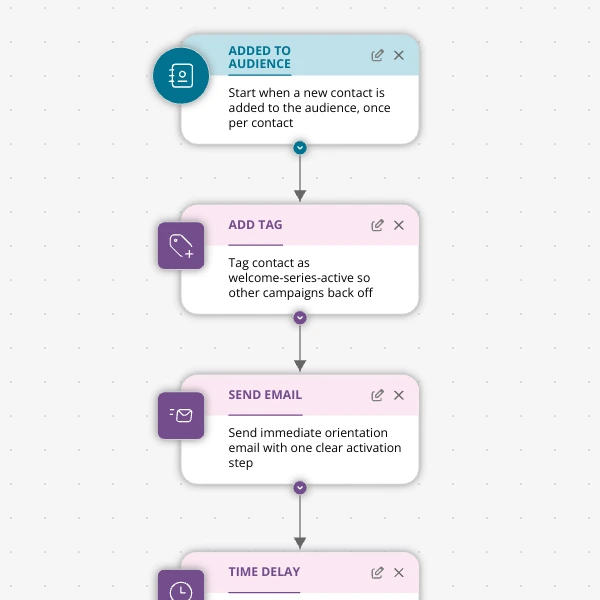
The Shopify app welcome series that turns installs into income
A step-by-step Shopify app welcome email journey for tools like CartSpark, showing how to turn new installs into activated, retained merchants using Spreeflo journeys, tags, and behavioral triggers so fewer trials quietly churn and more trials convert.
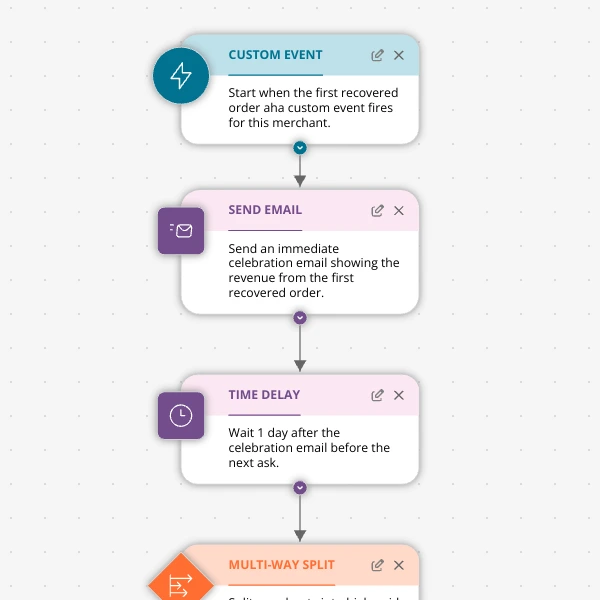
The Aha-Moment Playbook For Shopify Apps: Turn One Magic Action Into Months Of Revenue
A node-by-node playbook for Shopify and e‑commerce apps to center their lifecycle on one aha-moment custom event in Spreeflo, celebrate it, segment merchants by profile and engagement, and turn first recovered value into lasting revenue and retention.
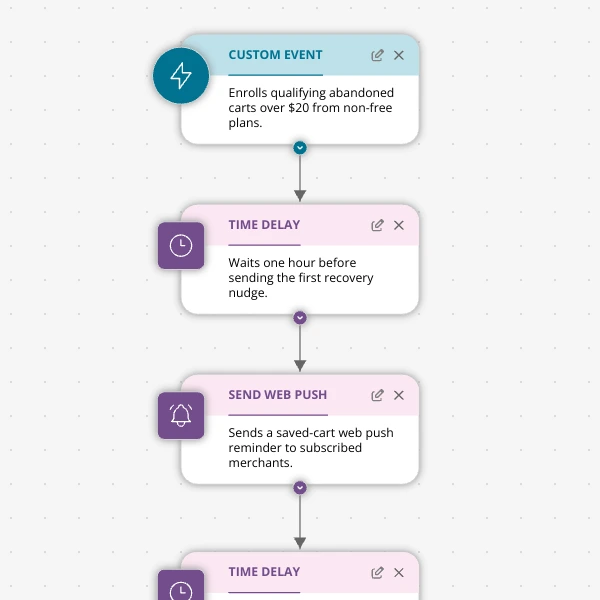
Stop Letting High‑Intent Carts Die: A 3‑Email Recovery Journey for Shopify Apps
A detailed, node-by-node walkthrough of a three-email (plus optional web push) cart-abandonment recovery journey for Shopify apps in Spreeflo, showing how to trigger events, branch on behavior, tag outcomes, and measure recovered carts and revenue.
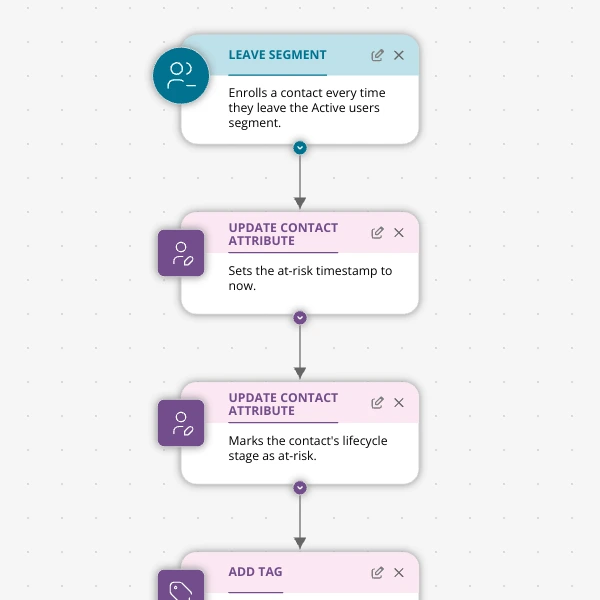
When Active Users Go Dark: A 4‑Touch Win‑Back Journey For Your Shopify App
A detailed, node-by-node Spreeflo journey for winning back previously active Shopify app users who stop engaging, using segment-based triggers, conditional logic, and a four-touch email plus internal alert sequence to recover usage and MRR.