Automatic VIP Perks for Your Best SEO Customers
This playbook shows how to automatically recognize and reward VIP SEO customers in Spreeflo, from defining a data-driven VIP segment to building journeys that tag them, send tailored perks, alert your team, and measure retention impact.
Industry
Niche
Pattern
Loading sequence...
An agency has paid you $199/month for two years, sends the nicest product feedback, then quietly churns with a one-line note: “We’ve consolidated tools.” They were one of your highest-LTV accounts. And from their side, they never felt treated any differently than a trial user.
This playbook fixes that with a single journey: the moment someone crosses your VIP threshold, they’re tagged internally, celebrated with perks, and put on a different track. The sequence at the top of this page is the whole journey, end to end.
We’ll walk through how a team like BrieflySEO (from the persona) wires this up in Spreeflo: from defining “VIP” using the segment builder to every node in the journey that fires when someone crosses that line.
Why VIP recognition is a retention play, not a vanity badge
In SEO SaaS, revenue is lumpy. A few agencies and power users carry a big slice of MRR:
Multi-seat plans for agencies
Long-tenure subscriptions on higher tiers
Teams building their workflows around your tool
Losing one of these hurts more than ten solo bloggers churning.
The pattern most founder-led tools fall into:
Everyone gets the same onboarding.
Everyone sits in the same “newsletter” list.
No one is watching for the exact moment a good customer becomes a great one.
That’s a lifecycle leak. You’ve already spent to acquire and onboard them; failing to acknowledge the milestone means you’re leaving lifetime value on the table.
A VIP journey does two things Spreeflo cares deeply about:
It uses detailed customer data (spend, usage, plan) so you can speak uniquely to each high-value account.
It nurtures your best customers at the exact moment they’re primed to stay, expand, or advocate for you.
Let’s set that up.
Step 1: Decide what “VIP” actually means in your product
Before you touch the journey builder, define the criteria.
For an SEO SaaS, “VIP” usually comes from a mix of:
Lifetime spend (e.g. ≥ $3,000 in total invoices)
Current plan (e.g. Agency/Team tiers)
Usage intensity (e.g. ≥ 500 keywords tracked, ≥ 200 briefs generated)
Tenure (e.g. paid for 12+ months)
The cleanest implementation in Spreeflo is a saved segment called “VIP Customers” defined in the segment builder. Some example rules you might combine:
Contact Attributes →
lifetime_valuegreater than 3000OR Contact Attributes →
planisAgencyOR Custom Events → event
brief_generatedtriggered at least 500 times over all time
You can nest these with AND/OR groups so your definition matches reality, not just a single number.
A few practical tips:
Keep the first version simple: one or two clear rules you trust.
Use attributes your billing or app can reliably maintain (more on that next).
Ensure the segment only includes active customers; exclude churned/cancelled ones if you sync that state.
Once that segment exists, Join Segment becomes your trigger.
Step 2: Feed VIP-relevant data into Spreeflo
Your VIP segment is only as good as the data behind it.
Most SEO SaaS products already track this in their own stack: Stripe or Paddle for billing, events in your app, maybe a data warehouse. You want the important bits in Spreeflo as contact attributes or events so they’re usable in segments and journeys.
Two main streams:
Backend events and attributes via the Spreeflo API
When a payment succeeds or a plan changes, your backend can POST to the Spreeflo API to:In-app usage via the Spreeflo SDK
In your frontend (React/Vue, etc.), you embed the Spreeflo SDK. When a user generates a brief or adds a batch of keywords, the browser callsSpreeflo.track('brief_generated', { ... })or similar. Those become Custom Events you can reference in segments and triggers.
Log a
invoice_paidorplan_upgradedcustom event for that contact.Update a numeric attribute like
lifetime_valueoractive_seats.
That’s server-side, next to your Stripe webhook handler or billing logic.
You don’t have to track everything. Focus on:
Spend:
lifetime_value,current_planBreadth of use:
projects_count,keywords_trackedDepth of use: events like
generated_content_brief,ran_technical_audit
With that in place, your “VIP Customers” segment stays accurate as people cross the threshold.
Step 3: Use Join Segment (VIP) as the journey trigger
Now move to the journey builder. This is a Journey, not a one-off campaign, because you want it running continuously as new customers become VIPs.
First node in the sequence:
Trigger: Join Segment
Segment:
VIP CustomersRe-enrollment: Off
Why Join Segment?
It fires the moment a contact newly meets your VIP criteria.
You centralize the definition in one segment instead of rewriting conditions in every flow.
Why turn re-enrollment off?
VIP status, as we’re defining it here, is a one-way crossing. Once someone is a VIP, they don’t need the same “you made it” perks email twice.
If you later create a higher tier (e.g., “Platinum VIPs”), that can be a separate segment and journey.
Every contact who joins VIP Customers now enters the journey at this trigger.
Step 4: Tag them as VIP for everyone to see
The first thing you want is a simple internal label.
Second node:
Action: Add Tag
Tag:
vipForce Tag Trigger: Off (you don’t need to retrigger flows if they already had it)
This does two jobs:
Humans scanning a contact record see “vip” immediately.
Other automations can key off “contact is tagged with vip” without replicating the segment logic.
If you’re not already using tags, this is a good time to skim getting started with tags. Tags are your quick, flexible labels; segments are your precise, criteria-based groups.
Step 5: Stamp VIP details into attributes
Next, you want structured data on how and when they became VIP. That’s what the Update Contact Attribute node is for.
In the sequence at the top of the page, you’ll see two of these in a row after Add Tag:
Update Contact Attribute →
vip_tier— Update type: Update (text); value: something likegoldoragency_vip.Update Contact Attribute →
vip_since— Update type: Set to now (timestamp).
Why bother, when the segment already knows who is VIP?
Attributes are simpler to query in tools outside this one journey (e.g., “all gold VIPs created before 2024”).
Time-based fields like
vip_sincelet you build follow-up automations later (“VIPs for 90+ days who haven’t tried feature X”).
Remember: Update Contact Attribute writes a static value you configure. It doesn’t pull in dynamic event payloads. That’s why thresholds and counts are best handled upstream via your own code and the API; in this journey you’re just stamping fixed labels and timestamps.
Step 6: Add a small delay so the email feels human
If you send the perks email at the exact millisecond their invoice clears, it can feel robotic.
Add:
Action: Time Delay
Delay: 2 hours
Unit: Hours
Two hours is enough that the message can plausibly be the result of someone noticing their account status, without waiting so long that the moment passes.
You can make this 1 day if your product is more “set and forget,” but don’t go shorter than 1 hour (that’s the minimum Spreeflo supports for Time Delay).
Step 7: Branch messaging for agencies vs in-house teams
Not all VIPs are the same. An SEO agency with 20 seats and a solo content marketer paying annually will care about different perks.
This is where If/Else comes in.
Add:
Process: If/Else
Condition: Something like
Contact Attributes →
account_typeisagencyOR Contact Attributes →
planisAgency
Contacts who match go down the “Agency VIP” branch; everyone else goes down “In-house VIP.”
Both branches will eventually send a perks email, but the content should speak to their world.
Agency VIP branch → Send Email (agency version)
On the “yes” branch:
Action: Send Email
Template: “Agency VIP perks”
Use your email builder to design a version that:
Acknowledges their agency status explicitly (“You’re one of our top agency partners”)
Offers perks that matter to agencies: extra seats, priority support, extended trials for their clients, co-marketing opportunities
The default “Send only once” behavior is what you want here.
In-house VIP branch → Send Email (in-house version)
On the “else” branch:
Action: Send Email
Template: “VIP perks” (in-house)
This version might highlight:
A free upgrade to the next tier for a month
Access to an advanced feature you normally reserve for higher plans
Priority access to roadmap calls or office hours
This is a good place to use AI-powered personalization. Subject lines that reference their actual usage (“You’ve run 120 rank checks with us. Here’s what you’ve unlocked…”) can be built using AI variables as described in personalize with AI variables.
At this point, each VIP has:
The
viptagStructured attributes for tier and since-when
A perks email written in the right voice for their context
Step 8: Merge paths and alert your team internally
Both branches now converge.
Add:
Process: Merge
Connect the Send Email node from each branch into this Merge node. This keeps your canvas valid and your downstream logic unified.
Next:
Action: Send Internal Email
Recipient: your shared “success@” inbox, founder, or whoever owns customer relationships
Content ideas:
Subject: “New VIP: {{contact.first_name}} from {{contact.company}}”
Body: summarize:
Plan and MRR
Key usage stats (briefs generated, keywords tracked)
How they crossed the VIP threshold (e.g., “lifetime value just exceeded $3,000”)
This is where founder-led teams win on leverage: you don’t have a big CS org, but systems like this give you a nudge to personally reach out when it matters.
Because Send Internal Email targets your team, not the contact, it doesn’t run afoul of any pacing rules that apply to customer-facing channels.
Finally, you can optionally add:
Action: Add Tag →
vip_perks_sent
That tag gives you an easy way to build a segment later like “VIP Customers AND tagged with vip_perks_sent” to check who has actually gone through the journey.
Step 9: Track whether these perks actually move the needle
The pattern’s suggested metrics are:
VIP retention
VIP LTV
Perk redemption rate
Here’s how you make those real.
VIP retention
VIP LTV
Perk redemption rate
Compare churn rates for:
VIPs with the
vip_perks_senttagNon-VIP customers, or VIPs before the journey existed
You can use segments that combine tags and attributes, then analyze in your own reporting or export.
Because you’re already syncing lifetime_value from your billing system, you can:
Look at the distribution of
lifetime_valuefor VIPsTrack how it changes over time after you launch the journey
If you use different vip_tier values (gold, platinum), you can slice by those as well.
When someone uses a perk (redeems a coupon, activates a bonus feature, books a VIP onboarding call), record a vip_perk_redeemed custom event via the API or SDK.
Then build a segment like:
Segment: “VIP Customers with perk redeemed”
Custom Events →
vip_perk_redeemedtriggered at least 1 time in the last 90 days
The ratio of that segment size to all VIP Customers with vip_perks_sent gives you redemption rate.
If you want to go further, you can create another journey triggered by a Custom Event vip_perk_redeemed that thanks them or nudges them to refer a friend. But keep the first version simple until you see baseline results.
If you’re curious how this fits into your plan limits (marketing contacts, tiers), the deeper breakdown in about Spreeflo pricing plans is worth a skim.
Optional: Multiple VIP tiers without breaking your logic
As you grow, you may want more than one VIP level:
“Rising stars” who crossed $1k
“Gold” at $3k
“Platinum” at $10k+
There are two clean approaches:
Separate segments and journeys per tier
Single journey with a Multi-way Split
Segment:
VIP Rising,VIP Gold,VIP PlatinumOne Journey per segment, each starting with a Join Segment trigger (
isReEnrollmentoff)
This keeps each flow simple and its perks distinct.
Trigger: Join Segment → a broader
High-value CustomerssegmentImmediately follow with a Multi-way Split:
Branch A:
lifetime_valuebetween 1000 and 2999 (Rising)Branch B:
lifetime_valuebetween 3000 and 9999 (Gold)Branch C:
lifetime_value≥ 10000 (Platinum)Else: everyone else (probably shouldn’t hit this if your segment is tight)
Each branch sends a differently framed perks email, then you Merge and Send Internal Email as before.
Whichever you choose, keep the “one-time celebration” principle: someone should not see the same “you’re now gold” email three times. Use isReEnrollment=false on each Join Segment trigger so each journey only runs once per contact.
Bringing it back to the bigger picture
This entire pattern is one philosophy in action: your best customers should never feel generic.
By:
Capturing detailed data about spend and usage,
Turning that into a clean
VIP Customerssegment,And reacting the instant someone joins it with tailored messaging,
you stop treating your whales like everyone else. Instead, every high-value account gets a moment of recognition, real perks, and a human follow-up, without adding a single person to your team.
For a founder running a lean SEO SaaS, that’s the point: build a system once and let it protect your LTV forever.
If you’ve got billing and usage data in place, you’re one afternoon away from this journey. Define your VIP segment, then head into the journeys builder to build a journey that does the celebrating for you.
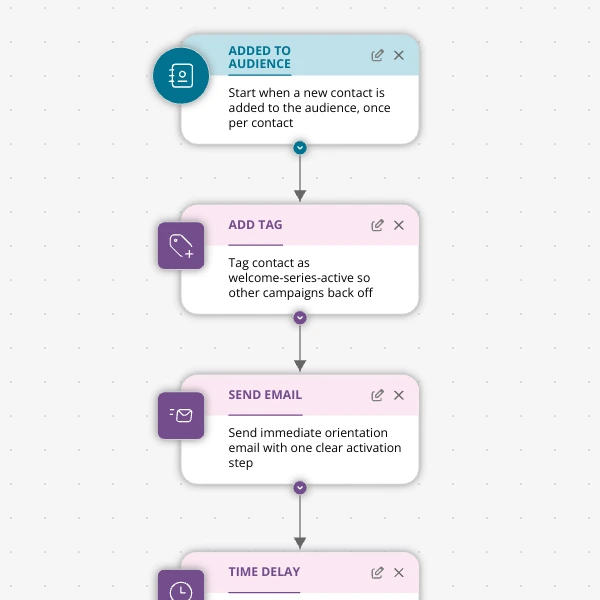
The Shopify app welcome series that turns installs into income
A step-by-step Shopify app welcome email journey for tools like CartSpark, showing how to turn new installs into activated, retained merchants using Spreeflo journeys, tags, and behavioral triggers so fewer trials quietly churn and more trials convert.
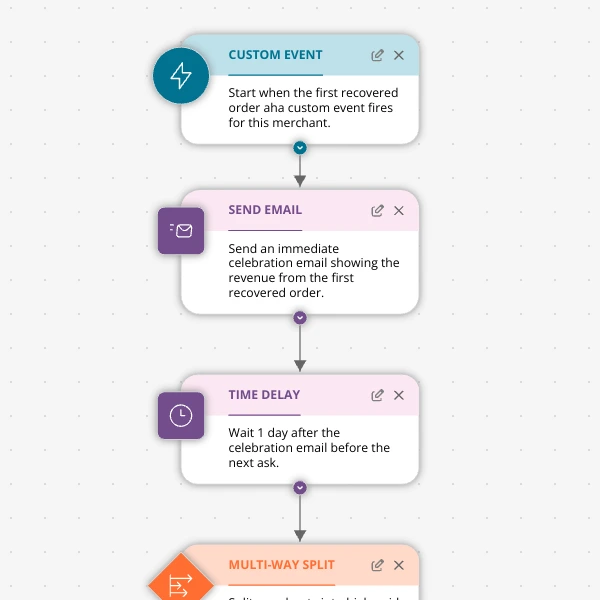
The Aha-Moment Playbook For Shopify Apps: Turn One Magic Action Into Months Of Revenue
A node-by-node playbook for Shopify and e‑commerce apps to center their lifecycle on one aha-moment custom event in Spreeflo, celebrate it, segment merchants by profile and engagement, and turn first recovered value into lasting revenue and retention.
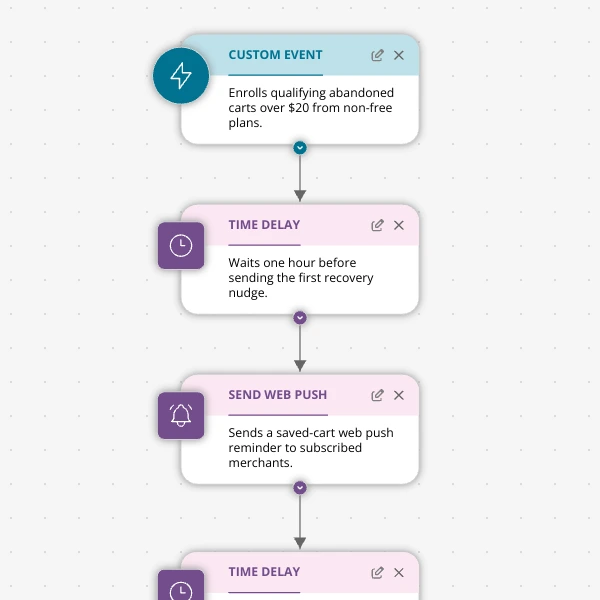
Stop Letting High‑Intent Carts Die: A 3‑Email Recovery Journey for Shopify Apps
A detailed, node-by-node walkthrough of a three-email (plus optional web push) cart-abandonment recovery journey for Shopify apps in Spreeflo, showing how to trigger events, branch on behavior, tag outcomes, and measure recovered carts and revenue.
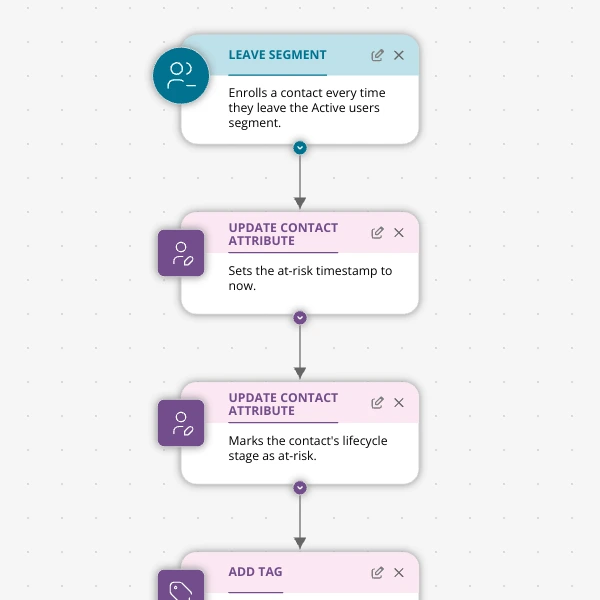
When Active Users Go Dark: A 4‑Touch Win‑Back Journey For Your Shopify App
A detailed, node-by-node Spreeflo journey for winning back previously active Shopify app users who stop engaging, using segment-based triggers, conditional logic, and a four-touch email plus internal alert sequence to recover usage and MRR.